

Modern and Contemporary Art: The South Asian Edit
South Asia encompasses myriad narratives and histories, resisting any attempt to be distilled into a single story. It is little wonder, then, that the subcontinent's art constitutes one of the world's most expansive and compelling artistic canons.
Yet no singular narrative can do justice to its creative legacy. Rather than attempting a sweeping survey, Sotheby's South Asia Edit celebrates six singular artistic voices whose practices marked a paradigm shift in contemporary South Asian art. Visitors are invited to encounter each artist on their own terms, revealing the breadth, complexity, and enduring influence of their work.
Pioneering Artists and their Pieces
The exhibition traces the evolution of modern and contemporary South Asian art through six focused presentations, each dedicated to an artist who redefined the creative landscape of the region.
1. Francis Newton Souza | Crucifixion
Few artists have shaped the course of modern Indian art as profoundly as Francis Newton Souza. A founding member of the Bombay Progressive Artists' Group, Souza rejected academic conventions in favour of a bold modernist language that drew from European Expressionism and the visual traditions of the Indian subcontinent. His uncompromising vision helped chart the direction of post-Independence Indian art, establishing him as one of its most influential and provocative figures.
Born in Goa in 1924, Souza's paintings were distinguished by their raw energy. Religious iconography, portraiture, and landscapes became recurring subjects, explored with an intensity that challenged prevailing social conventions. His paintings often examined themes of faith, identity, mortality, and the human condition, earning him a reputation as the enfant terrible of modern Indian art.
Souza relocated to London in 1949. After several challenging years, his career gained momentum with a sold-out exhibition at Gallery One in 1955, introducing his work to an international audience. The celebrated 'Black Paintings' he produced during the 1950s and 1960s are now widely regarded as the defining works of his career, cementing his position as one of the first post-Independence Indian artists to achieve lasting recognition in the West.
Central to Souza's exhibition at the South Asian Edit is Crucifixion (1984), an altarpiece-scale painting that reflects his lifelong engagement with Christian imagery. Depicting the artist himself offering Communion beneath the Cross, the composition unites the Last Supper, the Crucifixion and the Eucharist within a single pictorial space. Rich in religious symbolism and psychological complexity, it stands among the most compelling expressions of Souza's fascination with faith and mortality.
2. Mohan Samant | Music & Dance
Mohan Samant was among the first artists who helped mould India's post-independence artistic identity as a member of the Progressive Artists' Group. While his contemporaries became associated with distinct visual languages, Samant resisted a signature style altogether, instead embracing continual experimentation across media, techniques, and imagery. His work drew from an astonishing breadth of artistic traditions, from the cave paintings of Lascaux and Egyptian hieroglyphs to Indian miniatures, African sculpture, and the work of Pablo Picasso.
After training at Mumbai's Sir J.J. School of Art, Samant soon gained international recognition. In 1956, he participated in the Venice Biennale before relocating first to Rome and later New York, where he exhibited at institutions including the Museum of Modern Art. Art critic Ranjit Hoskote later described Samant as "the missing link in the evolutionary narrative of contemporary art in India”. His works are now part of major public collections worldwide, including the Museum of Modern Art, the Smithsonian American Art Museum, and the National Gallery of Modern Art.
Nowhere are these qualities more evident than in Music & Dance, the landmark series at the heart of Samant's exhibition. Bringing together his lifelong devotion to both music and painting, the series embodies the inventive material experimentation that defines his mature work. In Sarangi Nawaz (2002), a solitary, spectral musician evokes the resonant sound of the artist's beloved instrument, the sarangi, which he played throughout his life. Dancing Angels (1988), meanwhile, draws on mythology and performance, exemplifying the layered visual worlds of Samant's later work.
3. Bhupen Khakhar | The woodcuts and linocuts for Salman Rushdie’s Two Stories
Bhupen Khakhar revolutionised post-independence Indian art by challenging prevailing social norms and developing a practice that contradicted many of the conventions of modern Indian painting.
He began his professional life as a chartered accountant before forging an unconventional path as an artist, becoming one of India's first pop artists. Instead of pursuing abstraction, he turned to richly figurative, narrative compositions that focused on ordinary people. Barbers, tailors, accountants, and shopkeepers populate his vividly coloured paintings, reflecting the complexities of everyday life. Drawing from Indian mythology, popular culture, and Western art history, he developed a visual language that continues to influence artists today.
Anchoring Khakhar's exhibition is a rare presentation of his printmaking, a medium he embraced in the late 1980s. Working across etching, lithography, serigraphy, and relief printing, he reimagined familiar characters and stories with his characteristic wit and visual immediacy. At its centre is the complete set of woodcuts and linocuts created for Salman Rushdie's Two Stories (featuring illustrations for the short stories The Free Radio and The Prophet's Hair).
4. Zarina | Tasbih
Zarina redefined contemporary printmaking through compositions that combined architectural precision with personal explorations of belonging. Born in Aligarh in 1937, she developed an approach rooted in abstraction, where geometry and line became powerful tools for evoking a spiritual response from the viewer.
Her life took her across Asia, Europe, and the United States, with each move leaving a lasting imprint on her practice. The visual syntax of Islamic architecture and religious decoration remained a persistent influence throughout her oeuvre.
Today, her works remain landmarks of the Minimalist movement and continue to inform contemporary printmaking. Their pared-back compositions speak powerfully to ideas of home and displacement.
The highlight of Zarina's exhibition is Tasbih (2012), a marble interpretation of the prayer beads used in Islamic devotional practice. A recurring motif in Zarina's practice, the tasbih reflects her enduring engagement with spirituality through pared-back forms and materiality. Darkness, light, and the night sky emerge as recurring themes throughout the exhibition. In Tied to the Sky (2017) and Thirty Birds Flying on the Dark Sky (2017), stars and constellations become meditations on belonging, transcendence and noor, the Islamic concept of divine light.
Also featured in The South Asia Edit is pioneering Pakistani artist couple Zahoor ul Akhlaq and Sheherezade Alam, with Akhlaq's paintings presented in dialogue with Alam's ceramics.
5. Sheherezade Alam | Later Ceramics
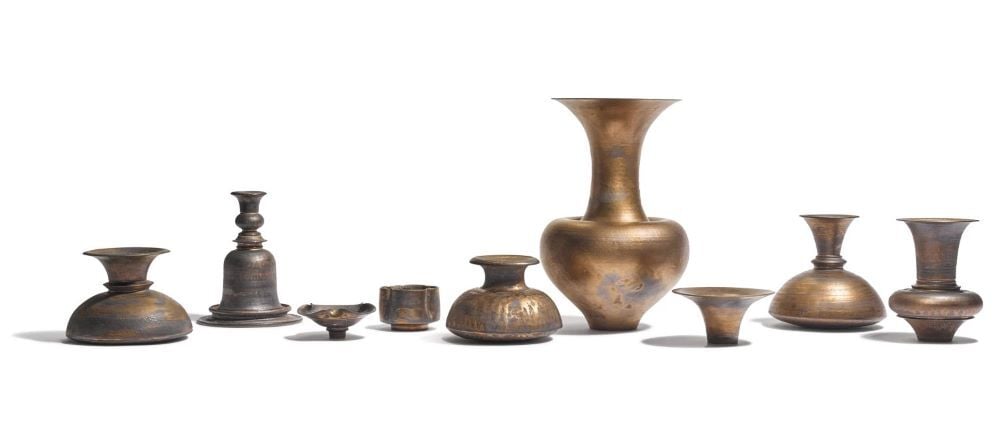
Sheherezade Alam transformed contemporary ceramics by reimagining traditional forms through a distinctly modern lens. Born in Lahore in 1948, she trained at the National College of Arts before establishing Pakistan's first independent pottery studio founded by a woman.
Rather than treating clay as a purely functional material, Alam used it to explore form, surface, and proportion, creating vessels that balanced centuries-old craftsmanship with a deeply personal vision. Her practice drew on the ceramic traditions of the Indus Valley and the wider Islamic world, breathing new life into ancestral forms. Today, her ceramics stand among the defining achievements of modern South Asian craft, lauded for their technical mastery and sculptural elegance.
The exhibition brings together thirty-two ceramics from Alam's later practice, including dishes, vases, matka pots, and urali bowls. Drawing on the traditions of Islamic ceramics and South Asian craftsmanship, Alam reinterprets familiar forms through metallic lustres, speckled glazes, and fluted rims, transforming objects into sculptural works. The collection reflects her enduring dialogue between innovation and inheritance, renewing the expressive possibilities of one of the world's oldest artistic traditions.
6. Zahoor ul Akhlaq | Radio Photo of Objects Unidentified
Zahoor ul Akhlaq was a seminal figure in modern Pakistani art, forging a new dialogue between South Asia's artistic heritage and international modernism. Born in Delhi in 1941, he relocated to Pakistan after the Partition and studied at Lahore's National College of Arts. He later returned to the institution as a teacher, where he spent nearly three decades mentoring a generation of artists who would come to define contemporary Pakistani art.
Akhlaq reinterpreted the visual languages of Mughal miniature painting, Islamic calligraphy, and vernacular architecture through the lens of Cubism. The result was a syntax that challenged mainstream readings of both Eastern and Western art, opening new possibilities for modern painting in Pakistan.
Beyond his practice, Akhlaq helped establish arts education in Pakistan. He was instrumental in setting up the National College of Arts' Miniature Painting programme, creating a framework that profoundly influenced a new generation of artists, including Rashid Rana, Shahzia Sikander, and Imran Qureshi.
Akhlaq's exhibition captures the evolution of his practice through works from his early career to the large-scale canvases of the 1990s. The grid emerges as both a compositional device and a recurring metaphor, bringing together references to Islamic calligraphy, architecture, Mughal miniature painting, Cubism, and Colour Field painting. In Radio Photo of Objects Unidentified (1983) and Untitled (1991), layered fragments of image and architecture shift between abstraction and representation, inviting multiple interpretations.
Final Thoughts
For more than 280 years, Sotheby's has connected discerning connoisseurs with some of the world's most significant works of art. The South Asia Edit upholds legacy, by spotlighting visionaries who ushered in a new age for the subcontinent's modern art. The selling exhibition is on view from 13 July to 7 August 2026 at Sotheby's London flagship on New Bond Street.