

Inside RM Sotheby's Monterey 2026
Returning to the Portola Hotel and Monterey Conference Center for its 29th edition, RM Sotheby's flagship Monterey sale has become far more than an auction. Each year, it brings together the world's foremost collectors in celebration of exceptional provenance and true singularity.
This year's sale is no exception. Spread across three days this August, the catalogue brings together some of the world's most coveted collector cars, with three consignments in particular commanding attention: a Pebble Beach-honoured Aston Martin, the only Le Mans competition Teardrop Coupé ever built, and the most focused variant of Porsche's landmark 1980s supercar. Each carries a story that has cemented its place in motoring history.
1962 Aston Martin DB4 GT Zagato
$12,000,000 - $15,000,000 USD | £9,000,000 to £11,250,000 GBP
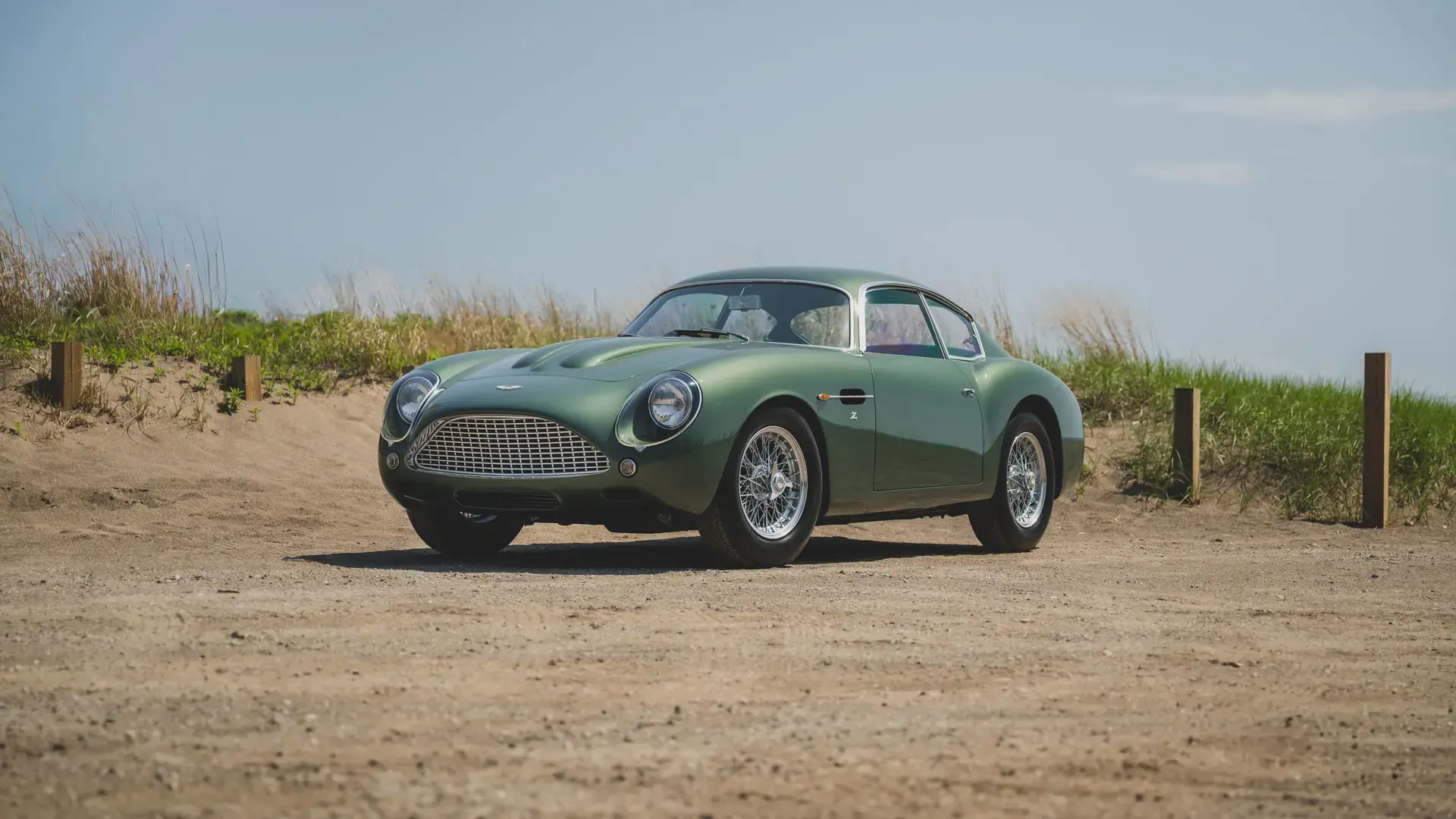
Few collector cars command the near-universal admiration afforded to the Aston Martin DB4 GT Zagato. Blending a distinguished motorsport history with exquisitely sculpted lightweight coachwork, exceptional mechanical credentials, and remarkable scarcity, it has long been regarded as one of the defining grand touring cars of the twentieth century. Just 19 examples were produced, and their appearances on the open market are exceedingly rare, making every offering an event in itself.
Presented here is chassis 0186/R, the 14th DB4 GT Zagato completed. Built at Aston Martin's Newport Pagnell works in December 1961, it was delivered shortly afterwards to Australia, where it became the only example originally supplied new to that market. Its competition career began in spectacular fashion. Piloted by three-time Australian Grand Prix champion Doug Whiteford, the car claimed victory in the GT Handicap at Calder in February 1962. Days later, at Longford, Whiteford added wins in both the GT Scratch race and the South Pacific GT Championship while recording an impressive 145 mph through the circuit's flying section in sports car specifications. Further appearances yielded additional class victories in hill climbs and circuit competition before changes to Australian regulations, allowing temporary-roof cars into the GT category, curtailed its racing career. Importantly, it escaped the kind of accident damage that befell many of its contemporaries, allowing both its original Zagato-built bodywork and matching-numbers engine to survive.
In the early 2000s, the car underwent an exacting restoration under Aston Martin marque specialist Richard Williams. As part of the programme, the body was returned to Zagato's Milan workshop before the finished car made its concours debut at the 2002 Louis Vuitton Concours d'Elegance, where it was awarded Best of Show. Further honours followed with class awards at both Villa d'Este and Pebble Beach.
Following its acquisition at RM Sotheby's New York auction in December 2015, the current custodian commissioned Kevin Kay Restorations to undertake a meticulous ten-month bare-metal refinishing programme. Guided by independent Aston Martin historian Stephen Archer, the work prioritised historical authenticity throughout. The restoration's quality was reaffirmed when the car returned to Pebble Beach in 2019, winning both its class and the Vitesse Elegance Trophy in the Zagato Centennial Postwar class, while also being shortlisted for Best of Show. That distinction is especially noteworthy given that only two post-war automobiles have received the concours' highest honour in more than seventy years.
1938 Talbot-Lago T150-C SS Teardrop Coupe by Figoni et Falaschi
$7,000,000 - $8,000,000 USD | £5,250,000 to £6,000,000 GBP
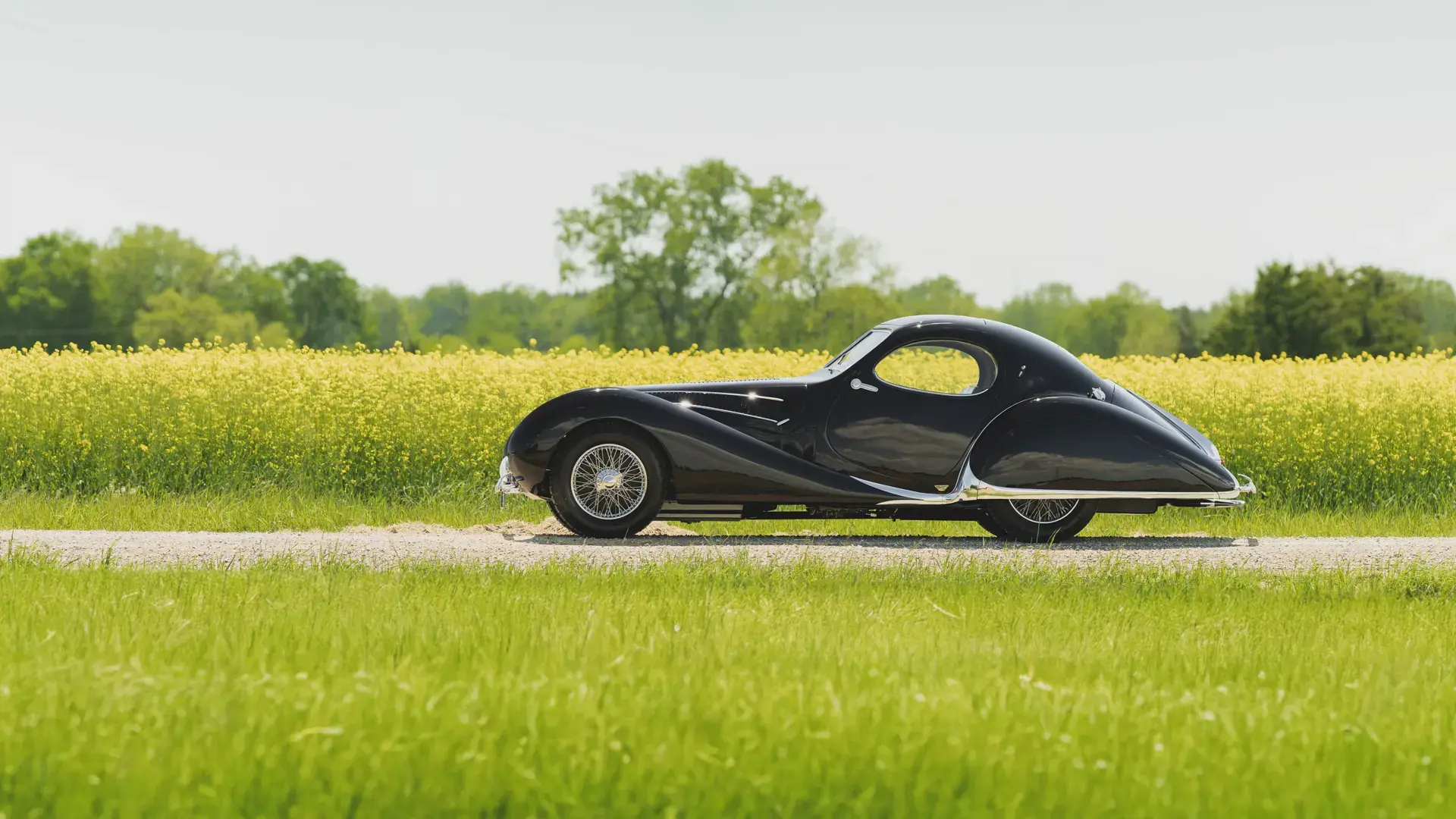
The Figoni et Falaschi Teardrop Coupé occupies a singular place in automotive design history. Few pre-war automobiles possess the ability to captivate enthusiasts and casual observers alike with equal immediacy. Its flowing fenders, dramatically raked windscreen, and tapering fastback silhouette embody the pinnacle of Art Deco automotive design. Just eleven examples were produced in the coveted "New York" specification, of which only one was purpose-built for competition.
Chassis 90117 was commissioned by Philippe Régnier de Massa, a scion of one of France's oldest aristocratic families, with endurance racing firmly in mind. Its engineering reflected that objective as much as its styling. Compared with the road-going cars, its body spanned two inches lower and four inches longer and benefited from competition driving lamps, strengthened engine-bay construction, a long-range fuel tank with an external filler, and a distinctive heart-shaped sunroof to improve cockpit ventilation during endurance events. In June 1939, de Massa and co-driver Norbert-Jean Mahé took the start at the 24 Hours of Le Mans, running as high as ninth before being eliminated on the 88th lap. Barely ten weeks later, Europe was plunged into war.
The decades that followed proved almost as remarkable as its competition debut. By 1942, the Talbot-Lago had been transported to Germany, where it was separated from its original engine and purchased by a private owner near Berlin. For almost fifty years, it remained hidden behind the Iron Curtain, becoming something of a legend among Western collectors, who knew of its existence largely through speculation rather than first-hand accounts. Following the fall of the Berlin Wall in 1989, the car re-emerged and was eventually acquired by San Diego collector Georg Lingenbrink. He undertook a painstaking six-year restoration, confirming the car's identity through extensive archival research and correspondence with Talbot-Lago experts, while locating a period-correct replacement engine in England.
Following its restoration, the car made its public reappearance at Pebble Beach. Later, while it was in the collection of noted enthusiast Oscar Davis, it benefited from further restoration work before receiving the Trofeo BMW Group Best of Show at Villa d'Este in 2010 and the Louis Vuitton Concours Classic Award the following year. Since acquiring the Talbot-Lago in 2022, the present owner has preserved its exceptional condition, with recent maintenance entrusted to RM Auto Restoration. As the only competition-specification Teardrop Coupé ever built, chassis 90117 occupies an unrivalled position within pre-war automotive history.
1989 Porsche 959 Sport
$5,000,000 - $6,000,000 USD | £3.73 million to £4.48 million GBP
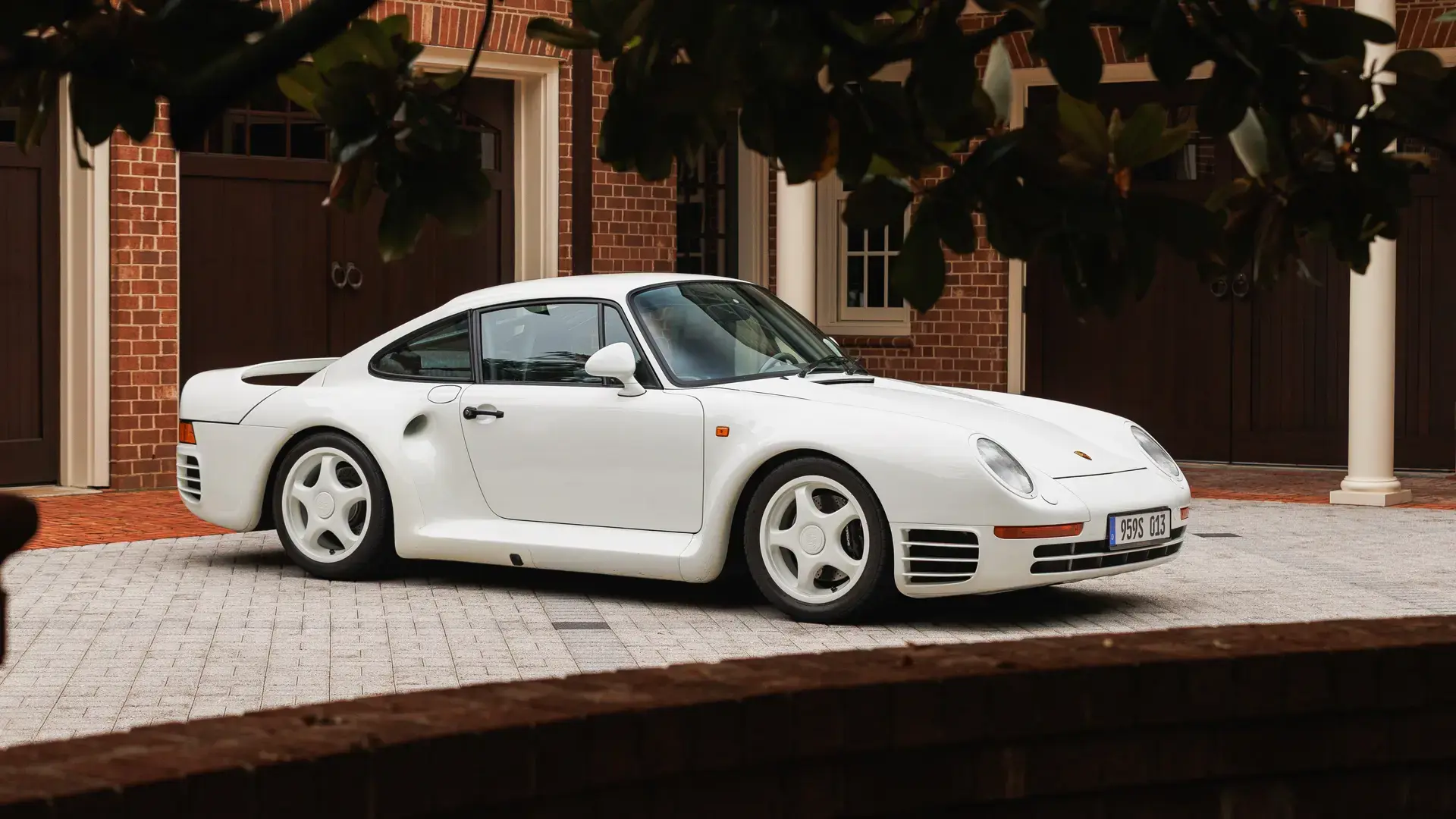
The Porsche 959 stands among the most consequential road cars of the twentieth century. When it was introduced in 1986, its intelligent all-wheel-drive system, adjustable suspension, tyre pressure monitoring and composite construction placed it years ahead of its contemporaries. Yet even within an already rare model, the Sport version occupies a still more exclusive position. Of the 292 production examples built, just 29 were completed in Sport specification. Conceived with performance as the clear priority, it shed many of the Komfort model's luxuries in favour of lower weight, sharper dynamics and greater output. A roll cage, racing harnesses, cloth upholstery and coilover suspension replaced the adaptive system, while power rose to 508 horsepower and weight fell by 100 kilograms.
The example offered here, chassis 5013, is among the most desirable of those few. Finished in Grand Prix White, it is one of only eleven Sports specified in the colour and one of only two known to feature factory air conditioning, an unusual addition on a car from which Porsche had otherwise removed comfort features in pursuit of reduced mass. Originally invoiced in September 1989, it was delivered to a South Korean collector with a notable collection of 959s before passing to German Formula 1 driver Nick Heidfeld in 2007.
Heidfeld later entrusted Porsche Classic in Stuttgart with a comprehensive mechanical overhaul, investing nearly €115,000 in work that included returning the Motronic engine management system to its original factory specification. Completed in December 2021, the programme reaffirmed the car's mechanical integrity while preserving its original engineering character. With only three owners since leaving the factory, chassis 5013 was acquired by its current custodian in 2022 and has travelled just 4,788 kilometres.
The car remains complete with its matching-numbers engine, original tool kit, German and English owner's manuals, and Porsche Classic Technical Certificate. With just three custodians, exceptionally low mileage and a meticulous maintenance history, chassis 5013 remains one of the most unspoiled examples of Porsche's iconic road-going creation.
Read More