

London’s Tallest Buildings in 2026
London has always reached for the sky through its architectural ambition. The Old St Paul’s Cathedral, which stood for over 300 years, was a triumph of medieval engineering as the tallest in London, and most of the world, during its time, with a spire that climbed to almost 150 metres high. Unfortunately, it was completely destroyed in the Great Fire of 1666, and the legendary architect Sir Christopher Wren was tasked with designing a suitable replacement where it once stood. The result was the majestic St Paul’s Cathedral that we recognise today, completed in 1710 with its iconic domed structure stretching 111 metres towards the heavens. For over 250 years, the cathedral held on to the title of London’s tallest building, helped by the London Building Act of 1894 that capped building heights to preserve the historic views across the city.
As skyscrapers populated cities all across the globe in the 20th century, London resisted right up until 1965, when the 177 metres tall BT Tower was completed. This ultra-modern structure ushered in a new era of skyline design for the capital and design eyes have been raised to the skies ever since.
Our guide to the tallest buildings in London details a collection of the highest points on the skyline in 2026.
The Shard
Central London
The iconic glass pyramid form of The Shard transformed the city's skyline when it was completed in 2012. And it has held both the title of London’s tallest building and the UK’s tallest building ever since. Architect Renzo Piano created a structure that rises to an astonishing 306.6 metres tall with a mix of commercial, residential and hotel space filling its floors. The Shard was always positioned as a Vertical City with a façade that reflects and transforms above the capital. with every passing hour and season. This is a masterpiece that was initially controversial and eventually beloved by London.
22 Bishopsgate
City of London
The historic square mile that marks the City of London financial neighbourhood is home to a new generation of skyscrapers, with 22 Bishopsgate the tallest amongst them. PLP Architecture completed this 278-metre-high building in 2020, with the aim of adapting to and flexing to the requirements of a post-pandemic world and working patterns. It also offers London’s highest free public viewing gallery for unmatched views across the historic landscape. Importantly, 22 Bishopsgate represents a developing philosophy of making such significant private structures open to all of the capital’s residents in accessible ways.
One Canada Square
Canary Wharf
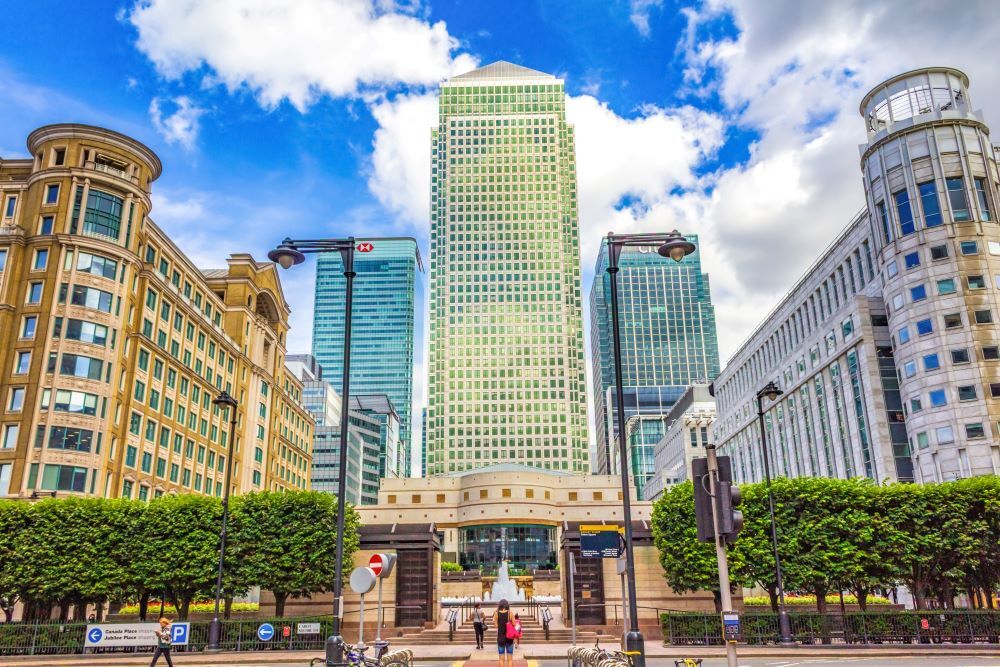
One Canada Square is considered very much a pioneer of the London skyscraper set. When the architect César Pelli oversaw completion of this 236 metres tall structure in 1991, it immediately became the biggest in the capital and held the crown for 21 years. The unmistakable pyramid roof and stainless-steel cladding were a bold symbol of the city’s developing status as a hub of wealth and prosperity that spoke to the world. Visually, it still defines both the era and the area with an imposing influence.
Landmark Pinnacle
Canary Wharf
The journey of Canary Wharf from a strictly commercial district to a mixed-use tapestry of residential, leisure and retail acts as a great example of the city’s development in general. This 233 metre tall residential tower is a softer domestic presence in the skies with its shared amenities such as gardens, lounges and wellness spaces all on show. It signalled a shift towards modern communities that are to be built high above the streets below. Architects Chapman Taylor has created something that will undoubtedly be considered a modern-day classic with Landmark Pinnacle.
110 Bishopsgate
City of London
The preserved sightlines of London that restrict buildings' shapes, sizes and form has meant that designers and architects must find adaptable ways to express their vision. Allies and Morrison Architects created 110 Bishopsgate in a purposely understated way with a simple glass façade that uses the changes in light and weather to quietly reflect its ever-changing surroundings. It effectively manages to make this 230 metre-tall building disappear into the cityscape with all of its important business carrying on unseen within its adaptable office floors.
Salesforce Tower London
City of London
This building that was once known as the Heron Tower was completed by architect Kohn Pederson Fox in 2011. Its defining feature, a tall mast that rises to 230 metres, is an echo of a grander past when cathedrals and civic buildings would once have ruled the skies above. The name change to software giant Salesforce is an appropriate indicator of how the landscape of London is changing in every way, from the visual to the commercial.
The Leadenhall Building
City of London
The nicknames that are awarded to the great buildings around the world often speak more about public reception and affection than anything else. The Leadenhall Building is definitely one of the most striking and has become known as The Cheese Grater due to its distinctively sharp and sloping design. This was another ingenious response to the protected view of St Paul’s Cathedral in the city to create a case study in design creativity when restraints are in place. At 225 metres high, The Leadenhall Building’s exposed frame is now an integral part of London’s horizon.
Newfoundland Tower
Canary Wharf
The Docklands of Canary Wharf are a treasure trove of social history that act as a timeline through the built environment of London. This neighbourhood’s latest purpose as a mixed-use area where families and professionals are building communities is down to buildings such as Newfoundland Tower, completed in 2019. It was amongst the first residential towers here with integrated leisure facilities and prioritised natural light to make living at 220 metres in the sky a major attraction. HOK architects managed to successfully lay a path for urban communities in the skies for an evolving modern London.
The title of London’s tallest tower is a status that many current developments will, of course, be chasing. Since the BT Tower first touched the clouds in the mid 1960s, the gauntlet was laid down to create ever more innovative and graceful ways to support the people and businesses of this incredible city. In 2026 and beyond, the sky is the limit for the built environment in the capital city of the UK.