

Living in Cobham: A Guide to Surrey’s Most Affluent Enclave
Cobham sits within Surrey’s most established ultra-prime corridor, positioned between Oxshott, Esher and Weybridge. Frequently referred to as the “Beverly Hills of Britain” and ranked as the second most desirable town in the UK by The Telegraph in 2026, the area is defined by gated estates, high-profile residents and a level of domestic scale more commonly associated with international luxury markets.
History
Despite its current identity as a residential commuter settlement, Cobham’s origins run considerably deeper, with evidence of habitation stretching back to the Iron Age and Roman periods.
The village appears in the Domesday Book as “Covenham”, where it formed part of the holdings of Chertsey Abbey. At this point, it was already an established agricultural settlement, with mills, meadow and woodland contributing to its manorial economy.
The name itself evolved gradually, recorded in various forms including Coveham, Cobbeham and Cobeham before settling on “Cobham” in the late 16th century. By the medieval period, Cobham had developed into two distinct centres: Street Cobham and Church Cobham. Street Cobham grew along the main London to Portsmouth road and functioned as a stopping point for travellers, while Church Cobham formed around St Andrew's Church, parts of which date to the 12th century. Today, the church still retains a Norman tower and remains one of the area’s most significant historic buildings. The surrounding landscape has remained equally influential, reinforcing Cobham's association with countryside and estate living.
Location
Set along the River Mole and bordered by protected countryside, Cobham occupies a section of Surrey that feels rural while remaining within commuting distance of London. It sits around 17–20 miles south-west of central London, within the borough of Elmbridge. Rail connections are straightforward: Cobham & Stoke d’Abernon station runs direct services to London Waterloo in roughly 40 minutes, with additional services from nearby Esher and Surbiton reducing journey times closer to half an hour.
Road access is equally efficient, with the A3 and M25 framing the village and providing direct routes into London, Heathrow, Gatwick and the wider South East. Despite this connectivity, Cobham retains a low-profile character, shaped more by residential life than through traffic.
The area carries a degree of quiet visibility. Chelsea F.C. maintains its training ground nearby in Stoke d’Abernon, while longstanding links to aviation and motoring industries sit alongside older landmarks such as Cobham Mill.
Property
Cobham’s housing stock is defined by scale and relative scarcity. Detached homes dominate, many set within private plots or gated estates and often designed on an individual basis. Over the past year, average house prices have sat just above £1 million, with detached properties typically exceeding £1.5 million.
The highest-value addresses cluster around roads such as Oxshott Road and Fairmile Lane, as well as within the wider Fairmile estate, where large modern houses sit alongside period properties behind gates and long driveways.
Closer to the centre, areas including Tilt Road and Leigh Hill offer a more central, walkable pocket of Cobham living, with sizeable houses within walking distance of the high street. The mix of architecture is broad but controlled, spanning Georgian-style builds, Victorian houses and contemporary developments, though always within the same overarching framework of space and low density.
Things to Do
For Independent Shopping and Cafés: Cobham High Street
The centre of the village is built around its high street, where independent shops, cafés and restaurants sit alongside everyday essentials. It avoids the churn of larger town centres, with a more settled mix of businesses, while a clear focus on wellness runs through it, from gyms to smaller studios such as The 225 Club.
For Landscaped Walks: Painshill Park
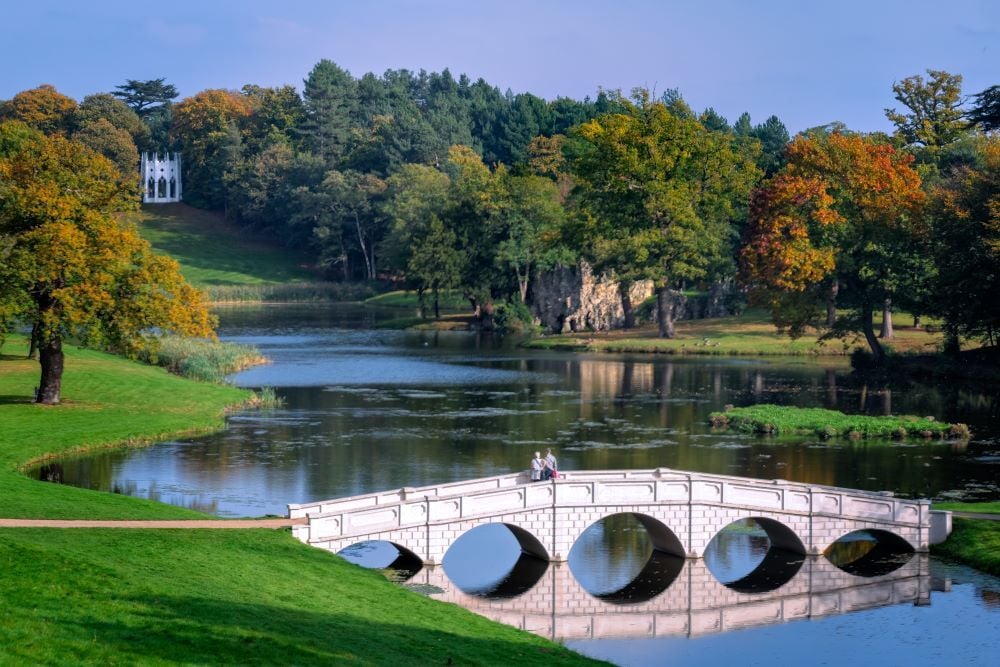
One of Cobham’s most established landmarks, this 18th-century landscaped garden was designed as a series of carefully constructed views rather than a formal park. Paths wind past a lake, grotto and follies, creating a setting that feels controlled but still quiet enough for regular walking.
For Riverside Walks: River Mole
The River Mole runs directly through Cobham and shapes much of its surrounding landscape. Footpaths follow the river through woodland and open stretches, making it an easy, everyday route out of the village rather than a designated attraction.
For Spa Days: Beaverbrook Hotel and Spa
Just outside Cobham, Beaverbrook operates as a full-service hotel and spa, with treatment rooms, thermal facilities and outdoor space designed for longer, slower stays rather than short visits.
For Full-Service Wellness: Pennyhill Park
Further out, Pennyhill Park is one of the area’s more established spa destinations, known for its scale and range of facilities, including hydrotherapy pools, saunas and outdoor hot tubs, alongside a structured treatment offering.
For Michelin-Star Dining: Sorrel
A short drive away, Sorrel offers a more formal dining option, with a Michelin-starred menu built around seasonal ingredients, served within a restored period building that keeps the overall setting relatively contained.
For Traditional Pub Dining: The Cricketers
Closer to the village, this gastropub sits near Downside Common and provides a more traditional alternative, with a menu centred on British staples and a garden that becomes a focal point in warmer months.
Education
Cobham supports a mix of state and independent education, with results that consistently sit above national averages and reflect the area’s strong concentration of selective and fee-paying schools. Across the local area, secondary schools record Attainment 8 scores which are notably higher than the England average.
At state level, Cobham Free School provides all-through education from primary to sixth form, with 2025 results above national benchmarks. Around 84% of pupils achieved grades 9–4 in English and maths at GCSE, while A-level outcomes included 30% A*/A grades and over half at A*–B. This supports steady progression into higher education.
Among independent schools, Reed’s School remains one of the area’s strongest performers, with 75% of GCSE grades at 9–7 and 51% of A-level entries at A*/A (85% A*–B) in 2025, well above national benchmarks.
For international education, ACS International School Cobham offers the International Baccalaureate and Advanced Placement pathways, with a 2025 IB average of 35 points and a 97% pass rate, placing it among the stronger IB-performing schools in the UK.
Cobham offers space, privacy and a slower pace of day-to-day life, while maintaining direct access to the capital and a level of schooling that consistently performs above expectation.
For those considering a move, it is less about reputation than how well the area functions in practice, from education and connectivity through to everyday amenities, which makes it one of the more complete residential markets found within Surrey’s commuter belt.