

Where to Stay in the Chilterns: The Best Towns and Villages for a Countryside Escape
Just beyond the edge of London, the Chilterns offer a landscape of rolling hills, ancient woodland and postcard-perfect villages that feel worlds away from the capital. Stretching across Oxfordshire, Buckinghamshire, Bedfordshire and Hertfordshire, this designated National Landscape has long been a favourite countryside escape, prized for its walking trails, historic market towns and slower pace of life.
The region is defined by the particular character of its natural environment. Vast beech forests carpet the hillsides, turning from vivid green to burnished copper as the year progresses, while chalk streams weave quietly through the valleys below. These streams are among the rarest freshwater habitats on earth: of the roughly 200 chalk streams in existence worldwide, more than 160 are found in England, and the Chilterns account for a significant share. The villages are no less distinctive, built from materials drawn directly from the land beneath them: locally quarried flint, clay bricks fired from surrounding fields and handmade tiles that have weathered gracefully over centuries, lending the area an architectural character that feels utterly unique to its place.
Whether you are planning a weekend retreat, a walking holiday or a restorative break in the countryside, there is no shortage of places to flock to. Read on to discover some of the finest places to go to in the Chilterns.
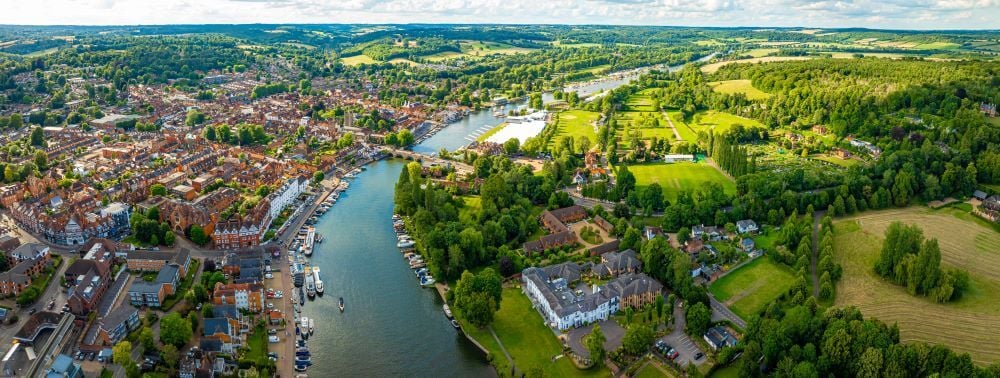
1. Henley-on-Thames
One of the prettiest market towns in the Chilterns, Henley-on-Thames sits on a broad and beautiful stretch of the Thames, framed by wooded hills on either side. First recorded in the 12th century, it has been named among the best places to live in the English countryside by both The Times and The Telegraph, and Mill Meadows Park on the riverbank has held a Green Flag Award for over a decade. The town is compact enough to cover on foot and rewards a wander: independent shops, a local theatre and a market square give way to a riverfront that is as animated in the quiet months as it is during the famous summer season.
The Thames is the town's defining feature, and there are plenty of ways to make the most of it. Hobbs of Henley offer boat hire and public cruises along the full length of the Regatta Course and downstream to the pretty Hambleden Lock, and for those who prefer dry land, the surrounding hills and river paths provide walking routes to suit every pace, from short riverside strolls to longer treks out into the Chiltern countryside. Henley sits along the Thames Path and is an accredited Walkers are Welcome town, making it a natural base for those covering longer distances.
That same stretch of river also sets the stage for one of the most celebrated event calendars in the region. Henley Royal Regatta opens proceedings in late June with five days of rowing and hospitality, followed by the Festival of Music and Arts, which brings internationally recognised performers to a floating stage on the water. July also sees the Henley Fringe Festival celebrating theatre and comedy, August brings the Rewind Festival, and September closes the season with the Literary Festival, whose River Readings take poetry and prose out onto the Thames itself.
Henley is well connected for those travelling from London, with Great Western Railway running regular services from Paddington, putting the town within easy reach for a weekend away.
2. West Wycombe
West Wycombe is one of the most unspoiled villages in the Chilterns, its High Street lined with original 16th- and 18th-century facades that have changed little since the coaching era. It is indeed like a time capsule of a bygone age, from the cobbled thoroughfares, independent shops, and trio of traditional inns.
St Lawrence's Church is the oldest surviving mediaeval structure in the village, its bell turret housing a clock mechanism that has been keeping time since 1668. Close by, the Dashwood Mausoleum is a considerable piece of theatre: a roofless hexagonal structure in local flint, its design drawn from the Arch of Constantine in Rome. It was built by Sir Francis Dashwood, 2nd Baronet, a Georgian aristocrat who returned from a tour of Europe with grand architectural ambitions and a reputation for excess to match. The chalk caves he commissioned beneath the estate in the 1750s became the setting for the Hellfire Club, a gathering of well-connected libertines that counted the Earl of Sandwich and Benjamin Franklin among its members. The tunnels run deep into the hillside and open out into a series of chambers, including the Banqueting Hall and Inner Temple.
That theatrical quality has made the estate a natural draw for film and television productions. The mansion and grounds have stood in for aristocratic England in The Duchess, The Importance of Being Earnest, Downton Abbey, and Stanley Kubrick's A Clockwork Orange, among others.
The countryside around West Wycombe is well worth an expedition. Naphill Common is one of the most ecologically intact woodlands in the Chilterns, holding a broad sweep of ancient oak and beech with areas of surviving heathland. A few miles away, Hughenden Manor preserves the country home of Benjamin Disraeli in considerable detail, with rooms reflecting both his political career and private life, a recreated Victorian garden, and a four-mile estate walk that passes the monument and church where he is buried.
West Wycombe is easily accessible from London via Chiltern Railways, the A40, and the M40.
3. Turville
Tucked into a fold of the Chiltern Hills, Turville is the kind of village that seems almost too perfect to be real. A cluster of ancient stone and timber houses around a village green, framed by rolling beech woodland and the kind of deep rural quiet that feels increasingly rare. It is, in short, a chocolate-box English village brought vividly to life.
That timeless quality has not gone unnoticed by film and television directors. Turville has served as a backdrop for productions ranging from The Vicar of Dibley and Killing Eve to Midsomer Murders and Foyle's War, and as you wander its lanes, you may well find yourself recognising a cottage wall or a church gate from the screen.
Presiding over the village from a nearby hilltop is Cobstone Windmill, Turville's most iconic landmark and a screen star in its own right, perhaps best known from Chitty Chitty Bang Bang. The climb to reach it rewards the effort handsomely, with sweeping views across the Chilterns stretching far into the distance on a clear day. For those who want to stretch their legs further, the nearby Warburg Nature Reserve offers an abundance of walking trails through ancient chalk grassland and woodland.
After a walk or simply for a quiet evening pint, The Bull and Butcher awaits: a handsome, timber-framed village pub with two open fires, well-kept local ales, and a dog-friendly welcome. It is the sort of place you intend to stay in for one drink and linger in for two hours. For a more adventurous affair, the Chiltern Valley Winery and Brewery is an exciting detour.
Turville sits just off Junction 5 of the M40, barely 40 miles from London, making it one of the most effortlessly accessible escapes the Chilterns has to offer.
4. Great Missenden
Great Missenden is a hidden gem in the Chilterns. Dotted with half-timbered dwellings and Georgian homes, it carries a quaint old-world charm. It is polished without being precious, feeling properly lived in thanks to its independent shops, pubs, and welcoming community.
The High Street is replete with buildings that are centuries old, their newer facades belying their rich heritage. The Old House, singled out by Buckinghamshire Council as one of the village's finest historic buildings, exemplifies that storied character. St Peter and St Paul dates to the 14th century, and the ruins of Missenden Abbey, a short walk away, stretch the village's history back to the 12th. It is the perfect hideaway for history enthusiasts.
However, what distinguishes Great Missenden from comparable Chiltern villages is its literary identity. Roald Dahl spent 36 years in Great Missenden, writing Charlie and the Chocolate Factory and Matilda from a hut in his garden that now forms the centrepiece of the Roald Dahl Museum and Story Centre on the High Street. The village's narrow streets, old inns and patinated walls feel like natural material for a storyteller, and the Roald Dahl Museum and Story Centre on the High Street gives that legacy a permanent, characterful home.
National Cycle Network Route 57 passes through the village centre, and the Chilterns Cycleway runs within a few miles, making Great Missenden a natural base for those exploring the valley on two wheels.
Read More