

The Ashmolean: Oxford's most beautiful afternoon
There are few cities that lend themselves to aimless wandering quite like Oxford. You set out with a destination in mind and, somewhere between a college gate and a bookshop, find yourself distracted by a hidden quadrangle, a churchyard or a particularly handsome doorway. The Ashmolean Museum has much the same effect.
Visitors often arrive armed with a plan. They want to see the Egyptian mummies, perhaps, or a particular painting. Yet the real pleasure of the Ashmolean lies in allowing yourself to be sidetracked. One minute you're admiring a delicate piece of Japanese lacquerware, the next you're standing in front of a Pre-Raphaelite portrait, wondering how on earth you've ended up here. It's less a museum than a gloriously eclectic collection of human curiosity.
Unlike many of Britain's great cultural institutions, which can feel overwhelming in both scale and ambition, the Ashmolean rewards a slower approach. There is no pressure to see everything. In fact, that would be impossible. Instead, it invites visitors to follow their instincts, drifting between galleries and discovering unexpected treasures along the way.
A museum built on curiosity
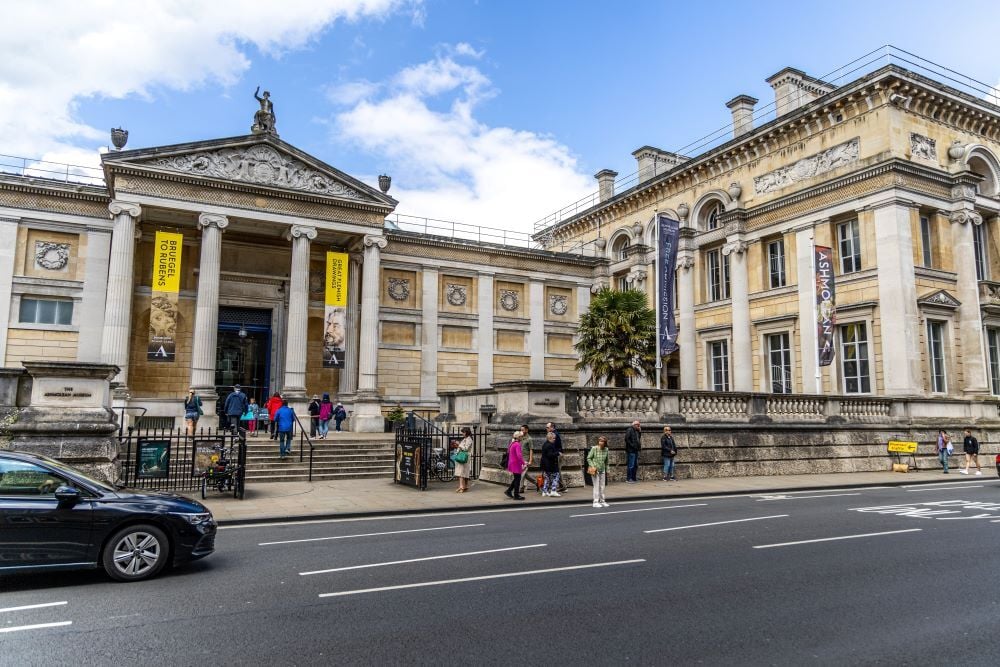
Standing on Beaumont Street, just beyond the bustle of Oxford's shopping district, the building itself makes a quietly impressive first impression. Unlike some of the city's grander institutions, there is nothing particularly showy about it. It doesn't announce itself with soaring towers or Gothic flourishes. Instead, it sits with a kind of confidence that comes from knowing it has been here a very long time.
And it has. Founded in 1683, the Ashmolean was Britain's first public museum, although thankfully it doesn't feel like one. Inside, the galleries are bright, spacious and refreshingly easy to navigate. There is none of the exhaustion that can creep in at larger institutions, where the sheer volume of objects leaves you feeling as though you've somehow failed if you don't see everything.
The museum as it exists today is the result of a major redevelopment completed in 2009, and the spaces strike a careful balance between old and new. Light pours in through large windows, staircases draw you naturally between floors and there are moments where the architecture itself becomes part of the experience. Unlike some museums, where visitors move with determined purpose from one highlight to the next, the Ashmolean encourages lingering.
That spirit of curiosity runs through the institution itself. The museum takes its name from Elias Ashmole, whose collection of curiosities, antiquities and natural specimens formed the basis of its holdings. More than three centuries later, it still feels shaped by that original impulse: a fascination with the world and the objects people create within it.
From Egyptian treasures to Pre-Raphaelite masterpieces
The Ashmolean is best approached in the same way one might browse an antiques market. Follow whatever catches your eye.
For some, that will be the extraordinary Egyptian galleries, where elaborately painted coffins and ancient artefacts offer an unexpectedly intimate glimpse into everyday lives lived thousands of years ago. Others will head straight for the paintings. The museum's collection includes works by Turner and Constable, alongside an enviable collection of Pre-Raphaelite art whose jewel-like colours seem to glow against the gallery walls.
One of the pleasures of the museum is that there is always something unexpected waiting around the corner. You might find yourself captivated by a tiny piece of jewellery, intricately worked and impossibly delicate despite its age. A room later, it could be a vast painting or a centuries-old ceramic vessel that catches your attention. The scale shifts constantly, and with it your perspective. Some objects demand admiration for their craftsmanship, others simply invite curiosity.
What makes the museum particularly appealing, though, is the way different collections sit alongside one another. A room filled with Chinese ceramics leads naturally into European decorative arts. Ancient sculpture gives way to contemporary craftsmanship. You move not through a timeline, but through a conversation between cultures and centuries.
An unexpected source of interiors inspiration
It's also a surprisingly useful place to visit if you're interested in interiors. Long before Pinterest mood boards and Instagram saves, museums like the Ashmolean served as sources of inspiration for designers, collectors and decorators. There are rooms here filled with beautifully worn furniture, intricate textiles and ceramics whose colours feel every bit as fresh today as when they were first made.
You begin to notice combinations that would feel perfectly at home in a contemporary interior: deep ochres paired with inky blues, richly patterned fabrics set against simple stone surfaces, collections of objects displayed not for symmetry but because they tell a story. It is easy to understand why artists, designers and collectors have spent centuries looking to museums for inspiration.
Perhaps that's why the Ashmolean feels so relevant today. While many museums can seem devoted entirely to the past, this one constantly sparks ideas about the present. It encourages visitors to think about how people have always lived with beautiful things, whether that meant a painted vase, a carved piece of furniture or a treasured work of art hanging on a wall.
Seeing Oxford through fresh eyes
The best museums leave you wanting to look more closely at the world outside their walls, and that's certainly true here. After a few hours spent among the collections, Oxford itself begins to feel different. You notice details you might otherwise have missed: the curve of a doorway, the craftsmanship of an iron gate, the way afternoon light catches a stone façade.
This is, after all, a city built on centuries of craftsmanship and scholarship. The honey-coloured stone colleges, hidden gardens and historic streets feel like a natural extension of the museum's collections. Leaving the Ashmolean often feels less like the end of an experience and more like the beginning of another.
A stroll through nearby Jericho, with its independent cafés, handsome Victorian houses and village-like atmosphere, makes a fitting companion to a museum visit. Equally, it's easy to continue towards Broad Street and Radcliffe Square, where some of Oxford's most recognisable landmarks await.
The best view in the city?
Before leaving, it's worth making time for the rooftop restaurant. While Oxford's dreaming spires have become something of a cliché, they're a cliché for good reason. From up here, the city unfolds in a patchwork of honey-coloured stone, college towers and church steeples, stretching towards the countryside beyond. It's the sort of view that encourages you to linger over a coffee longer than intended.
From the terrace, you can trace the layers of the city itself. Medieval colleges sit alongside Victorian buildings, their rooftops telling the same story as the museum below: centuries of history existing comfortably alongside one another.
On a clear day, there are few better places to pause and take stock of Oxford's remarkable architectural landscape.
The pleasure of getting lost
It feels fitting that one of Oxford's greatest attractions offers such a view. The Ashmolean is, after all, a place devoted to looking closely. Not rushing from highlight to highlight, but pausing, noticing and allowing yourself to be surprised.
In a city famous for scholarship, that may be its most enduring lesson.
The museum has spent more than three centuries collecting objects from across the globe, yet what it offers visitors is something rather simple. Time to slow down. Time to look. Time to follow your curiosity wherever it leads. In an age when so much travel is planned down to the minute and every experience arrives pre-recommended, that feels increasingly rare.
Perhaps that's why so many people leave the Ashmolean talking not about a single exhibit, but about the experience of being there. The pleasure comes not from ticking off famous objects, but from the unexpected discoveries made along the way.
Like Oxford itself, it rewards those willing to wander.
Read More