

There is an exclusive status reserved for roads and streets that are instantly recognisable. With just a glimpse, these places can be identified by people from all over the world using a single image. London is fortunate enough to have quite a few of its own, with the dark bricks of Downing Street, the zebra crossing of Abbey Road and the unforgettable skyline of Westminster Bridge to name just a few.
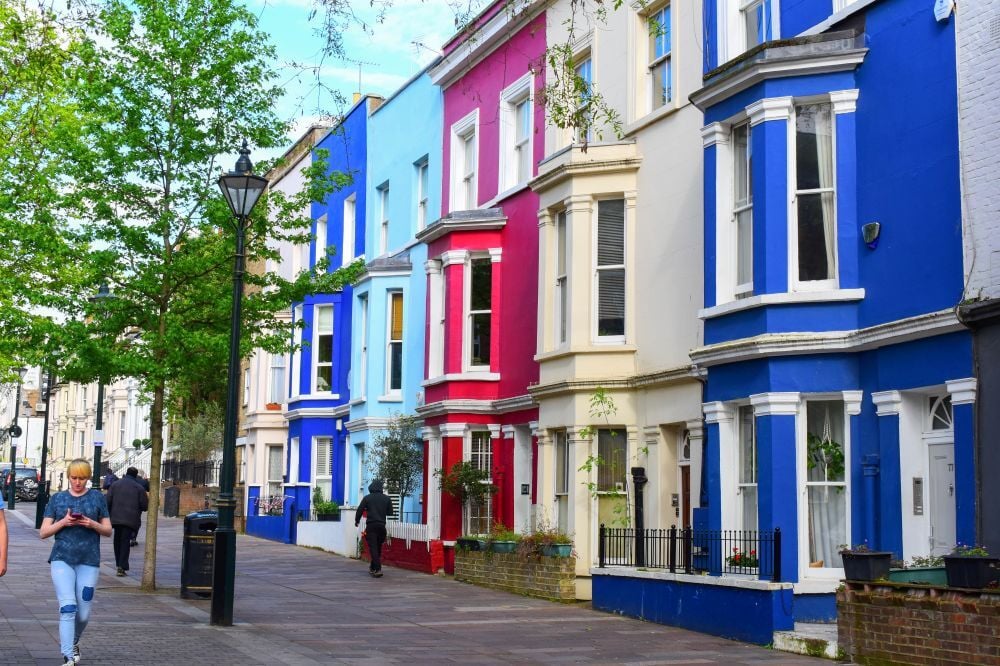
In a calm and elegant residential neighbourhood of West London, in Notting Hill, there is a collection of these iconic destinations too. Their townhouse facades are a tapestry of pastel colours that employ a wonderful palette of blush pinks, powder blues, sage greens and serene yellows that make it one of the most photographed urban locations on the planet. From St Luke's Mews that appeared in the Love Actually movie, to Pembridge Road, serving as the key entrance to the world-famous Portobello Road Market, these are the famous streets of Notting Hill, and they tell a fascinating story informed by architecture, migration, decline and renewal.
It Began With Uniformity
The streets of W11 and W8 in Notting Hill were designed and built in the mid-19th century as part of the vast Victorian development that was known as the Ladbroke Estate. This was a strategic construction that aimed to lend a new respectability and authority to a new suburb on the ever-advancing edge of west London at the time. The now famous Lancaster Road, Elgin Crescent and Colville Road originally enjoyed a much more restrained decoration of stucco white. This was chosen to present an overall architectural cohesion and uniformity amongst the capital’s most desirable residences.
The Colours Bloom
Following the end of the Second World War, London went through a long and often tough period of transformation. The effects of the Blitz had altered the landscape in many parts, with buildings and entire neighbourhoods completely destroyed. An inevitable economic decline led to a downturn in social conditions and the functions of housing in the capital had to change to accommodate this. The townhouses on streets such as the Ladbroke Estate were repurposed as apartments, which made overall building maintenance a huge challenge. They began to fall into serious disrepair, with once impressive facades now looking tired, old and unloved.
Like many of the most valuable, impressive and important solutions for London in the 20th century, it was migration that offered the right answers. New communities moved into Notting Hill from all over the city, the country and the commonwealth with perhaps the largest influx being through people from the Caribbean. A new culturally diverse neighbourhood meant more expression, more creativity and a new sharing of ideas. The colours that began to appear on the house fronts were a brilliant example of this transformation. Bright colours were a personal attempt at claiming a new identity and community for the new world that was developing in the area.
Purpose and Pride
Importantly, these colours also had a practical purpose. They concealed the damage and wear and tear that the ageing exteriors and facades now clearly suffered from. The brighter the colour, the more renewed the houses would look. On the streets of Notting Hill, a new working class from around the world was bringing light to the future. Everything we see now in the charm of Denbigh Terrace, to the pristine excellence of Portobello Road and the glamour of Highgate Village began its renaissance from these humble and city-changing beginnings.
The Artists Take Over
By the 1970s and 80s, the area was home to a new Bohemian crowd of artists and young creatives who were lured by affordable living and a vibrant reputation. What was briefly a symbol of neglect and obfuscation became a sign of individuality and charm, with the colours serving as a gateway to an exciting new period for Notting Hill.
This was, of course, crystallised in the late 1990s when the Richard Curtis film Notting Hill projected a somewhat romanticised version of the area to a world audience. The iconic blue door of William Thacker’s house on Westbourne Park Road and the façade of his famous travel bookshop were all filmed on actual locations in the neighbourhood. The cobbled streets of St Luke’s Mews were also committed to celluloid in this cultural landmark.
The colours of the houses were now an asset to be preserved, albeit in increasingly more muted tones and aesthetics as the decades went on. As with so many of the quirks in London neighbourhoods, it was ‘function first’ for the beautiful colours of Notting Hill’s streets and gradually a more reasoned form of expression and intentional aesthetics took shape.
A Backlash of Sorts
The rise of social media, and the user-generated image app Instagram in particular, had a profound effect on this part of London. Where they were once quietly admired in a respectful and non-intrusive way, they had now become a public commodity used as backdrops for constant photo opportunities and influencer shoots. It has reached such a saturation point that tour groups on Lancaster Road have even been arranged outside private homes.
Unfortunately, this trend has meant that some residents have now repainted their homes in dark grey or black as a rejection of this attention and a form of discouragement.
The Hue of History
Although the debate surrounding these predominantly private homes is certain to continue, the legacy of their colours will endure for a very long time to come. With every layer of paint and passing decade, they speak to a fascinating social history of London that charts the ambition of the Victorian era through post-war reinvention and the vital and regenerating influence of new ideas from new communities.
All of which is something that London in 2026 is keen to celebrate. Prime properties such as this wonderful example on Ladbroke Grove and this stunning mews show just how well these historic streets are regarded as we move on into the new year.