

Modern & Contemporary South Asian Art Comes to Sotheby's London
On 29 September, Sotheby's London will present its Modern & Contemporary South Asian Art sale, bringing together paintings, sculpture and works on paper by some of the most important artists from across the region.
Spanning different generations and artistic movements, the sale traces the development of South Asian modernism through figures including Maqbool Fida Husain, Bhupen Khakhar, Francis Newton Souza, Sayed Haider Raza and Vasudeo S. Gaitonde. Alongside these established names are works by Rabindranath Tagore, George Keyt, Meera Mukherjee, Zarina and Zahoor ul Akhlaq.
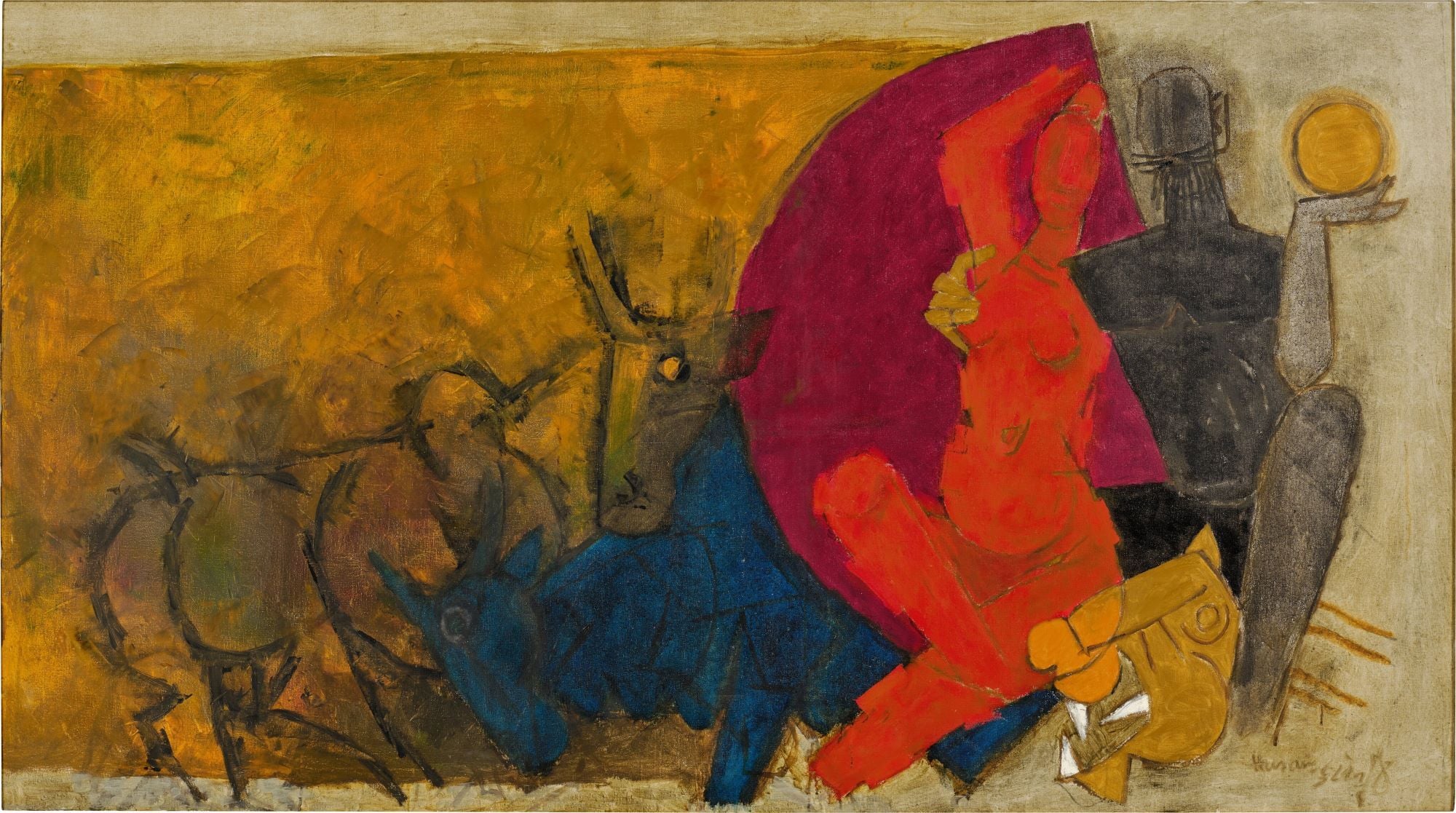
Maqbool Fida Husain's Mithuna Crimson
Among the leading works in the sale is Maqbool Fida Husain's vibrant Mithuna Crimson. One of the defining figures of twentieth-century Indian art, Husain developed a highly distinctive visual language, drawing on sources ranging from Indian mythology and classical traditions to the rapidly changing society around him. A founding member of the Progressive Artists' Group, formed in Bombay in 1947, Husain helped forge a modern idiom rooted in local subject matter yet conversant with international abstraction.
Mithuna Crimson also carries a significant provenance. The painting was formerly part of the collection of Chester and Davida Herwitz, pioneering American collectors of modern Indian art, and was included in Husain's first solo international institutional presentation, held at the Worcester Art Museum in 1974 — making its reappearance at auction more than half a century later a chance to acquire a work with a well-documented place in the artist's exhibition history.
A Monumental Work by Bhupen Khakhar
Another centrepiece is Bhupen Khakhar's monumental Old Men Playing Chess, which comes directly from the artist's estate. The painting was included in Khakhar's 1972 exhibition Truth is Beauty and Beauty is God at Chemould Gallery in Bombay, an early show that helped establish his reputation as one of the most original voices to emerge from India in the postwar period.
Khakhar, who trained first as a chartered accountant before turning to painting, was closely associated with the artistic community around the Faculty of Fine Arts at Maharaja Sayajirao University in Baroda. His paintings brought ordinary people and everyday life into the foreground, combining close observation with humour and psychological complexity — a sensibility that later earned him a major retrospective at Tate Modern in 2016.
His presence in the sale provides a natural starting point for one of the auction's central themes: the Baroda School.
The Artists of Baroda
The sale places particular emphasis on artists associated with Baroda, whose Faculty of Fine Arts, established in 1950, became one of the most influential centres of post-independence Indian art. Unlike the more commercially driven Bombay scene, Baroda fostered pedagogical experimentation, encouraging students to test the boundaries between painting, sculpture, printmaking and narrative art.
Alongside Khakhar are works by Shanti Dave and K.G. Subramanyan, as well as Subramanyan's students Vivan Sundaram and Dhruva Mistry. Subramanyan, who taught for decades at Baroda after also studying and teaching at Santiniketan, was a pivotal figure linking two of India's most important art schools, and his influence shaped generations of younger artists.
Together, their works reveal the breadth of practices that emerged from Baroda — an environment that encouraged engagement with both Indian tradition and contemporary ideas, producing a generation who developed distinctly individual approaches while reshaping the direction of modern Indian art.
Masters of South Asian Modernism
Beyond Baroda, the auction brings together an impressive cross-section of twentieth-century and contemporary South Asian art. Works by Francis Newton Souza, Sayed Haider Raza and Vasudeo S. Gaitonde represent three markedly different approaches to Indian modernism: Souza, another founder of the Progressive Artists' Group, brought a raw, confrontational energy to his figures and landscapes; Raza, who settled in Paris, moved toward the meditative geometry of his celebrated Bindu series; and Gaitonde pursued a quieter abstraction informed by Zen Buddhism.
The inclusion of Rabindranath Tagore reaches back further still, to one of the formative figures in the development of modern art in India. Better known internationally as a poet and Nobel laureate, Tagore took up painting seriously only in his sixties, producing a largely self-taught, expressionistic body of work closely associated with the intellectual circle he built at Santiniketan.
The geographical scope extends beyond India too. Sri Lankan modernist George Keyt, whose work absorbed European Cubism while remaining rooted in Buddhist and Hindu iconography, appears alongside Pakistani artist Zahoor ul Akhlaq, who taught at the National College of Arts in Lahore and fused Mughal miniature painting with modernist abstraction. Also included are sculptor Meera Mukherjee, celebrated for her lost-wax bronze-casting technique learned from tribal artisans, and Zarina, whose pared-back works in paper and woodblock explored home, displacement, memory and belonging drawn from her own experience of Partition.
Together, the works on offer provide a window into a period of extraordinary artistic development across South Asia, while demonstrating the diversity of practices and perspectives that shaped the region's modern and contemporary art.
Sotheby's Modern & Contemporary South Asian Art sale will take place in London on 29 September 2026 at 2pm BST.
Read More