

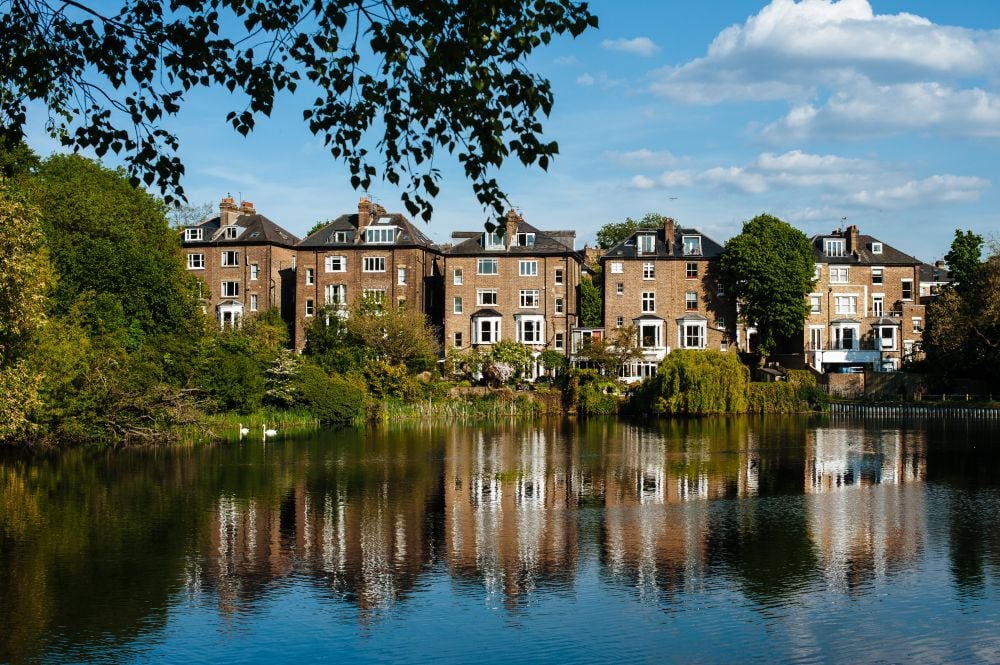
Long prized by writers, intellectuals and families seeking space without exile from the capital, Hampstead has perfected the art of understatement that continues to make it one of London's most desirable neighbourhoods.
The Heath sits at the centre of it all and opens out into sprawling green space with views that remind you just how close the city really is. Despite its village atmosphere, Hampstead is anything but cut off. The Northern line gets you into the West End in minutes, while the Overground makes east–west travel across London straightforward, whether heading to Stratford, Richmond or anywhere in between.
Read on as we highlight what living in Hampstead feels like, and take a closer look at what this charming neighbourhood has to offer.
History
Hampstead is one of London’s oldest neighbourhoods, with roots that stretch back to its Anglo-Saxon origins as Hanepearth. For centuries, it remained a rural settlement on the city’s edge, its elevation and clean air setting it apart from the growing capital below. In the 17th and 18th centuries, Hampstead began to change character, instead emerging as a fashionable spa town thanks to its chalybeate springs, whose iron-rich waters were believed to offer restorative benefits. Wealthier Londoners often came seeking relief from overcrowding, disease and pollution, drawn as much by the fresh air as by the promise of health.
By the Georgian and Victorian periods, Hampstead had established itself as a retreat for artists, writers and political thinkers, a reputation that still clings to the area today. Crucially, its transition into a desirable suburb never came at the expense of its landscape. The protection of Hampstead Heath as public land in the late 19th century ensured that open space remained at the heart of the neighbourhood.
Property
Hampstead’s housing stock is famously eclectic. With some of the most expensive housing in London, at the very top end sits Bishops Avenue, often referred to as ‘Billionaires’ Row. Grand Georgian and Victorian houses line roads such as Heath Street and East Heath Road, while smaller lanes reveal cottages that reinforce the area’s village feel. There are also striking modernist notes, most famously the Isokon and Goldfinger’s 2 Willow Road.
Family houses dominate demand, drawn by space, greenery and long-term value, whilst flats above shops and within converted houses provide options for downsizers and younger buyers, though prices across all property types reflect Hampstead’s prime status.
Education
Education is one of Hampstead’s strongest appeals, particularly for families who are planning to stay long term. The area offers a dense concentration of high-performing schools, with academic results that consistently place them among London’s top performers.
Among the independents, St Margaret’s School stands out for its academic track record. The school has achieved exceptional results relative to its size, including being ranked first nationally in the Sunday Times league tables for schools without a sixth form in 2023. Small class sizes support consistently strong attainment at Key Stage 2 and GCSE level, while membership of the London 11+ Consortium reflects the school’s competitive academic standing.
At senior level, South Hampstead High School is regarded as one of the strongest academic girls’ schools in the capital. GCSE and A-level results regularly exceed national averages, with a 100% GCSE pass rate recorded in 2024 and a high proportion of grades awarded at 7–9 (A–A* equivalent). Leavers often progress to leading Russell Group universities and selective international institutions.
Entertainment
Hampstead High Street resists the homogeneity seen elsewhere in London. Yes, there are recognisable names, but the majority come from independent cafés, delis and specialist shops. Flask Walk, a short pedestrianised lane just off the high street, captures Hampstead at its most charming, with florists spilling onto the pavement, antiques shops and restaurant tables clustered closely enough to encourage conversation, especially within the warmer months. Food shopping is particularly strong here, with bakeries, cheesemongers and delis well suited to impromptu Heath picnics.
The Hampstead Theatre is one of the capital’s most respected venues for new writing, while the Freud Museum and Keats House, home of the Romantic poet John Keats, reflect its rich literary and intellectual history.
Perched on the northern edge of Hampstead Heath, Kenwood House is one of London’s most notable historic estates. Now under the care of English Heritage, the house pairs its neoclassical architecture with an unexpectedly rich art collection, featuring works by Dutch masters including Vermeer and Rembrandt. Many will also recognise it from its cinematic turn in Notting Hill, where its sweeping lawns provided one of the film’s most memorable backdrops. Film lovers also favour the Everyman Cinema, which suits Hampstead’s taste for comfort and atmosphere over multiplex scale.
Just beyond the Heath lies the Hampstead Pergola and Hill Garden, a secluded Edwardian walkway set high above the city. With its colonnades, overgrown vines and formal terraced gardens, it offers one of Hampstead’s most atmospheric corners, particularly at golden hour. Less formal than the grand estates nearby, it feels quietly romantic and slightly hidden and remains a favourite with photographers, walkers and those in search of calm away from the high street.
Nightlife
Hampstead’s social life revolves around food and pubs rather than late-night clubs. Long lunches, Sunday roasts and early evenings dominate. Historic pubs are central to this rhythm, none more so than the Spaniards Inn, which has been serving travellers and locals since the 16th century. Others, such as The Wells Tavern and The Holly Bush, reward those willing to explore Hampstead's side streets. Restaurants lean towards neighbourhood favourites rather than destination dining, with a strong showing of European cooking, cafés and bakeries.
Those seeking clubs and late bars will look elsewhere, but Hampstead’s nightlife suits its residents perfectly. Evenings revolve around pubs, wine bars and cinemas, with a calm and conversational tone, which is a rare balance in London.
In a city defined by constant reinvention, Hampstead remains reassuringly itself, a place that proves London can still feel like a village, without ever forgetting it is a capital. Morning walks on the Heath, coffee on the high street, children walking to school, evenings in the pub garden, it is London living slowed slightly, without sacrificing depth or opportunity.