

The enduring appeal of the House of Garrard
Garrard is Britain's oldest jewellery house, and few names are as closely tied to the history of British jewellery. Founded in London in 1735, the house has made pieces for monarchs, aristocrats and some of the most photographed women in the world. Its work has featured at coronations, royal weddings and state occasions. But patronage alone doesn't explain why the name still carries weight almost three centuries on. Behind the famous stones is a recognisable design language, built on the idea that jewellery should carry meaning as well as value. That language shows up in details that repeat across decades: particular settings, particular ways of using colour, a habit of returning to certain motifs rather than chasing whatever is fashionable that season.
From royal warrant to Crown Jeweller
The story starts with the silversmith George Wickes, who opened his business on Panton Street, near St James's. Frederick, Prince of Wales was among his early clients, and the firm's ties to the Royal Family deepened over the following century. In 1843, Queen Victoria appointed Garrard as the first official Crown Jeweller, a role that came with responsibility for the Crown Jewels and for making pieces that would become part of Britain's ceremonial history.
The Crown Jewels and the Cullinan diamonds
One of those pieces was the Imperial State Crown, made for the coronation of King George VI in 1937. Garrard also worked with some of the world's most celebrated gemstones, including the Cullinan diamonds: Cullinan I was set into the Sovereign's Sceptre with Cross, and Cullinan II went into the front of the Imperial State Crown. Commissions like these called for technical skill, and just as much for a sense of proportion, the stones had to read clearly from across an abbey while still holding up to close inspection. Getting that balance right, on objects that will be photographed for a century and studied for longer, is a different kind of pressure than making a piece for a private client, and it shaped how the workshop approached scale and weight more generally.
The ring that broke with tradition
Garrard's best-known piece, though, is a far more personal object. The sapphire and diamond cluster ring Diana, Princess of Wales chose as her engagement ring in 1981 stood out because it broke with royal convention: instead of commissioning something unique, she picked an existing Garrard design, an oval blue sapphire ringed by diamonds. When Prince William gave the same ring to Catherine Middleton in 2010, it took on another layer of meaning. Its appeal has less to do with the size of the sapphire than with what it now represents: a link between two women, two generations.
Jewellery's private meanings
That's really what jewellery does over time. A necklace or ring starts as an object of beauty, but wearing it changes what it means, it becomes tied to a marriage, a birth, an inheritance, or simply to the person who wore it first. Garrard's long history gives the house a particular grasp of that shift. Its jewels are often made for grand public occasions, but their real significance tends to be private.
Recurring motifs, not repetition
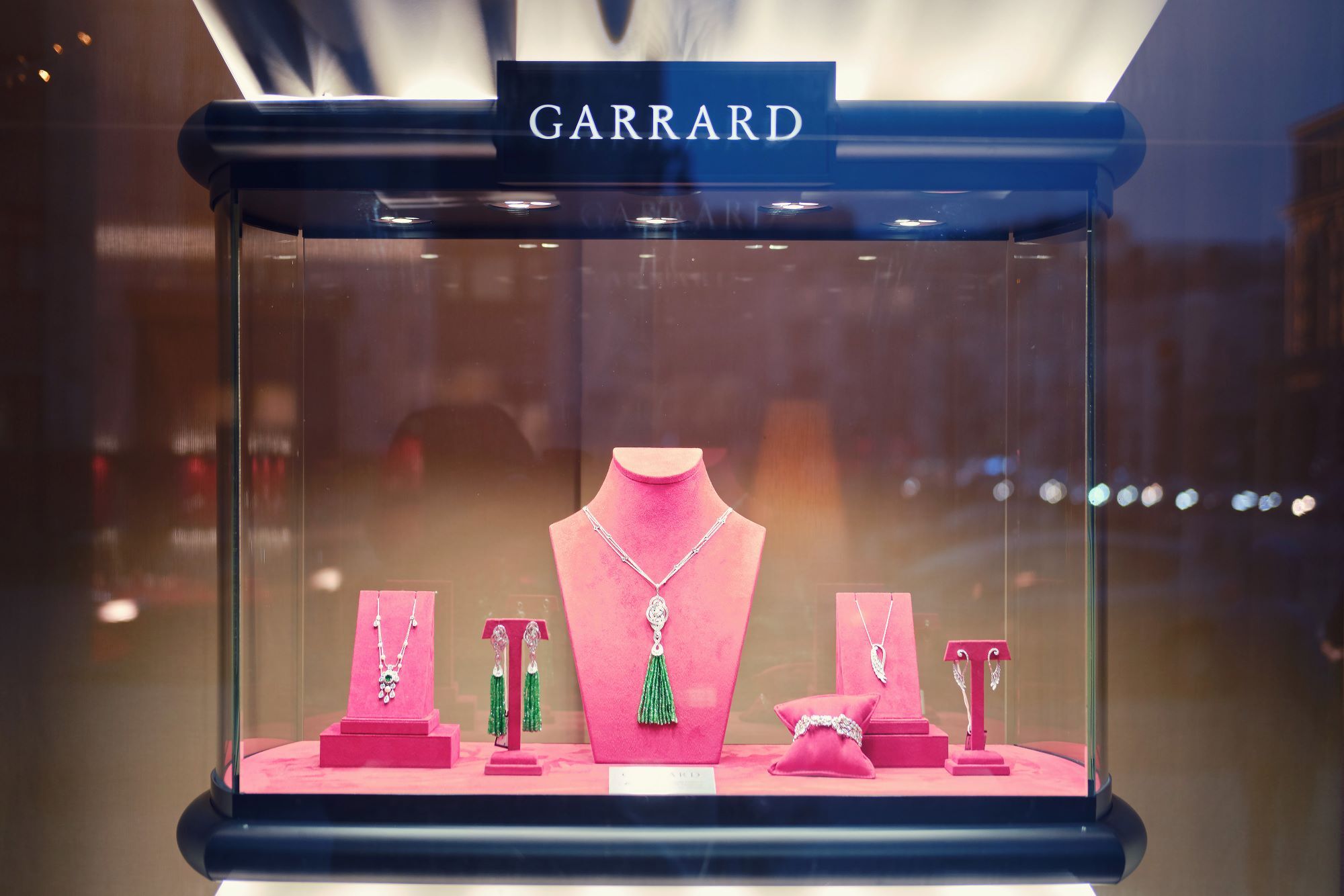
There's also something to be said for continuity in a business that runs on fashion. Garrard's recurring motifs link its past to its present without making every new piece look like a museum copy. The cluster setting from Diana's ring reappears in the 1735 collection; the Wings collection borrows the idea of a guardian angel. Fan shapes, open hearts and coloured gemstones turn up across the current collections, worked into rings, pendants and earrings meant to be worn, not kept behind glass. Even the newer lines tend to nod back to something in the archive, so a piece bought today rarely looks unconnected to what came before it.
The role of colour
Colour does a lot of the work. Sapphires, emeralds, rubies and richly coloured hardstones give many Garrard pieces their presence, while diamonds add movement and light. There's formality in that, but also pleasure; the best designs don't hide from their heritage, but they don't get buried under it either. Historical references get pared down into shapes that still make sense today.
Balancing ceremony and sentiment
Much of what makes Garrard interesting is this gap between ceremony and sentiment. A crown has to represent an institution; an engagement ring belongs to two people. The house has worked at both scales for nearly three centuries, making jewels that can signal authority in public and affection in private. Not many jewellers can claim that range.
Heritage without stagnation
Being around a long time isn't enough on its own; heritage can turn into a weight, especially once it's treated as fixed and untouchable. What keeps Garrard relevant is its willingness to return to familiar emblems, stones and settings without simply copying them. The craftsmanship hasn't loosened up, but the mood has: many current pieces are made to be layered, mixed and worn daily, so the wearer decides what they mean, rather than the occasion.
Nearly 300 years after George Wickes opened his workshop in London, Garrard still holds a distinct place in British jewellery. Its royal history gives it grandeur, but it's the human stories attached to individual pieces that keep the house going. Crowns belong to the nation, and famous diamonds pass into legend, but jewellery lasts because people wear it, remember it, and pass it on.
Read More