

Wembley Stadium is hallowed ground within British footballing culture. Its original incarnation was a beloved global landmark, the site of sporting miracles and the home of iconic tournaments such as the 1966 World Cup and the European Championship of 1996. Completed in 2007 to replace the original 1923 structure, the new stadium was designed to re-establish the image of England as the leading institution of the footballing world and Wembley, as its crown jewel. Whilst the old Wembley was defined by its distinctive Twin Towers, serving as a colossal backdrop for FA Cup Finals, Olympic events, and historic musical performances such as Live Aid, the contemporary update is defined by its magnificent 133-metre arch that soars above London and illuminates the skyline by night.
The stadium’s narrative is inseparable from the evolution of English football itself. Wembley is where careers have peaked, hopes have been dashed, and generations have built emotional histories tied to single moments on its turf, and this has continued over the last two decades of sporting competition. It operates not only as a venue for sport, but also as an institution that shapes the collective memory of fans across the globe.
Read on, as we take a look behind the curtain at what efforts went into its design, the structure and the level of service it operates at now, in order to make Wembley the institution that it is today. A Bold New Look.
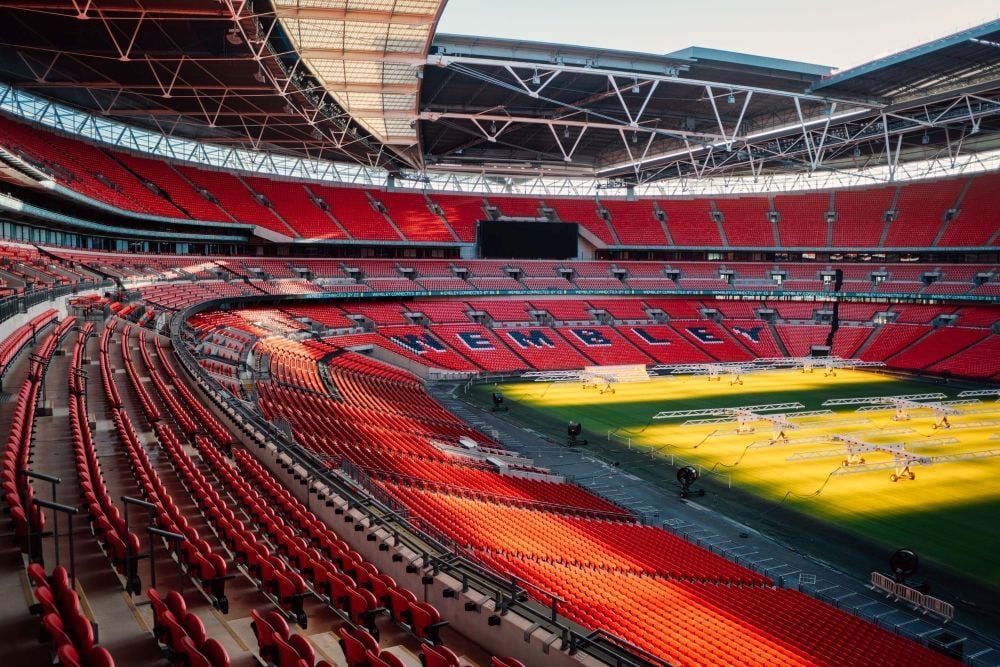
The new Wembley was designed to function on a scale that dwarfed that of its predecessor. The stadium bowl seats 90,000 spectators and is configured to deliver optimal sightlines from every tier, with steep banking ensuring proximity to the pitch regardless of position. The retractable roof was engineered to protect most of the crowd from the elements while retaining an open-field atmosphere during major events. The arch, weighing over 1,750 tonnes, also functions as a structural support, replacing internal columns to create an unobstructed internal view from everywhere in the building.
With wide internal concourses connecting food courts, bars, and hospitality suites, the stadium was engineered to handle significant traffic flow without compromising on comfort and safety for even maximum capacity crowds. The internal lighting and acoustics have been configured to pivot between all manner of sporting fixtures, concerts, and other events, allowing the stadium to adapt to the personality of every occasion, whether hosting NFL matches or megastar like Taylor Swift on her “Eras” tour.
Sporting Theatre
The pitch at the new stadium has become something of a character within English football in its own right, admired and criticised in equal measure over the last two decades. Maintaining a perfectly conditioned surface remains an ongoing challenge for any ground with a heavy fixture list. But when you throw in an extensive schedule of non-sporting events, the demand can take its toll on the surface, as has been the case at unfortunate moments, from major international fixtures to domestic trophy finals. The current hybrid system combines natural grass with synthetic reinforcement, allowing the stadium to host international football, domestic finals, and NFL games with minimal surface breakdown, although tackling extended football seasons and increasing temperatures globally have made this more of a challenge.
With that said, stepping into Wembley on matchday is very much a unique experience. The sheer size of the stadium is only comparable to a few other areas in the world, echoing back to antiquity and the age of the Colosseum in Rome. From the stands high above, the throats of 90,000 spectators ring hoarse after 2 hours in position watching the spectacle unfold below. To say it is noisy, particularly on hotly contested finals, is an understatement. Yet, far from being overwhelming, this very much remains part of the appeal and crucial to the football match experience. Fans from opposing teams are seldom silenced for long, particularly if egged on by their opposition for any perceived lack of vocal support for their own team.
Behind the Curtain
For those that desire a look when not attending a match or major event, Wembley Stadium offers an extensive tour with access to spaces normally reserved for players, officials and VIP guests. The tour covers the dressing rooms, touchline and technical area, the press conference suite and attached media rooms, and finally, a look at the Royal Box. Through the tour, visitors can learn more about the amazing operation that goes on behind the scenes on match days or at events, to keep Wembley running smoothly. The technical side of this incredible stadium requires a small army of staff to keep it running.
Wembley operates a broad hospitality infrastructure, with premium suites, lounges, and private dining spaces designed to accommodate corporate guests and supporters seeking an elevated matchday experience. Suites typically overlook the pitch and provide sit-down dining, drinks service, and private seating tiers. The highest level of hospitality at Wembley comes by way of the Bobby Moore Club, named after the eponymous England football captain and legend. The Bobby Moore Club facilitates access to the best box seats and hospitality levels in the house. Membership is tiered, with the highest level, Corinthian, reserved for major sporting figures with a special connection to Wembley and football.
It’s not uncommon to see the likes of David Beckham chatting with the head of the FA and the future King of England, Prince William, whilst celebrities and sporting stars from other disciplines like Tom Cruise and Lewis Hamilton mingle in the background. Service options at this level are exceptional, with fine-dining included pre-match, unlimited champagne service (courtesy of official supplier, Laurent-Perrier), as well as private concierge facility to ensure that guests' experience runs smoothly.
Beyond Football
Wembley has cemented itself as a cultural hub within not just London, but the world, thanks to its prolific status as a host of major sporting, music and charitable events. Even before the construction of the “new” stadium, Wembley was playing host to some of the biggest names in music, the largest televised charity event in history (Live Aid) and its fair share of major sporting competition climaxes. Its capacity and capability have made it suitable for high-complexity staging, with multi-level platforms, pyrotechnics, and broadcast integration all achievable on an enormous scale, ensuring that entertainment, sport and professional organisers continue to be drawn to it for creating major events like moths to a flame.
The venue’s ability to shift personality from footballing Mecca to Coliseum-like entertainment platform ensures that all events often sell out months in advance, sometimes even on the first day, such is the guarantee of the experience that awaits those at Wembley. Football teams see it as the nexus through which they can progress their season’s fortunes, artists see performing here as a career-defining moment, and fans will always prioritise booking to watch any sport here due to its reputation for spectacle and hospitality. Wembley, now as much as ever, remains a global benchmark for what sport and entertainment excellence looks like.