


The Swiss-French architect, designer and writer Le Corbusier is one of the most influential figures in home design and the built environment of modernity. In his seminal 1923 book Vers une Architecture (Towards a New Architecture), he famously stated that ‘A house is a machine for living in’.
He wanted to drive modern home design into a brave new world where the efficiency and rationality of a modern age was supported by, and integrated into, the places we live. Over a century later this philosophy is increasingly brought to mind by the rapid rise and acceleration of smart home technologies that are the foundation of new builds and modern renovations. Our homes are now filled with a wealth of connected hardware and gadgets that promise to make our lives easier and liberate us from the boundaries between work and home lifestyles.
A Smart Home History
Although the term Smart Home is widely thought to have been created in the 1980s by the American Association of Home Builders to promote technology integration, the roots of the idea go back much further. Automation in its simplest form through appliances such as washing machines and dishwashers became the very height of post-war sophistication for elite homes across Europe and the USA. In the 1960s, very early home-computer automation prototypes such as the ECHO IV were showcased that looked like science fiction to families at the time. It was designed to centrally manage housekeeping tasks like shopping lists, household inventory and even family accounting with control over environmental systems such as air conditioning, heating and even clocks. However, as one can imagine the huge hardware specifications and power required to install such a system made it prohibitively expensive and cumbersome.
Connectivity is King
Through the 1970s and 80s similar advances proved to be difficult to produce, maintain and develop on a mass scale. They would require bespoke wired installation and often the technology would be obsolescent by the time a way forward had been planned to get it to a wider market. What was needed was a standardised way of connecting all the ideas together that was simple for locations all around the world to access and build upon. As with almost every design element and innovation at the end of the 20th century and the beginning of the 21st, the internet was the answer.
The Smart Speaker Lands
During the second decade of the 2000s, mobile phone use was almost ubiquitous in its adoption across every age range and demographic. This meant that there was an accepted familiarity and understanding of the user interface used for applications which paved the way for more and more connected devices. The arrival of smart speakers such as Amazon’s Alexa in our homes signalled the next phase of smart home technology and networked communication in our houses. They offered a vital central point that could ‘talk’ to the systems and infrastructure within homes without the need for bespoke installation, wiring or ongoing maintenance resources required.
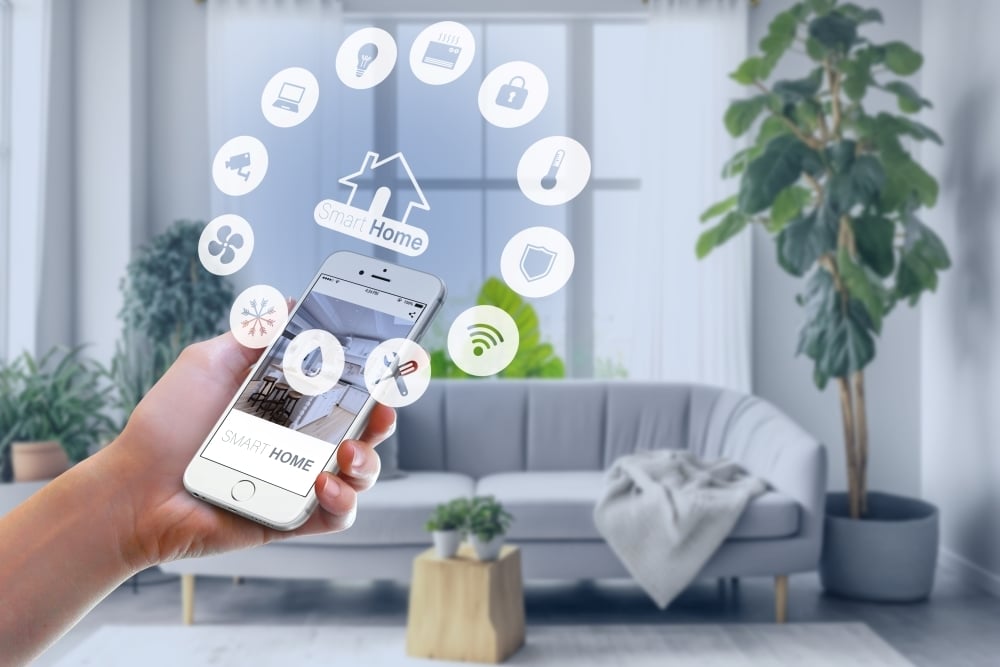
The systems that heat houses could easily be accessed through voice commands or a mobile application to deliver remote control capability from anywhere in the world. Similarly, security systems and alarms could be operated in the same way for added peace of mind and flexibility. Recent reports suggest that almost 600 million Alexa devices have been sold to date and just in the UK around 2 million Hive Smart Home Heating devices are currently at work. The smart home revolution had truly begun in earnest.
The Internet of Things
2008 marked a watershed moment in the history of smart home tech when there were eventually more devices connected to the internet than people. Every major tech brand had their own version of hardware and software required to offer connected home capability and with the flexibility and storage space offered by cloud servers, all of the data and information they gathered could be put to use. Smart thermostats could track use and suggest optimum heating patterns to match lifestyles. Water-quality monitoring and air sensors could inform us of how our own living environment was performing and work in tandem with very connected devices to ensure maximum comfort and resource-efficiency. Fridges were now capable of tracking inventory and could automatically order replacements for products that had been used or expired, and wellness apps could track our sleeping patterns through the night to produce ultra-tailored fitness plans.
A New Era for Entertainment
Perhaps the biggest sea change within smart homes was through how entertainment was now consumed. The streaming platforms of Netflix, Amazon Prime, Apple TV and Disney + moved from niche audiences to become the major players in the creation of video on demand content. All AV equipment in the home was capable of syncing with mobile devices to create an entertainment ecosystem that was always on and always watching what its audience was doing. Through smart home technology, our watching habits, tastes and trends were now part of the development loop with broadcasters creating content based on the data that they had gathered.
The Next Generation
Smart home technology shows no signs of slowing down in the near future. It is rapidly moving beyond reactive controls to a more anticipatory role in the house. Biometrics and behaviour will be the information that powers the climate inside the home in the most sustainable and energy-efficient way. For older residents it will eventually be able to integrate with any necessary healthcare to prompt and deliver medication while monitoring any changes through wearable devices. All of which will be connected to the caregiver’s central controls. The ultimate destination for smart homes will then be through robotics that are ever present in the home to take care of the cleaning and housekeeping tasks, all coordinated with external suppliers and services in a self-managed way.
When Le Corbusier wrote of a house as a machine all those years ago it is difficult to imagine he could have known exactly what tech wizardry was on the horizon. The most exciting step for his philosophy could well be the next one as the structural design of our homes now begins to be dictated by the machines that operate in them, working in tandem with human creativity for a brand new era of architecture that will undoubtedly appear. For smart home technology developers this is a very exciting time indeed.