

In the ultra-precise world of elite watchmaking, everything is driven by a desire to innovate through functionality, purpose and necessity. So much of the development of the wristwatch was a result of this philosophy from the needs of soldiers on the battlefields through to the submariners and maritime professionals on the world’s oceans and up to the commercial pilots that demand accuracy, detail and authority in our skies above.
For well over a hundred years, the Rolex brand has been at the forefront of this development with a disciplined focus on engineering, production and a keen understanding of their customer’s ever-changing lifestyles. It is precisely this fact that makes the Rolex Yacht-Master stand out as one of the most important watch model ranges of the 20th and 21st centuries. The Yacht-Master was not created out of changing utility requirements or purpose in the military world. Instead, it was a response to an emerging market of affluent individuals in the late 1970s who were beginning to covet the look and prestige of Rolex, without strictly requiring the professional capability. This was a transformative moment in luxury accessories and the Yacht-Master immediately stood out in a sea of pale competitors.
Time to Evolve
Rolex had owned the maritime watchmaking space for a long time. Their Submariner and Sea-Dweller models had provided essential support for seamen and divers since the early 1950s, solving problems for their unique tasks in purpose-built ways. However, as the 20th century drew to a close, these exquisite timepieces had started to appear on the wrists of those who sailed the seas purely for pleasure. If the yacht was indeed the ultimate status symbol for the wealthy elite of the 1980s, then a Rolex displayed on the hands at the wheel was the ultimate accessory to go with it.
The Rolex Yacht-Master was released in 1992 to some fanfare and with significant confidence as one of the very few entirely new Rolex models of the century. For the first time, it was a Rolex watch that wasn’t marketed through what it could do; it was positioned as what it would tell others about the wearer. In doing so, it laid a path for all high-end sports watches to follow ever since.
Couture Complications
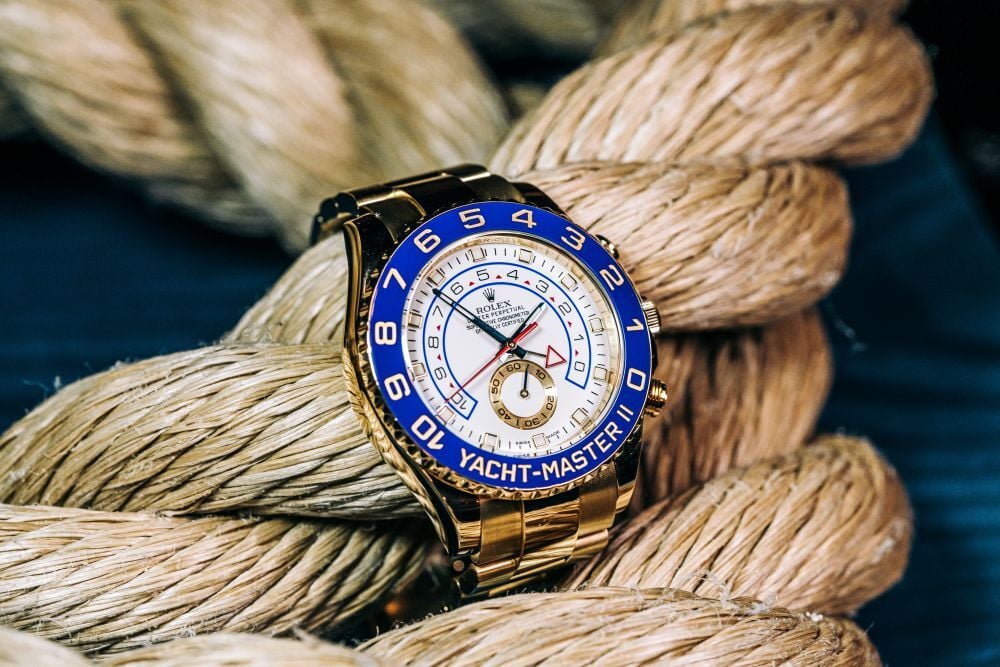
The original Yacht-Master was a 40mm case in a solid 18-carat yellow gold bracelet that arrived with opulence and luxury at its very heart. The complications and immaculate manufacturing that had come to define Rolex had not been compromised, though, with a wealth of features and functionality also at hand. A 48-hour power reserve, date marker and hacking seconds allowed for chronometer-certified accuracy with the Rolex Calibre 3135 movement powering everything on show.
Its design language was largely familiar to the Rolex aficionados, with a similar look to the Rolex Submariner, but the feel was entirely different. A bidirectional bezel replaced the utility of a unidirectional model with a 60-minute scale for short intervals. The raised and polished numerals spoke with a little more volume than the engraved tool markings of the Submariner and the gold accents made one aware of its new status as a luxury item.
The original list price was around £9000 at the time of release and although Rolex are always reluctant to release production numbers, it is thought they were deliberately extremely limited. The choice of gold on release definitely added to this accessibility and availability choice from the brand to ensure demand always outweighed supply. This was a policy that clearly worked well, as a good condition model can now easily fetch up to £20,000 in private trading or auctions.
A New Rolex Family
The Yacht-Master was such a success that Rolex began to explore generations of distinct iterations in the years since its launch. More than a dozen references have been created with evolutions in bracelet options, dial colours and material choices.
The latest of these in the Yacht-Master format is the 42mm sport watch that is presented in a choice of titanium, white gold or yellow gold. The titanium version is currently viewed as the most accessible and entry-level option with a price of around £13,00 from an authorised dealer. The precious metal variants range from £28,000 to £32,000, depending on differences in finish and regions. Several upgrades have been applied to the Yacht-Master alongside the developments across the entire Rolex range to deliver a 70-hour power reserve and Superlative Chronometer certification through the Rolex Calibre 3235 movement.
Will it Rise in Value?
As a general rule, the Yacht-Master doesn’t appreciate as well as many others in the Rolex family. Information suggests that a 7-15% rise per year from retail to the secondary market is possible for some of the most coveted styles. Indeed, the secondary market is currently showing an average 22% below list prices. For the Yacht-Master, it would be prudent to look upon it as a long-term purchase that will find its way into the appreciating categories over the next decade or so. The rare and precious metal models are obviously most likely to perform well in this regard.
Seaworthy & Seductive
The Rolex Yacht-Master ushered in a new era for how watches were viewed as assets and symbols of status and wealth. It would be fair to say that the rise in luxury watch trading of the last 20 years owes a lot to the foresight and marketing of this particular timepiece. It is now far more likely to be seen on land at the wrists of film stars than it is out on the ocean with Brad Pitt, Tom Cruise and Bruce Willis all confirmed owners and fans. However, with its incredible heritage and craftsmanship born out of eighty years of maritime watchmaking, it will always belong to the sea in some way.