

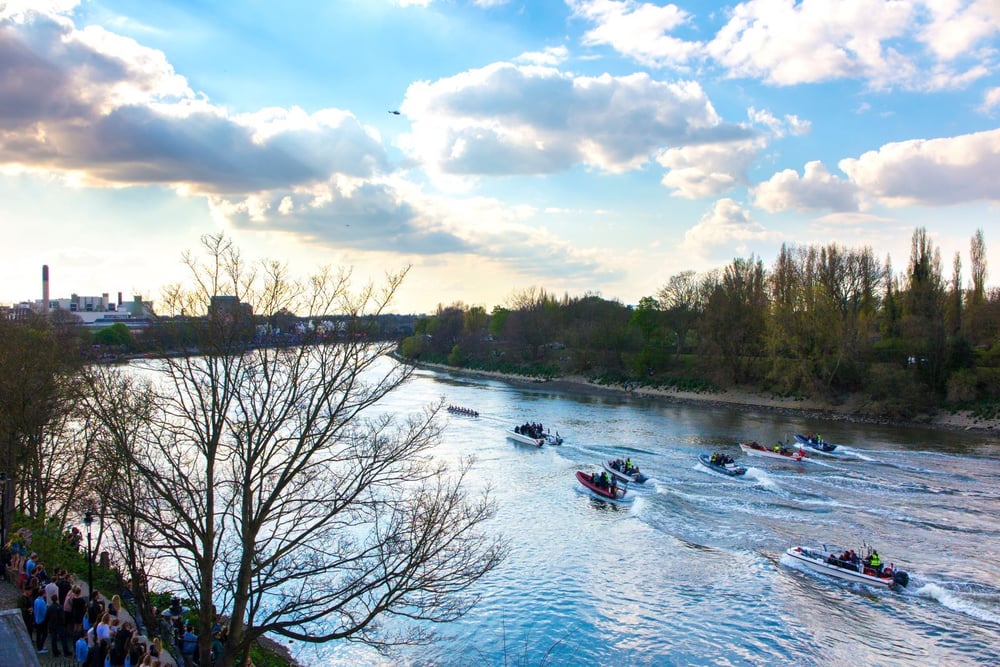
The River Thames is an iconic waterway that has been an essential character in so many London stories and events over time. One of the most recognisable of these is the University Boat Race. As Spring begins to finally bloom in the city, almost 250,000 people line the banks of Old Father Thames to witness a 4 mile rowing race on the river between Oxford University and Cambridge University.
For most of the year, the rivalry between these two incredible educational institutions is firmly academic in nature, but on race day it becomes a charged affair of sporting prowess and drama. It may only last around 20 minutes, but the impact of a win is certain to carry plenty of weight for the next 12 months.
A Gentleman’s Challenge
The race began life in 1829 as a private challenge between friends in a good-natured spirit when Charles Merivale of Cambridge first wrote to Charles Wordsworth of Oxford. He suggested a rowing race at Henley-on-Thames that would shift their intellectual rivalries into the realms of athleticism to add another dimension to it. The letter acted as a formal challenge that was eagerly accepted by Wordsworth, and Oxford were crowned as inaugural champions.
The race continued as a rather irregular fixture with a few routes and courses trialled before settling on what is now recognised as the Championship Course that runs from Putney to Mortlake on the river. By 1856 it was clear that Victorian London was ready to embrace the competition as a permanent and important feature of the British sporting calendar. Huge crowds would gather on the riverbanks with newspapers eager to report on the result and interest growing all over the city and well beyond. At this point it was clear that a simple gentleman’s challenge had evolved into a noteworthy tradition for the city.
The Championship Course
Perhaps the most engaging thing about the University Boat Race is the fact it remains a very public spectacle. The location of the River Thames, and the route that the Championship course follows, allows the residents of many neighbourhoods to witness a global sporting event right on their doorstep. At 4 miles and 374 yards, the distance is well beyond any standard regatta course as it winds westwards from Putney Embankment to the eventual finishing line at Chiswick Bridge, just before Mortlake.
The Start
The race begins just upstream of Putney Bridge. This location holds a particular affinity with rowing as the home to both London Rowing Club and Thames Rowing Club, with boathouses lining the river here. On race day this will always be one of the most crowded spots with a festival atmosphere in full swing.
For the competitors this is where control must be asserted to establish pace and power.
Putney to Crab Tree Reach
The river widens slightly as the boats pass the banks at Fulham. As the splendid period terraces that line the water look on, the boats reach Crabtree Reach with The Crabtree pub proving to be another key spot for spectators.
The water flows much faster here so the teams will be looking to perfect their form for the best positioning.
Hammersmith Bridge
This remarkable Victorian suspension bridge is a major draw for the day to watch the race sweep underneath it. With a collection of pubs and restaurants tightly packed here it can be very packed very early on the big day.
As the river starts to bend it is important for the boat crews to work towards a lead here that can be enforced for the rest of the race.
The Surrey Bend
Running alongside the leafy edges of Barnes and some of the most impressive neighbourhoods in southwest London means that the crowds thin here. It becomes a glorious pageant for those that live here to experience.
For the rowers, the flow of the river demands concentration as the race works towards its second half stretch.
Chiswick Reach
The river begins to straighten as it enters Chiswick Reach. At the beautiful, riverside Dukes Meadows park next to the water, many families and small groups gather for a more open and exposed spectator platform.
This is where the race begins to take its toll from an endurance point of view and both teams will be digging in to keep their rhythm optimised.
Barnes Bridge
The spectacular enclave of Barnes is one of the most coveted postcodes in all of London. Barnes Bridge becomes a hive of activity for the day as the boats pass beneath it with a demanding approach.
As the river narrows here it becomes an intense combination of power and strategy to line up for the finishing sprint.
The Finish
The race concludes just before Chiswick Bridge in the district of Mortlake. This area has long been associated with a quiet and sedate pace of life for its residents. However, for one day in Spring it is frenetic and fast as the University Boat Race reaches its climax.
The crowds and TV cameras watch on as two exhausted teams try to maintain pace, power and poise across the final yards to glory.
The Scores So Far
The University Boat Race has been hotly contested for well over a century, and the scores detail an incredibly close rivalry over all of that time for the men’s teams
- Cambridge University 88 wins
- Oxford University 81 wins
As any aficionado of the event will tell you there is also one standout instance when the race was drawn. The Dead Heat of 1877 saw both crews so tightly matched at the Mortlake finish that judge John Phelps was unable to determine a clear winner. There was such outrage at the time that judging standards and procedures were altered to prevent it ever happening again. In 2003, the Oxford University team were crowned winners by an incredibly tight margin of just 30 cm to emphasise just how difficult it can be to separate these two teams after almost 200 years of competition.
What to Expect for 2026
When the light blue Cambridge team and dark blue Oxford team step in their boats on Saturday afternoon the stakes could not be higher. With four wins out of the last five for Cambridge, including three in a row up to 2025, the sensible prediction would be to tip Cambridge for further glory.
However, as the hundreds of thousands of riverside spectators and millions at home will know, there is always the chance of more surprises and drama in this quintessentially English sporting event.