

Published: 24 March 2026
There are collectors, and then there is Magnus Walker. Born in Sheffield, raised on punk and football, and eventually transplanted to Los Angeles, Walker has spent the better part of three decades assembling one of the most talked-about private Porsche collections in the world. This month, RM Sotheby's offers them all, comprising 162 lots spanning nearly five decades of Stuttgart production, from spindly early 911s to the wide-arched excess of the Turbo era and beyond.
Walker is not a collector in the conventional sense. He pursues character above concours condition or factory correctness, gravitating toward cars with provenance, rarity, and the kind of history that cannot be replicated. His "outlaw" aesthetic, shaped in equal measure by 1970s motorsport and his own background in fashion through his label Serious Clothing, is immediately recognisable: louvred engine lids, period-correct modifications, patina worn with intent rather than apology. The 2012 documentary Urban Outlaw brought his story to a global audience, but within Porsche circles his reputation had been established long before. The second release of lots has now concluded, with the final drop having taken place on 3 March 2026. Below, we examine three lots that reward closer attention.
1976 Porsche 911 Carrera 2.7 MFI
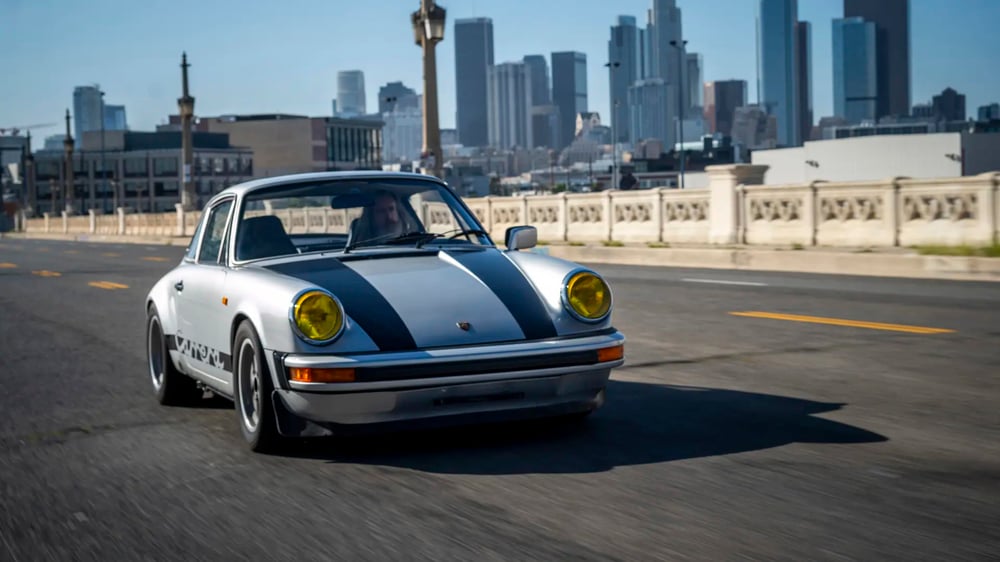
The significance of this car is easy to miss if you are not looking for it. Outwardly, it presents as a standard G-series 911 — the generation most readily associated with rubber bumpers and a gradual softening of the 911's original character. But under the engine lid sits the Type 911/83 unit: the same Bosch mechanically fuel-injected flat-six that powered the original Carrera RS 2.7, producing 210 horsepower and delivering the kind of instant, unfiltered throttle response that the later CIS-equipped cars simply could not match.
The full production run of the Carrera 2.7 MFI stretched to 1,633 units between 1974 and 1976. This example belongs to a far smaller subset — one of just 113 built in 1976, as the model was being wound down in favour of the 3.0-litre Carrera. All 113 were sunroof-delete coupes. All carried the RS-specification MFI engine. All were reportedly earmarked for the German market as homologation Sondermodells for a racing series that was ultimately cancelled before it began. They represent the final chapter of mechanical fuel injection in road-legal 911 production; everything that followed on the competition side — the 934 ½, the 935, the SC/RS — used MFI exclusively in race trim.
Walker identified this car in 2009 through its VIN, which carries the "9" homologation prefix, and subsequently verified its provenance. It is believed to be the 23rd example of the 113 produced. The Porsche Certificate of Authenticity confirms factory delivery in Silbermetallic over black leatherette, with antenna, front loudspeakers and noise suppression specified.
His modifications are characteristic — tartan velour buckets, a ducktail spoiler, Carrera script and a two-tone bonnet — but the numbers-matching engine is untouched. For those who understand what the MFI lineage represents, this is a serious car wearing Walker's personality lightly over a historically significant drivetrain.
1976 Porsche 911 Turbo
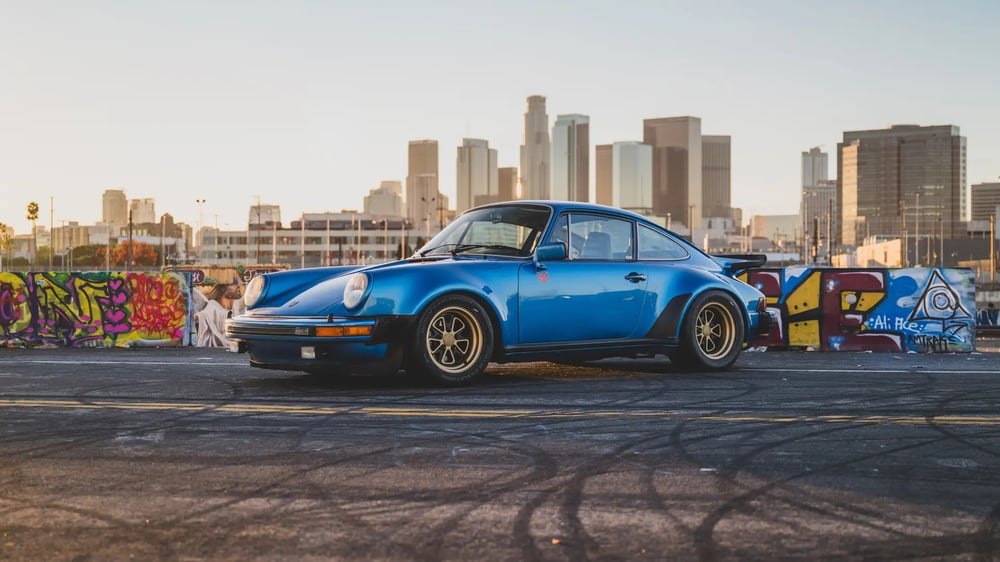
The 930 Turbo's reputation requires little rehearsal. What is worth noting here is the specification. This is a European-market 3.0-litre car — 260 horsepower against the 240 of the US-spec equivalent — with a camshaft profile that sharpens the already considerable mid-range delivery. The smaller bumper overriders of the Euro configuration give it a visual cleanliness that the federalised cars lack, and the marginally increased headroom is a welcome detail for anyone who has spent time in one.
The car is a Swiss-delivery, sunroof-delete example in Minerva Blue Metallic — a combination that already marks it out from the crowd. The white leather interior of its original specification has been replaced with blue leather and corduroy seats sourced from Walker's 1978 911, designated "78SCHR" within his collection, introducing a textural contrast that is deliberate and considered rather than arbitrary.
Walker acquired it in 2013 and has developed it in keeping with his outlaw philosophy. The wheels — deep-dish, Fuchs-inspired items produced in collaboration with Fifteen52 — were the first set made for what became his Outlaw Wheel project. The staggered setup runs Hoosier R6 rubber, and the lowered stance reads clearly as a reference to the racing 934. A semi-custom exhaust by RarlyL8 sharpens the soundtrack, bringing turbo spool and overrun into focus in a way the standard system never quite managed.
The engine is numbers-matching, confirmed by Jürgen Barth. The repaint is a faithful rendition of the original Minerva Blue, finished with gold-bronze and black wheel centres. This is a 930 Turbo that has been developed with knowledge and restraint — modified enough to reflect Walker's vision, but not so heavily altered as to obscure what it fundamentally is.
1966 Porsche 911
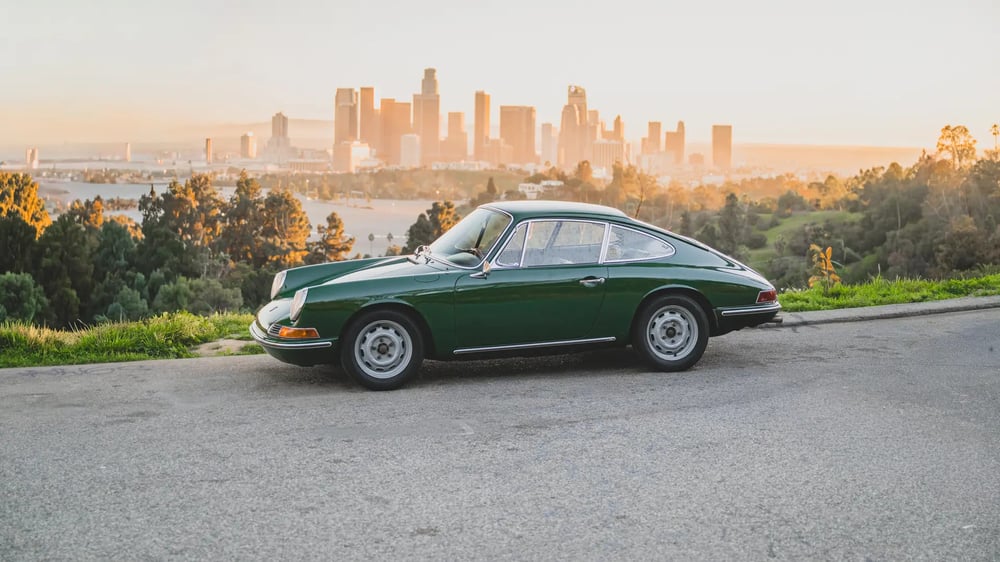
This is the oldest car in the selection and, in many respects, the most interesting. Completed in January 1966 and delivered through Porsche Car Pacific in Burlingame, California, it is an early short-wheelbase 911 — the configuration that most closely reflects Ferdinand Piëch and the original engineering team's intentions before the car began its long process of development and enlargement.
The factory records name "B. Wilson" as the original owner, which tells us little beyond the faint possibility of a transatlantic connection. Walker bought it in 2009 after travelling to Seattle to inspect it. The numbers-matching flat-six remains in place, paired with an earlier type 901/0 gearbox. The factory Irish Green paintwork has been correctly resprayed, and the original interior — carpets, upholstery and wood-rimmed steering wheel — survives with genuine, unstageable patina.
The one deliberate change Walker made was to the wheels. Non-period Fuchs alloys were removed in favour of plain grey-coated steel wheels without hubcaps, a decision that communicates exactly the right things about the car's character. On period-correct 70-series rubber, the driving experience is everything the early 911 promises: talkative, physically engaging, and entirely without the electronic mediation that conditions expectations today.
This is one of the least modified cars in Walker's collection, and that restraint is the point. It has appeared occasionally at events and featured in a 2013 XCAR film, but has largely remained in his garage unchanged since purchase. He has described it as a car he never felt the need to improve — and for anyone with serious knowledge of early 911s, the reasoning is self-evident.