

The fundamentals of Japanese architecture have always dealt with the balance of an existing environment and the structures within it in a precise and considered way. The philosophy is that visible harmony must be sought between the land that humans occupy and the new forms that will take residence there. Over time and through every movement, the architecture has taken cues from clues present in nature to create innovations and styles that have lifestyle and connections as their beating heart and working mind.
Letting the Land Decide
A constant thread that ties all Japanese architecture movements is allowing the land itself to dictate functional concerns. From the earliest origins before the 6th century, raised storehouses would be created from timber and thatch, which allowed natural resources to continue their purpose underneath. The soil and streams continued their own journey, only being drawn from when needed.
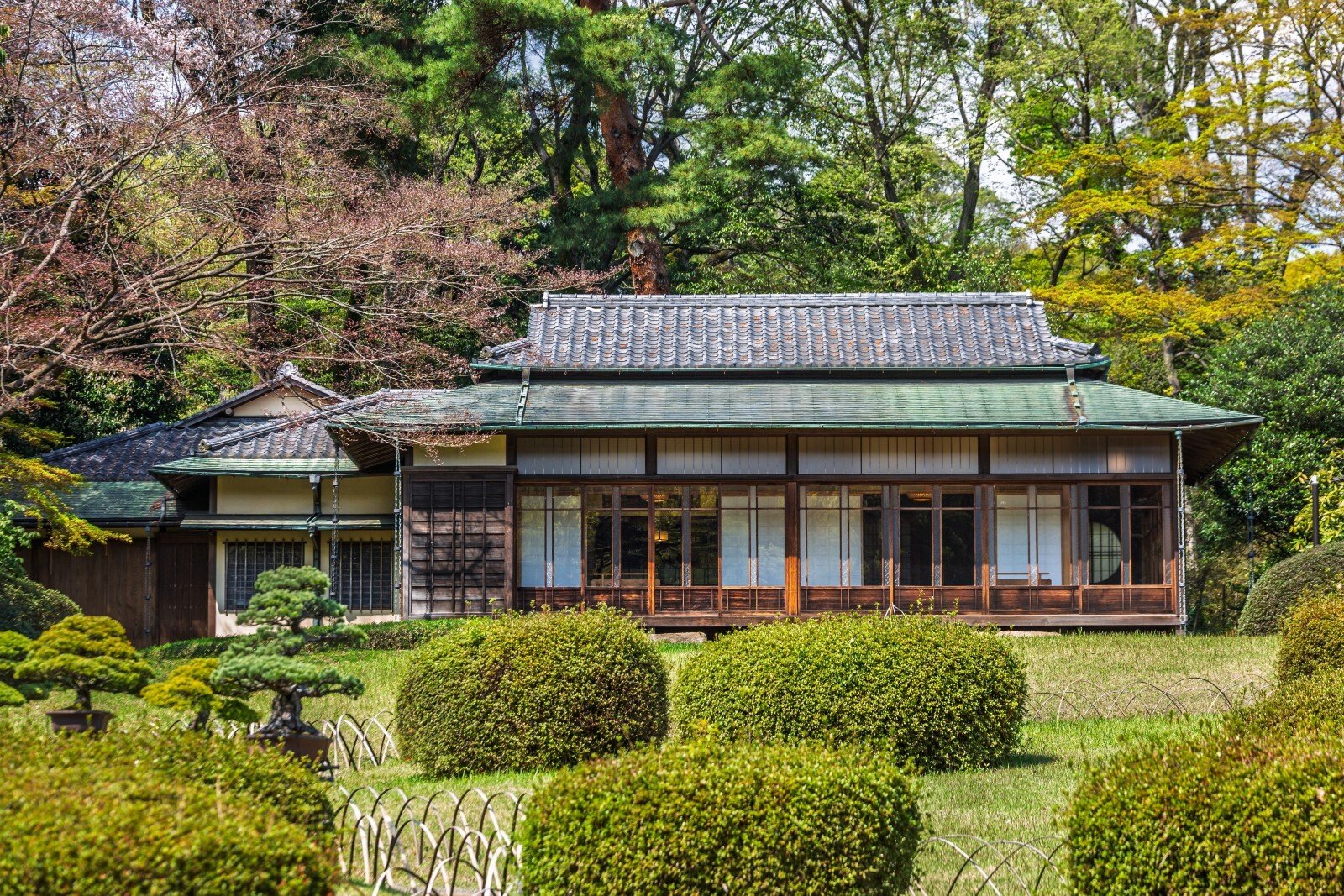
In a country with such a varied climate of humidity and rain, challenging terrain and the constant threat of seismic activity, it was critical that a dialogue with the land was created from the outset. It had to be flexible, adaptable and charged with the ability to be reconfigured in an almost organic way. The spatial adaptability that became a key element of Japanese interior design is a clear callback to this idea. What we understand as Fusuma and Shōji are the sliding doors and screens that remove the need for fixed walls and permanent rooms. Instead, they encourage an impermanence in the home environment that adds multiple purposes for the inside spaces and makes the boundaries with the outside much less static.
A Tale of Temples
When Buddhism arrived in Japan from China and Korea in the 6th century, it brought with it a wave of new ideas for every facet of Japanese society. Chief amongst these was the way it offered new forms of worship and spiritual reflection. The temples and spaces that were built to accommodate this new era would have a transformative effect on the country that lasted for centuries and is still evident to this day.
The Shinto architecture that existed before the arrival of Buddhism was of a much simpler style, using entirely natural materials. Unpainted wood was crafted to create rectilinear structures with scant thought for ornamentation in a pure and minimal aesthetic. Occasional cross-beam finials were applied with end-beams and log weights on the roof, acting as Shinto symbolism to mark them as sacred.
Ise Jingū in Mie Prefecture is the perfect representation of this style. It is a complex of 100 shrines built in Shinmei-zukuri, meaning divine brightness, where natural light was considered a material to be used in the construction. For over 1300 years, the main shrines here have been rebuilt in cycles of 20 years to pass this knowledge on to new generations. The Shikinen Sengū ritual dismantles the existing shrines and repurposes the materials across the country to demonstrate renewal through the ancient craft.
A New Architectural Age
Japanese temple architecture quickly aligned with the Buddhist influence, adding curved tiled roofs with deep eaves and modular configurations throughout the interior spaces. Open walkways and verandas were created in a celebration that shared the Shinto philosophy of communion with nature. Exquisite methods of carpentry were used to conceal joins and allow for complicated brackets that did not require nails as fixings. Everything appeared sophisticated, subtle and divine.
Todai-ji in Nara Prefecture from the 8th Century displays this transition between periods in a striking way. Vermillion red woodwork gives a bold flash of colour with black and green accents on the supporting beams. The gold leaf interiors add majesty to the monument, surrounding the altars and imagery in beautiful layers of light that would have created an incredible experience for its visitors.
Large elements of this temple architecture, and the methods to achieve it, would inevitably trickle down to the aristocracy, municipal buildings and eventually further down the feudal scale.
Medieval to Modernity
The Edo period of the 12th to 19th centuries saw the diversification of Buddhism and the emerging influence of Zen thinking. Alongside this came more context-sensitive architecture and design that led to more modest teahouses that championed a rustic simplicity. Rows of wooden townhouses were appearing in cities such as Kyoto, Kanazawa and Nara too, which provided housing and work studios for the chōnin class of townspeople. They would employ clever architectural dimensions in a long and narrow footprint that helped avoid the taxes applied to street front buildings and became known as unagi no nedoko, or eel bed houses. This is when shōji and fusuma were much more widely adopted, as merchants could combine their work with their home lives in these developing communities.
Westward Glances
From the late 19th century onwards, Japanese architecture had absorbed the forms, methods and styles of Western design. As a result, bricks, stone and eventually steel would begin to replace the timber-centric structures that were favoured for almost 2000 years.
The Imperial Crown Style that gained popularity in the first half of the 20th century managed to display this modern ambition with a clearly defined cultural identity, often topping the structures with traditional Japanese roofs. The Tokyo National Museum’s main hall is perhaps the finest illustration of this, built in the 1930s with a formal façade adorned by bronze roof ornaments that speak to the temples of the past.
Future Forward
Following the global chaos of World War II, Japanese architecture looked set to reimagine urban spaces as a macrocosm of the modular space philosophy that had defined it for so long. Flexible megastructures could now combine high-tech ideas with spatial imagination in a thrilling way.
The Metabolist school of the 1960s, with architect Kenzo Tange as its most prominent figure, envisioned a collection of organic and modern buildings that could adapt and grow. His Yoyogi National Gymnasium, created for the Tokyo Olympics in 1964, demonstrates how modern engineering could assist his vision of fluid movements and natural forms in remarkable ways. The sweeping suspended roof added drama and theatre to the skyline, albeit with its own celebration of beauty and craftsmanship.
As Japan addresses the architectural challenges of the 21st century, it is clearly responding to another step change in its history. The rise of a predominantly urban landscape in relatively small spaces is forcing new ideas of how to accommodate living, working and leisure in one space, with projects such as the mixed-use development of Azabudai Hills in Tokyo beginning to form a blueprint. One thing can be guaranteed: the presence and influence of light, movement and nature is sure to be highest on the list of priorities in every design brief.