

Horse riding in the UK has evolved over thousands of years and has moved from a practical necessity for transport, agriculture and warfare into a cultural pursuit encompassing sport, leisure and even therapy.
From the Bronze Age, when horses were used for carts and ridden in battle, to the Anglo-Saxon period, with early records of saddling dating to around 631 AD, riding remained central to work and warfare for centuries.
By the 19th century, industrialisation shifted horse riding away from daily utility and towards organised sport, leading to the formal development of disciplines such as dressage, show jumping and eventing, alongside major events including the Royal Horse Show.
For beginners, however, the idea of learning to ride can feel opaque, particularly when navigating where to begin, what to expect from a first lesson and how to find a suitable riding school in a city better known for buses than bridleways.
In this guide, we set out the fundamentals of horse riding and how to find reputable teaching and venues in and around London.
Understanding the Fundamentals of Horse Riding
At its core, horse riding is about balance, communication and trust. Contrary to popular belief, it is not about strength. A good rider learns to communicate through subtle shifts of weight, leg pressure and rein contact.
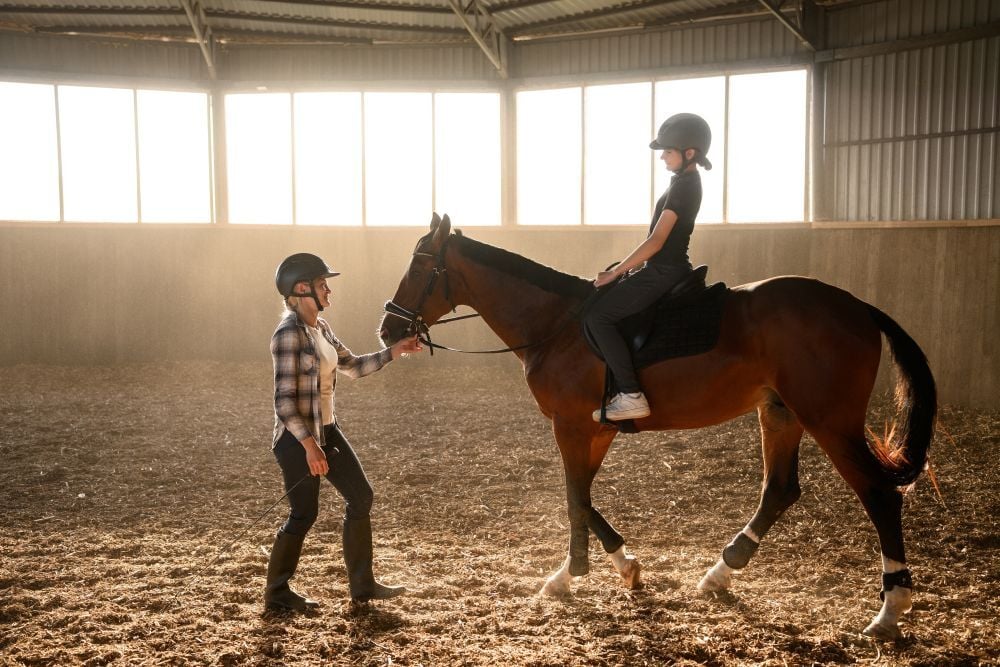
Most beginners start in a controlled environment, usually an indoor or outdoor arena, on calm, well-schooled horses chosen specifically for novices. Early lessons focus less on speed and more on posture, rhythm and confidence.
Key Points for Beginners Include:
Position and balance
Learning to sit correctly is the foundation of everything. Riders are taught to align ear, shoulder, hip and heel, creating a balanced seat that allows the horse to move freely beneath them.
The aids
“Aids” are the signals riders use to communicate with the horse, such as legs to encourage forward movement, hands to guide and regulate speed, and seat and weight to support balance and direction.
Gaits
A gait refers to the specific, rhythmic pattern of a horse’s footfalls and limb movements as it travels. The four main natural gaits are walk, trot, canter and gallop. Beginners typically start at walk and trot, with learning the rising trot being an important early milestone, helping riders move in rhythm with the horse and ride more comfortably. Canter is usually introduced later, once balance, coordination and control have been established.
What to Expect from Your First Riding Lesson
The first lesson is rarely dramatic, and that is by design. Expect to spend time on the ground, meeting the horse, learning how to approach safely and understanding basic equipment.
Most beginner lessons include:
- Mounting with assistance
- Walking exercises to develop balance
- Simple steering and halting
- Learning how to hold the reins correctly
- Dismounting and basic aftercare
Lessons are usually private or in very small groups to allow instructors to correct posture and build confidence gradually. A good instructor prioritises calmness and clarity over speed of progression.
Finding an Instructor
One of the most important decisions a beginner makes is where and with whom they learn and in the UK, the gold standard is the British Horse Society. BHS-approved riding schools and instructors are assessed on a regular basis for horse welfare, teaching quality, safety procedures and facilities.
When choosing an instructor or school, it is crucial to look for:
- BHS approval or equivalent accreditation
- Clear beginner pathways
- Calm and well-trained horses
- Official safety equipment (including approved riding hats)
- Transparent pricing and lesson structure
Where to Learn Horse Riding in and around London
London offers excellent access to riding, often within parks, commons and greenbelt land just beyond the city’s edge. Several centres cater specifically to beginners.
Hyde Park Stables
Hyde Park Stables offers escorted rides and lessons in one of the capital’s most historic equestrian venues, with routes that stretch through Hyde Park and Kensington Gardens. Sessions include semi-private and private rides with mounted escorts, as well as small-group arena lessons, all suitable for beginners and delivered under professional supervision. Riding takes place along Rotten Row and beside the Serpentine, within Hyde Park, a landscape that also formed part of the London 2012 Olympic venue.
Wimbledon Village Stables
Set beside Wimbledon Common, this long-established riding school offers beginner lessons in both arena and open heathland settings, with access to extensive off-road riding across Wimbledon Common and into Richmond Park.
Its award-winning Members’ Riding Club is designed specifically for adult riders, offering guaranteed stable access, priority booking and tuition on well-schooled horses. Training is also supported by an interactive Equicise horse simulator, used to refine technique and develop confidence at every level.
Lee Valley Riding Centre
Located in East London, Lee Valley Riding Centre is BHS-approved and particularly popular with complete beginners. Purpose-built facilities, carefully selected horses and a clear, progressive lesson structure make it well-suited to those learning from scratch, while also supporting riders as they advance.
Alongside private and group tuition, the centre offers structured Learn to Ride and Learn to Jump courses, BHS assessment and study evenings up to Stage 2 Teach. It also operates as a Pony Club Centre.
Ealing Riding School
Ealing Riding School is a British Horse Society–approved centre that welcomes riders of all ages and abilities, from complete novices and nervous returners to experienced riders. With a stable of 38 carefully chosen horses and a team of experienced instructors, the school places equal emphasis on safety, encouragement and steady progression.
Riding instruction is clearly structured through a progressive level system for both children and adults, beginning with basic position and rising trot and advancing through independent riding, pole work and jumping, to more technical skills such as lateral work and riding into contact.
Trent Park Equestrian Centre
Set within the woodland landscape of Trent Country Park, Trent Park Equestrian Centre is a long-established, British Horse Society–approved riding school offering lessons, hacking and livery just beyond north London. With individual and group flatwork lessons designed to support riders at every stage, tuition is structured, progressive and delivered by an experienced team, with lessons available in small groups or on a one-to-one basis.
Beyond the arena, the centre is particularly well known for its escorted hacking, with access to miles of traffic-free bridleways through the surrounding countryside of Middlesex and Hertfordshire.
Horse riding is not an exclusive sport, nor is it reserved for childhood or countryside upbringings. With the right instruction and environment, beginners of any age can learn safely and confidently, even in and around London. The key is to start slowly, choose accredited professionals and allow the relationship between rider and horse to develop at its own pace. The rewards, physical and otherwise, tend to follow naturally.