

Ancient Greece is a cornerstone of culture for the modern world. The myths, stories, philosophy and incredible creative output that sprang from this area of Europe thousands of years ago laid the ground for so much of what came after. Its essence is in the books we read, the films we watch, the understanding we have of human behaviour and of course in the built environment that we all share.
Greek architecture charts the journey of thousands of years of experimentation, trial and error and refinement to create a collection of recognisable styles that search for the right balance between order, function and beauty. This harmony that originally began in mud and brick eventually found a new home in the majestic marble temples and awe-inspiring civic theatres, with people at the heart of every development.
Before The Common Era
Thinking of Greek architecture naturally conjures images of the great structures from the Classical and Hellenistic periods that ran from around 500 – 146 BCE. However, it is possible to trace even further back for clues and the foundations of styles from over a thousand years prior to their construction.
The Mycenaean period of 1600 – 1100 BCE was full of architecture concerned chiefly with war and defence. Power, control and protection defined the forts and citadels and palaces of Mycenae & Tiryns that would dominate social life for their residents. The huge beehive tombs that applied corbelled vaulting to extend spaces also demonstrated engineering well in advance of anything seen before across Bronze Age Europe.
As the Greek Dark Ages of 1200 – 800 BCE took hold, this kind of palatial and monumental construction largely vanished for centuries. Decentralised societies shrank back and their structures followed suit in small and scattered settlements that offer little or no archaeological record to follow.
The First Revival
Archaic Greece from around 800 – 480 BCE offered renewed stability with much bigger populations and a rise in trading for the country. The results meant a revival of sorts back to the ideas that underpinned monumental architecture that once again favoured temples, public spaces and civic buildings. The Temple of Hera at Olympia is a wonderful example of this idea, created in long and narrow proportions that would originally have relied on timber, eventually replaced by stone.
Crucially, this temple displays some of the most important DNA for Greek architecture, with evidence of the famous Doric order in a rectangular plan with columns surrounding the building on all sides.
The Search For Order
The design language and architectural vocabulary that followed in Greece for the Classical and Hellenic periods are most simply understood through the three classical orders of structure for buildings.
Doric
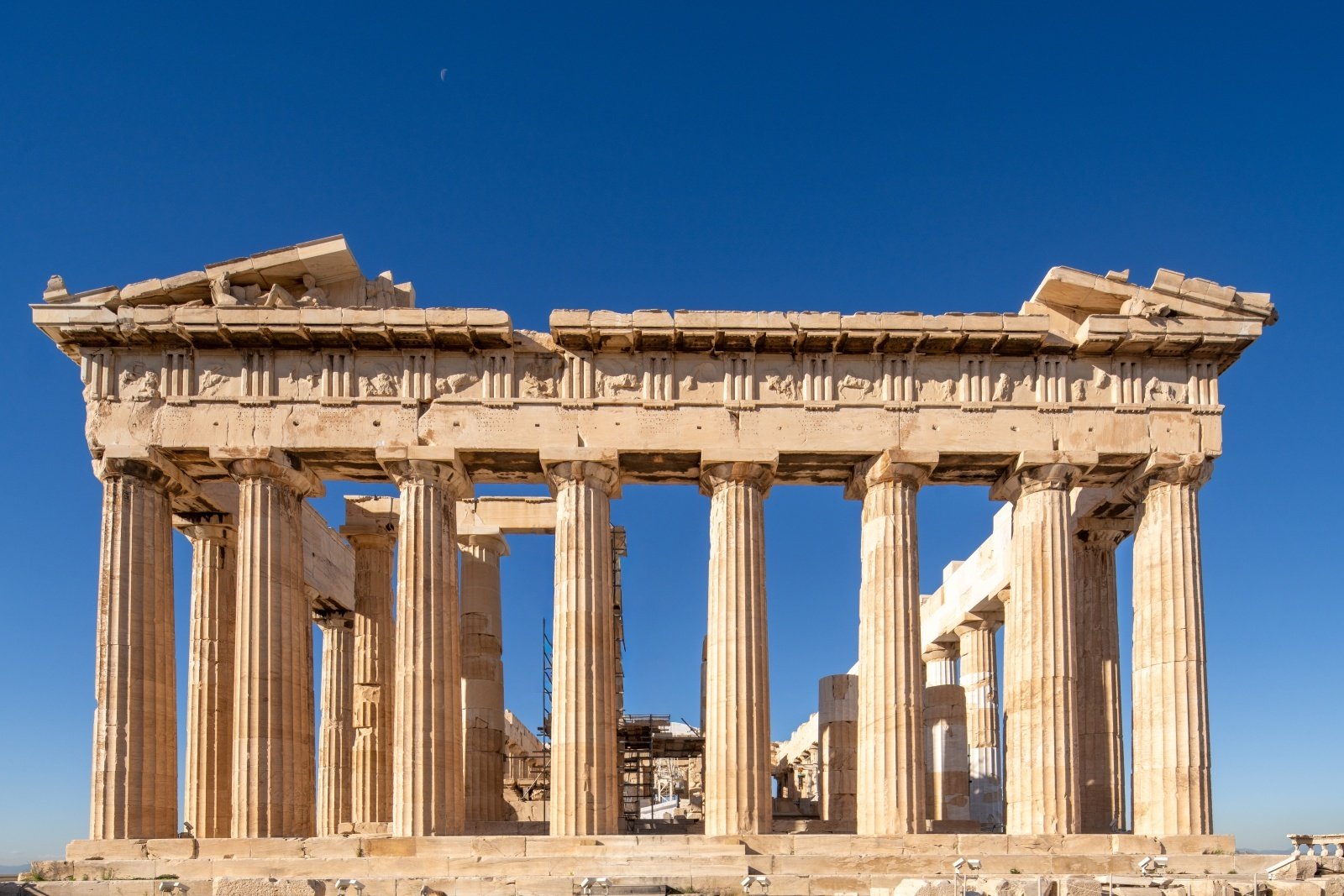
As the oldest of the Greek orders, the Doric works with columns that rise from the temple platform without a base. This gives them their distinctly heavy and somewhat stout appearance, using geometry in a rather austere manner.
The Parthenon in Athens was constructed between 447 and 423 BCE by the architects Ictinus and Callicrates with the overall artistic supervision supplied by Phidias, one of the most important Greek sculptors of any period. They employed optical refinements and corrections to make the structure appear perfectly straight and precise to the human eye, although nothing was actually as it seemed.
Tilting columns, curved bases and thicker corner columns all have an illusory element that shows how important the perception of the building was at the expense of rigid maths that may have imbued a weakness in it against vast, open skies. This was one of the first ever instances of understanding how to accurately balance strength and dimensions in construction with real-world impact on people’s engagement with it.
Ionic
The Parthenon was such an impressive and huge structure that it also demonstrated an evolution of the Doric order into what eventually became known as Ionic.
Building on the functional innovation of Doric sensibilities allowed the Ionic order to diversify and develop a much more elegant aesthetic. A base appeared for Ionic structures under each column for more strength and presence. And the uppermost part of the column, known as the capital, that supported the architrave structure above it, was now decorated with the familiar scroll or ram head design. Historical theorists do often like to suggest that this was a representation of the feminine form in response to the more masculine Doric that had ruled before it.
The Temple of Athena Nike, positioned at the southwest of the Acropolis of Athens, is marked as the first full realisation of the Ionic order for structure. Appropriately, this temple was a celebration of the goddess in her guise as the talisman of victory, displaying strength and valour in a feminine way. Four Ionic columns loom at the front and rear, holding up an elaborate and continuous frieze that wraps around the entire building, significantly telling historical stories combined with those of mythic and divine. Visitors would be aware in no uncertain terms that this intimate yet grand shape on the landscape, made entirely from bright white Pentelic marble, was a symbol of the civic identity of a culture emboldened by the past and fit for the future.
Corinthian
During the late Classical period, Greek architecture took the stability and refined purpose of the Doric and Ionic orders and added levels of artistry and adornment never seen before at scale. This was the Corinthian order that became widespread in the Hellenistic period and was so enthusiastically adopted by the Romans in their own monumental structures.
Their columns and capitals were inspired by the symbolic botanical structures found in nature, with the acanthus plant and its descending spiral leaves regularly cited as a key influence. Life, energy and a flourishing natural beauty were being embodied into the very fabric temples through exquisite design and craftsmanship. Sophisticated details were now appearing everywhere in the Corinthian order that would inform the shape of buildings in the western world up to the present day.
The Temple of Olympian Zeus in Athens became one of the largest in the ancient world, with a construction period that spanned centuries and was finally completed using Corinthian order methods. There had been numerous unsuccessful attempts to build on this site using both Doric and Ionic styles. In around 170 BCE, work was renewed under Antiochus IV Epiphanes with a strictly Corinthian aesthetic that worked in a much neater way. However, it was not until the Roman Emperor Hadrian revived its construction in 131 CE that the temple was finally completed. 104 massive columns surrounded an inner sanctuary that had such a transformative effect, reshaping the location of Ancient Athens into Hadrian’s City.
All Roads Lead to Rome
This was a hugely significant passing of the architectural torch from the Ancient Greeks to the Romans, who duly conquered swathes of Europe and the wider world, bringing their Corinthian order of superstructures with them. This marked the third act of a story of design and construction that began almost 2000 years earlier with the pioneering fundamental work of Greek architecture.