

German Architecture has been shaped by discipline, conflict and a collection of ideas and philosophies that quietly redefined how the modern world interacts with its buildings. It begins with the pragmatism of early timber structures that were a response to the bitter cold and dense forests of the landscape. The Gothic cathedrals then soared skywards in a celebration of divinity and civic ambition before industrialised war scarred the land on a huge scale.
A Tapestry of Ideas
It seems fitting that German architecture is recognised for its layers that have developed through different periods of time. For a large part of its past, the country was not a unified nation, it was a collection of kingdoms, imperial cities and principalities that each brought their own influence and methodology to bear. In the 20th century too, it was a divided symbol of post-war Europe where its citizens and infrastructure were so famously split between east and west.
Mediaeval Foundations
The distinctive shape and style of the Fachwerkhaus came to prominence in Germany in the High Middle Ages. These half-timbered constructions are perhaps the most recognisable examples of domestic German architecture, with their exposed wooden frames infilled with wattle and clay. Around 2 and a half million of these structures remain across the country as entire towns grew around them over the centuries that passed. The UNESCO World Heritage Site of Quedlinburg is home to over a thousand of these houses that were built by master craftsmen working to strict guild systems that developed over 600 years.
A Romanesque Revolution
As the collection of towns and areas that formed modern Germany began to grow in wealth and power, ideas from empires past and present would ultimately build their future. The Romanesque style of architecture that had taken hold of Europe between 1000 and 1200 CE became a unified design language that had a clear impact in this part of the world. Thick walls of stone and rounded arches projected solidity on a monumental scale as opposed to the modest architectural ambition that had gone before it.
Speyer Cathedral in south-west Germany remains one of the most important Romanesque architectural landmarks anywhere in the world. Constructed in the 11th century from an original commission by Emperor Conrad II, leader of the Holy Roman Empire, it stands at 33 metres high and 134 metres long as a political statement made entirely from stone. The huge round arches and massive cylindrical piers dominate the landscape, more than meeting the initial brief to become bigger than any church or place of worship north of the Alps. Many architectural scholars will point to Speyer Cathedral as the pinnacle of Romanesque design, with its enduring silhouette writ large on the German landscape for almost a thousand years.
The Gothic Arrives
As German buildings began to experiment with new structural ideas, an entire architectural style was appearing. From the 12th century onwards, developments expressed through pointed arches and huge ribbed vaults meant that designs could reach higher in terms of both ambition and scale. Without the need for the restrictive thick walls of the Romanesque, space and light were prioritised in stunning ways through incredible window spaces. This was Gothic architecture, where all attention was directed upwards and the celebration of the divine. The people that worshipped in these breathtaking structures were being given places for prayer that were as majestic and ethereal as the songs and masses that were performed there.
Cologne Cathedral is the most important example of the High Gothic anywhere in Germany and perhaps the world. Construction started in 1248 as the relics of the Three Kings had arrived in the city from Milan and made it a major pilgrimage site. It was therefore decided that a new building of international renown was required to rival the great French cathedrals of Amiens, Reims and Chartres. The medieval master builder Meister Gerhard was responsible for a single coherent vision that would be developed and built over the next six centuries.
Vast stained glass windows and ambitious towering arches gave the cathedral a luminous and aspirational atmosphere where height and light ruled everything the eye could see.
The Beautiful Baroque
As the Renaissance found its way into German towns through trade routes, universities and networks of European courts, it brought a more gradual transformation for architecture in the country. Renaissance ideas were absorbed over time, with buildings such as Heidelberg Castle revealing this process through their classical facades that also demonstrated clear Gothic principles, drawing the structure up and attracting light for the interior.
However, the order, proportion and symmetry of the Renaissance would soon give way to the much more emotionally driven and theatrical architectural style of the Baroque. The Protestant Reformation of 1517 had divided the country, with consequences for its architecture. As the restraint and simplicity of Renaissance architecture was adopted by Protestant German regions, the Catholic church would look to spectacle and scale as a tool of persuasion and that’s how the Baroque period came to life. Baroque buildings were designed to engage the senses and instil awe with emotion and religious authority as their foundations.
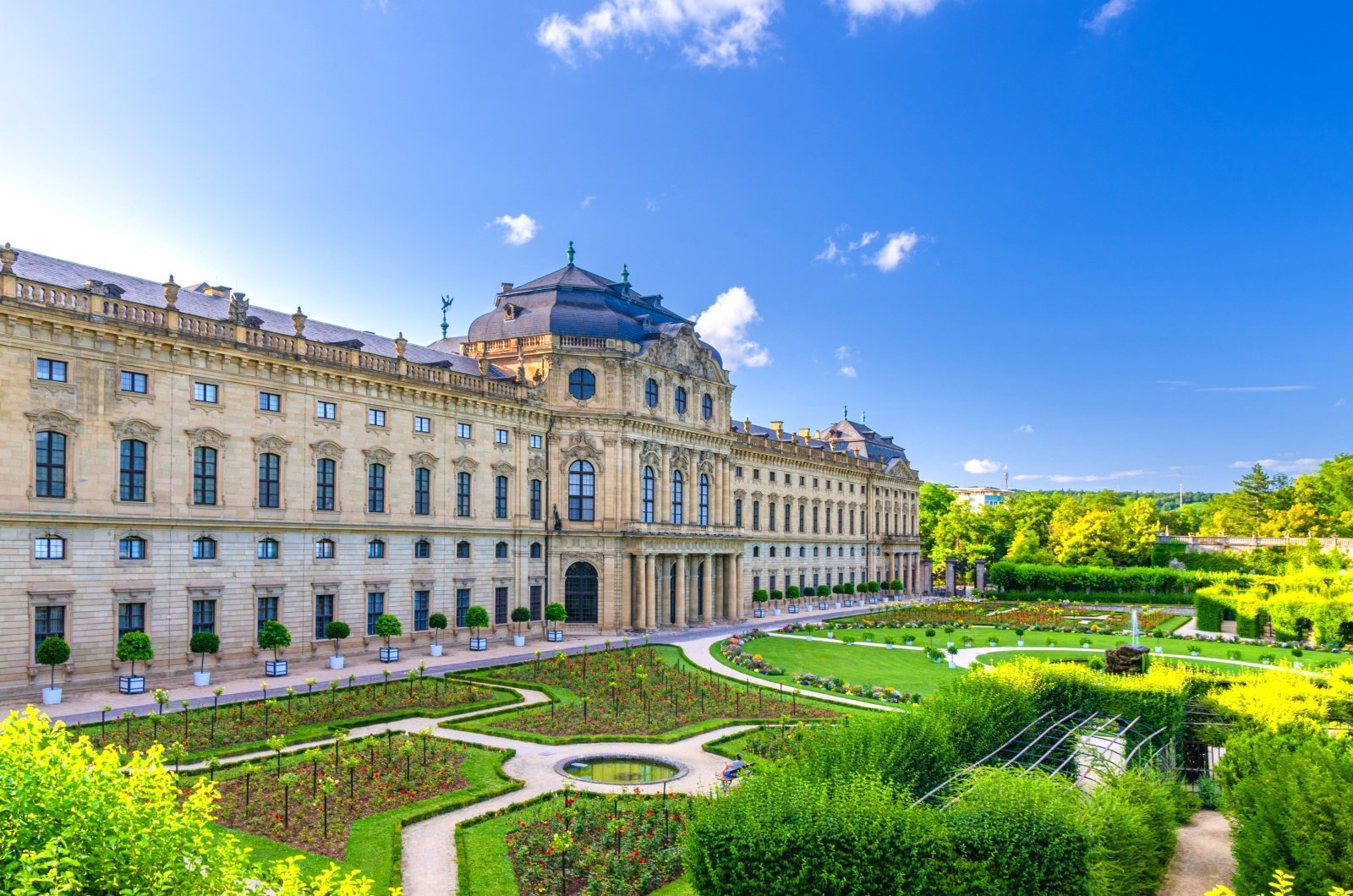
The Würzburger Residenz, designed by Balthasar Neumann and built between 1720 and 1744, is perhaps the most complete expression of German Baroque. There is illusion and theatricality everywhere here, with its monumental staircase and seemingly never-ending fresco on the ceiling. Everything feels staged with grandeur through the curved walls and fluid geometry of the space. It represents a combined world of architecture, art, engineering and sculpture conducted as a Baroque orchestra.
Modernity & Bauhaus
As the 20th century dawned on Germany, a radical new rethinking of how the built environment should attend to technology, industrialisation and social changes was evident for designers in the country. The architect Walter Gropius founded the Bauhaus School in the wake of World War I with a manifesto that declared, ‘The ultimate aim of all creative activity is the building’.
The Bauhaus principles were clear. Function must be valued over ornament and form should follow function, where the shape of a building is defined by its use. All material used should be truthful, with no decoration, where steel looks like steel and concrete looks like concrete. Essentially, architecture should serve society and not the elite. In practice, this meant flat roofs, white facades with steel, glass and reinforced concrete making up the structures. The Bauhaus Dessau building in eastern Germany is testament to this philosophy. Designed by Gropius himself in 1925, it is a radically modern and stark building with an entire wall of glass that exposes the steel structure to literally display how the school worked.
As the Nazi regime took power in Germany in the 1930s, the school was forced to close and many of its most eminent figures moved to the United States of America to spread their ideas across the world. As a result, the Bauhaus influence is still at large all over the world on modern housing design and office buildings, almost 100 years since it began.
Into A New World
Following World War II, Germany became almost a testbed for the even more radical architectural discipline of Brutalism as it rebuilt entire cities and wrestled with social housing challenges. With a country reunited at the end of the 20th century, there was a new freedom to civic design and planning that looked forward with a respectful eye to the past. All the myriad layers and influences of its architectural history will undoubtedly be acknowledged as the nation continues to build a new world as a home for all.