

French cuisine stands as one of the world’s most prestigious and respected culinary traditions, its name synonymous with artistry, discipline and an almost reverential respect for flavour.
Whilst boasting the highest number of Michelin-star restaurants, food in France has never been just about sustenance; it is a way of life, a form of expression and a foundation of its national identity.
History
The origins of French cuisine stretch back to the Middle Ages, when lavish royal feasts showcased spiced meats and sauces designed to assert power as much as to please the palate. Cooking relied heavily on local and seasonal produce, with dishes served all at once and extravagance formed a key part of the experience.
As trade expanded, new ingredients slowly entered the French kitchen and chefs moved away from heavy spicing and instead began formalising sauces, menus and kitchen organisation. This transformation was shaped by exploration and social change, which included the rise of public restaurants that came after the French Revolution.
By the 17th century, what we now recognise as haute cuisine began to take form, determined by a focus on preparation, high-quality ingredients and elegance over excess. François Pierre de La Varenne helped lay the groundwork for modern French cooking, while the 18th and 19th centuries saw figures such as Marie-Antoine Carême and Auguste Escoffier refine and codify the cuisine through structured menus and the foundations which included the mother sauces that remain central to the cuisine today.
In the 20th century, nouvelle cuisine marked a deliberate shift towards lighter preparations and clarity of flavour. This approach reached a far wider audience through Julia Child, whose work translated professional technique for the home kitchen. France’s gastronomic authority was formally recognised in 2010, when UNESCO listed the gastronomic meal of the French as intangible cultural heritage.
Regional Variations
Part of French cuisine’s richness lies in its regional diversity, best understood when grouped by broad geography. Climate, borders and local produce shape each area, resulting in a layered tapestry of cooking styles rather than a single national flavour.
Northern France
Northern France, including Hauts-de-France and Normandy, favours hearty, comforting food designed for colder climates. Butter, cream, potatoes and apples dominate, alongside slow-cooked meats and beer- or cider-based sauces. Signature dishes include carbonnade flamande (beef stewed in dark beer), ficelle picarde (a filled crêpe with ham and mushrooms), marmite dieppoise (a creamy seafood stew).
Eastern France
Along France’s eastern borders, Grand Est and Bourgogne-Franche-Comté reflect strong Germanic and Alpine influence. Sausages, pork, fermented cabbage and baked casseroles sit alongside wine-led stews. Classic dishes include choucroute garnie, tarte flambée, bäeckeoffe, quiche lorraine, bœuf bourguignon and escargots de Bourgogne, with cheese-heavy Alpine dishes such as tartiflette and raclette.
Central France
Central France, including Centre-Val de Loire and Île-de-France, is defined by classicism and restraint. In the countryside, pork preparations, river fish and straightforward sauces prevail, seen in rillettes de Tours and andouillette. Paris refines these traditions into brasserie and bistro staples such as croque monsieur, steak tartare, hachis parmentier and the famous steak frites.
Western France
On the Atlantic edge, Brittany and Pays de la Loire are shaped by the sea. Seafood and shellfish sit alongside butter-rich cooking, pork and buckwheat, often paired with cider rather than wine. Defining dishes include Breton galettes and crêpes, bouchot mussels, mogettes de Vendée and rillauds d’Anjou.
Southern France (South-West & South-East)
Southern France, encompassing Nouvelle-Aquitaine, Occitanie and Provence-Alpes-Côte d’Azur, offers the country’s most sun-driven cooking. Inland, the south-west is rich and rustic, defined by duck, goose, preserved meats and beans, with dishes such as cassoulet, confit de canard, poulet basquaise and tielle sétoise. Coastal areas lean more towards seafood, while Basque influences introduce peppers, spice and bold flavours that are synonymous with the cuisine of nearby Spain.
Further east along the Mediterranean, olive oil replaces butter and vegetables take centre stage. Provençal cuisine is lighter and aromatic, built around herbs, tomatoes, garlic and fish, expressed through bouillabaisse, ratatouille, pissaladière and gratin dauphinois.
Classic French Dishes
Entrées
Escargots
Perhaps the most quintessentially French entrée, snails cooked in garlic, parsley butter, are a delicacy, often associated with festive meals and classic French cuisine, showcasing the country’s penchant for transforming the unassuming into the extraordinary.
Quiche Lorraine
Hailing from the Lorraine region, this savoury tart is a combination of eggs, cream, cheese and lardons that are housed in a buttery pastry shell. Whilst somewhat simple in concept, a quiche Lorraine is exceptionally rich in flavour and epitomises French bistro cooking with influence from its rustic roots.
Main Courses
Bœuf Bourguignon
A quintessential French stew from Burgundy, this dish combines beef slow-braised in red wine with onions, pearl onions, mushrooms and bacon. Its deep and layered flavours are a masterclass in patience and technique, transforming somewhat simple ingredients into something sublime.
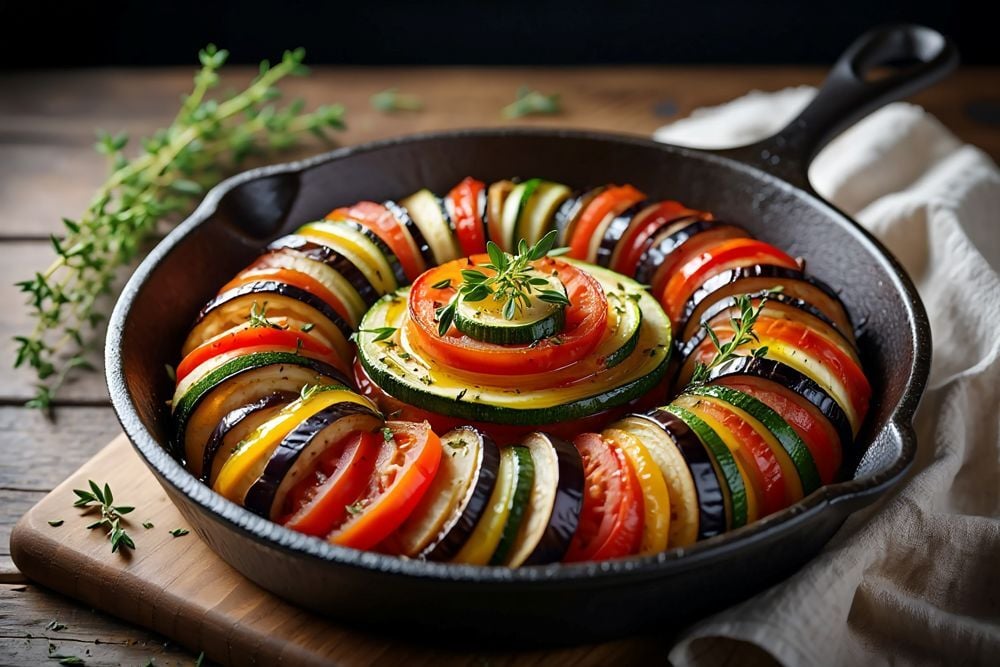
Ratatouille
A vibrant summertime dish that originated in Nice, ratatouille celebrates the region’s bounty, eggplant, zucchini, tomatoes, peppers and herbs cooked slowly to meld their flavours. It’s emblematic of cuisine du soleil, which translates to food inspired by sunshine and simplicity.
Confit de Canard
In southwest France, duck legs are cured and then slowly cooked in their own fat until meltingly tender. The preservation technique dates back centuries and reflects a tradition where flavour and sustainability once walked hand in hand.
Desserts
Crème Brûlée
Topped with a brittle and caramelised sugar crust, the Crème Brûlée classic French dessert is made from a rich baked custard and is typically flavoured with vanilla.
The custard is gently cooked in a water bath to achieve a smooth and creamy texture, then chilled. This balance of creamy and crunchy textures underlines the French mastery of pastry and sweets.
Macarons / Madeleines
Delicate and deceptively simple, macarons and madeleines speak to two sides of French pâtisserie. Macarons, with their smooth domed shells and soft, ganache-filled centres, are a balance of almond flour, meringue and timing that leaves little room for error. Once a regional speciality, they have become an international symbol of French pastry at its very best.
Madeleines, by contrast, are slightly nostalgic. These small and shell-shaped sponge cakes, enriched with butter and often scented with lemon or vanilla, are rooted in home baking rather than haute pâtisserie. Light, tender and best eaten fresh, they capture the French affection for simple pleasures executed perfectly.
Tarte Tatin
Tarte Tatin is one of French cuisine’s most celebrated accidents. Created in the late 19th century at the Hôtel Tatin in the Loire Valley, the dessert is said to have been born when apples were overcooked in butter and sugar, then salvaged by topping them with pastry and baking the tart upside down. The result is a masterclass in caramelisation, soft apples steeped in dark and buttery caramel beneath crisp pastry.
French cuisine continues to shape global cooking through its techniques, standards and philosophy, even as it adapts to modern priorities. Its influence lies not in tradition, but in its ability to evolve while remaining rooted in balance and respect for ingredients, which truly ensures its place at the heart of gastronomy for years to come.