

Alpha and Omega: A Guide to the Two Defining Stadiums of the 2026 FIFA World Cup
Two of the defining pillars of every World Cup are the venues that host its opening match and lay out the stage for its finale. In 2026, those two roles fall to stadiums that could scarcely be more different in character, age, or provenance. The Estadio Azteca in Mexico City, opened in 1966 and steeped in more footballing mythology than almost any other ground on earth, will host the opening match on 11 June. MetLife Stadium in East Rutherford, New Jersey, completed in 2010 and purpose-built for American sports culture at its most expansive, will stage the final on 19 July.
Between them, these two venues frame 39 days of competition across a continent. Each deserves to be understood on its own terms.
Estadio Azteca - Mexico City, Mexico
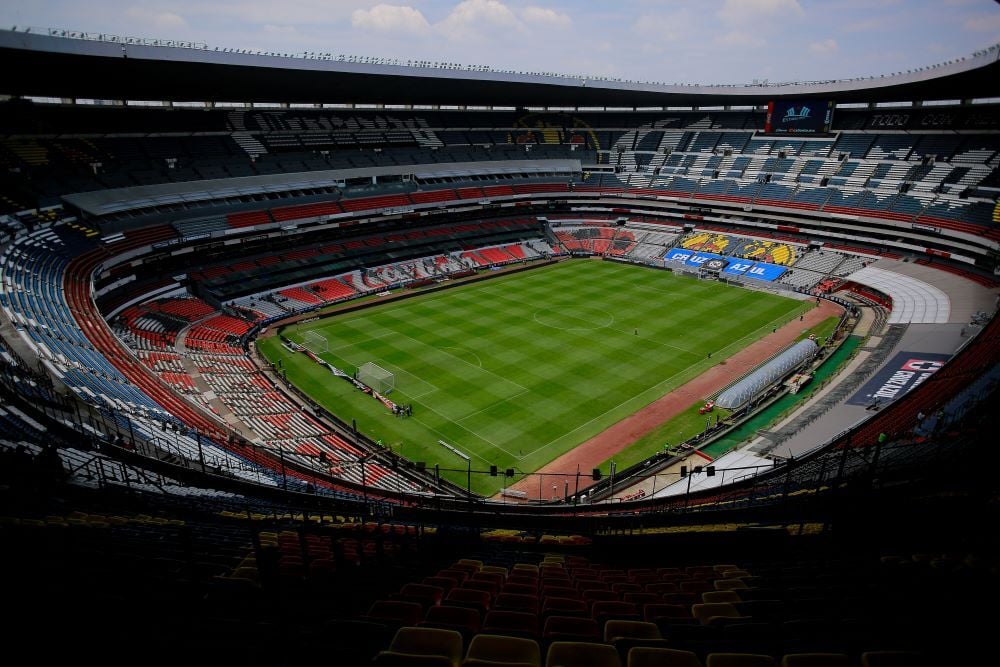 image credit: Mauricio Salas Franco / Shutterstock.com
The Setting
The Azteca sits in the Santa Úrsula neighbourhood of southern Mexico City, at an altitude of approximately 2,240 metres above sea level. This is not an incidental detail. Players who have never competed at altitude frequently report feeling the effects within the first twenty minutes: a thinning of the air that has influenced the outcome of matches at this ground for sixty years and will continue to do so in 2026. Supporters travelling from sea level are advised to arrive a day or two early and to hydrate accordingly.
The stadium is accessible via its own stop on the Xochimilco light rail section of the Mexico City metro. On match days, the approach from the station through the dense, electric atmosphere of a Mexican city preparing to watch its national team is an experience that no amount of description quite prepares one for.
The History
There is no neutral way to discuss what the Azteca has witnessed. It hosted the 1970 World Cup final and Brazil's 4–1 victory over Italy, the summit of the most celebrated team ever to play the game, and the 1986 final in which Argentina defeated West Germany 3–2. The 1970 edition also produced what is widely regarded as the greatest single match in the tournament's history: the semi-final between Italy and West Germany, decided 4–3 in extra time on this very pitch.
Sixteen years later, in the quarter-finals of 1986, Diego Maradona scored two goals against England in this stadium on the same afternoon: the Hand of God, punched illegally over the goalkeeper's head, and the Goal of the Century, a 60-metre individual run from his own half that has never been surpassed. It is a footballing coincidence that will not be lost on travelling English supporters.
The stadium held the opening matches of the 1970 and 1986 tournaments, and as of 2026, it will become the first venue ever to have hosted three World Cup openers, a distinction it will hold alone, in all likelihood, for the foreseeable future.
The 2026 Renovation
The Azteca closed in May 2025 for an extensive renovation costing approximately $150 million, reopening on 28 March 2026 with a friendly between Mexico and Portugal. The works included a new hybrid pitch, replacement seating, an upgraded sound system with over 340 speakers, two new large video screens, renovated dressing rooms, and repairs to the roof. The renovation pushed the World Cup capacity to approximately 87,500, making it the largest stadium in Latin America and one of the largest venues in the 2026 tournament.
The renovation philosophy was, by all accounts, one of respectful modernisation. Stadium director Felix Aguirre described the approach as one that respects the venue's legacy whilst improving the fan experience for the next forty to fifty years. The essential character of the ground — its bowl shape, its atmosphere, its sense of collective weight — has been preserved. The infrastructure around it has been brought into the present.
Role in 2026
The Azteca will host five matches: the opening ceremony and group match between Mexico and South Africa on 11 June, a second Mexican group fixture on 24 June, and a round of 16 tie on 5 July. For the tournament's opening weeks, it is the unambiguous focal point of proceedings in the Western cluster.
MetLife Stadium - East Rutherford, New Jersey, USA
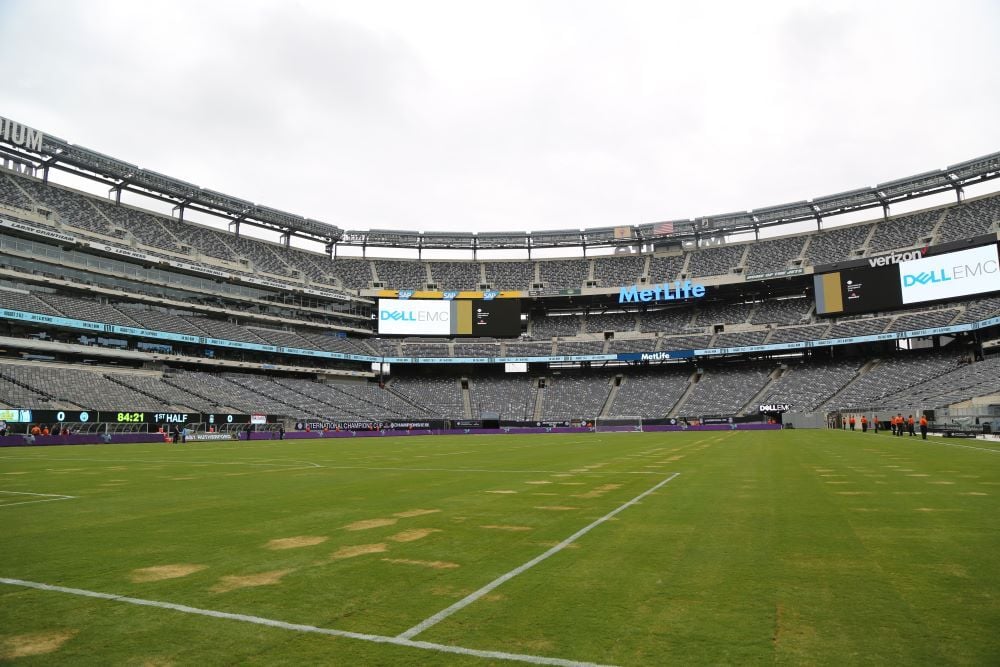 image credit: Leonard Zhukovsky / Shutterstock.com
The Setting
MetLife Stadium sits in the New Jersey Meadowlands, approximately 13 miles west of midtown Manhattan. It is, in almost every measurable respect, a stadium built for scale: opened in 2010 at a cost of $1.6 billion, it is the most expensive stadium ever constructed in the United States and one of the largest in the world. Its record capacity for sports events reached 83,367 for a Jets-Giants game in October 2023, with a World Cup capacity of 82,500.
The stadium has no dedicated rail station, a circumstance that has generated considerable logistical planning ahead of the tournament. Shuttle buses will run to the venue from the Port Authority Bus Terminal and Midtown East in Manhattan, whilst NJ Transit will operate an increased train service from Penn Station, with fans transferring at Secaucus Junction for matchday-only services. Return train fares have been confirmed at $150, a figure that reflects both the scale of demand expected and the premium nature of the occasion.
The Character
Where the Azteca is defined by history, MetLife is defined by infrastructure. It is an open-air stadium, and one of a number of venues at this tournament where the natural elements are part of the experience. It also shares its home with two NFL franchises, the New York Giants and the New York Jets. The stadium's design reflects that dual purpose: a vast, symmetrical bowl engineered for maximum sightlines and acoustic presence, without the idiosyncratic character that older grounds acquire over decades.
It has, however, already begun accumulating its own footballing history. MetLife hosted the Copa América Centenario final in 2016, when Chile defeated Lionel Messi's Argentina on penalties, and staged the FIFA Club World Cup final in 2025. The 2026 World Cup final will be its most significant occasion yet, and the city around it will see to it that the occasion is marked with appropriate grandeur.
The 2026 Renovation
In preparation for the tournament, MetLife underwent a two-phase renovation overseen by architectural firm EwingCole and construction contractor Skanska, the same firms responsible for its original construction. The works involved removing 1,740 permanent seats in the lower corners of the stadium and replacing them with lightweight, modular seating that can be dismantled to accommodate the wider football field required by FIFA. Natural grass was installed to replace the stadium's usual artificial surface, bringing it in line with FIFA's requirements for World Cup play.
Role in 2026
MetLife will host eight matches, which is the second highest fixture allocation of any venue in the tournament, behind only AT&T Stadium in Dallas. Five group stage matches are scheduled in June, with the venue then hosting knock out fixtures through to the final on 19 July. FIFA president Gianni Infantino has confirmed a Super Bowl-style half-time entertainment show for the final, with Coldplay among the confirmed performers.
Two Venues, One Tournament
The Azteca and MetLife Stadium represent, in a sense, the two poles between which the 2026 World Cup operates. One is an institution whose walls have absorbed more history than most sports federations have accumulated in their entire existence, playing host to its third tournament with a confidence born of legacy. The other is a $1.6 billion statement of contemporary ambition in the shadow of the world's most famous city, preparing to stage the sport's defining occasion on a continental stage of unprecedented scale.
Both, in their own fashion, are worthy of the moment. The 2026 World Cup begins at one and ends at the other, and in doing so, it encompasses football's past and its future within a single tournament.
Read More