

Easter has occupied a central place in the Christian calendar since the earliest years of the faith. While it remains, at its core, a religious festival marking the resurrection of Christ, in Britain it also developed a set of widely observed social customs that extended beyond church walls and into shared public space, laying the foundations for what would later be recognised as the Easter parade in London. From an early point, Easter was experienced not only through worship, but through collective visibility in how people gathered, dressed and moved through the city.
History
In medieval England, the sense of public participation was reinforced by elaborate church rituals and highly theatrical religious observances. Clergy and congregations took part in processions, night-long vigils and plays that unfolded across the Easter weekend. However, these traditions were brought to an abrupt halt in 1647, when the Puritans outlawed Easter celebrations altogether. Although the festival was formally restored after 1660, its religious spectacle never fully recovered and much of Easter’s public expression gradually shifted away from the church.
One of the most enduring social customs to emerge in this period was the tradition of wearing new clothes at Easter. Closely linked to the conclusion of Lent, the forty days of fasting and restraint, the practice reflected ideas of renewal that were expressed as much through outward appearance as through belief. As religious ceremonies became quieter, dress, display and the act of being seen assumed a more prominent role in how Easter was marked in public.
The Custom of New Clothing
The habit was well documented in early modern London. Writer and naval administrator Samuel Pepys recorded in his diary in 1662 that he purchased new clothes for his wife “against Easter”, while Shakespeare references the same social convention through Mercutio, who jokes about the risk of wearing a new doublet before the appropriate season.
New clothes were traditionally worn to parish church services on Easter Sunday and then displayed afterwards during a walk through town. This informal but highly visible habit was widespread across London parishes and became the basis of the Easter parade. In its earliest form, this was not an organised procession but a slow promenade through surrounding streets, churchyards and public parks, particularly in central and west London where churches, marketplaces and residential streets sat in close proximity.
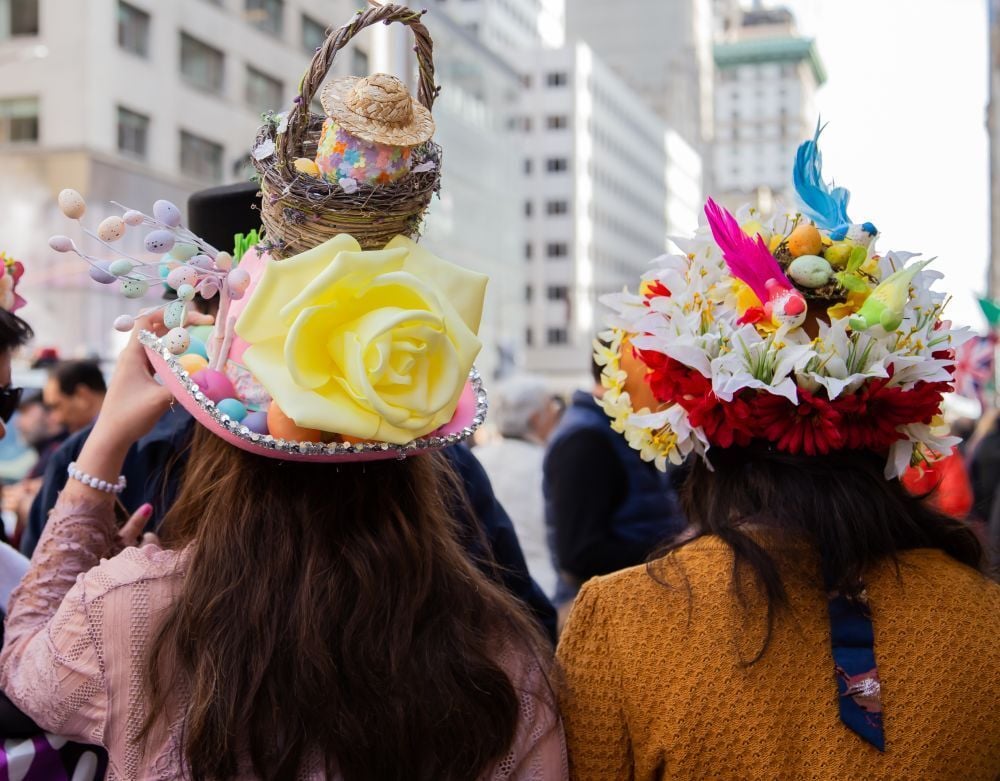
For those unable to afford a full new outfit, a newly trimmed or redecorated hat was considered sufficient. By the late nineteenth century, Easter bonnets had become a recognised seasonal marker, allowing wider participation in the ritual of renewal. Civic bodies, including the London Tourist Board, actively promoted Easter bonnet competitions, reinforcing the link between Easter, dress and public display.
Organised Parades and their Revival
By the twentieth century, Easter in London had acquired a more formal public dimension. Organised procession and public displays took place across the city and were often tied to local identity and post-war community. One of the most prominent was the Battersea Easter Parade, which ran through much of the post-war period and drew large crowds to Battersea Park.
The Battersea parade was the successor to earlier van, cart and horse parades traditionally held at Easter. By the 1970s, it had grown into a large-scale public event, featuring horse-drawn carts, fire engines, brewery drays, carnival clubs and elaborately themed floats. The 1979 parade, held in warm spring weather, reflected a period when such events were open, un-ticketed and largely free of commercial sponsorship. Families lined the route, children climbed onto shoulders and the city briefly paused to watch itself pass by.
By the end of the century, many such events had disappeared. Rising organisational costs, changing leisure habits and a gradual retreat from large civic gatherings meant that Easter’s public life became quieter. Observance increasingly shifted indoors into homes, churches and private venues and the tradition of collective public display diminished.
In recent years, Easter has begun to reassert itself in London’s public spaces, though in a more restrained and informal form. The emphasis has moved away from large municipal parades towards smaller, self-organised events that consciously echo older traditions.
The Covent Garden Easter Parade
The Covent Garden Easter Parade is not a parade in the conventional sense. There are no tickets, no barriers, no entry requirements and no fixed route. Instead, it deliberately returns to the older idea of Easter as a public walk.
After a long absence, the parade returned in 2025 as an informal Easter Sunday gathering. Participants met beneath the portico of St Paul’s Church in Covent Garden, dressed in traditional Sunday attire. Hats were encouraged but not required and there was no formal programme or entertainment.
From there, the group set off on a slow walk through central London, taking in familiar streets and landmarks. The inspiration was partly drawn from the New York Easter Parade, a long-established Easter Sunday custom along Fifth Avenue. Dating back to the mid-nineteenth century, the New York parade developed in much the same way: churchgoers leaving Easter services would walk northwards, wearing new clothes and decorated hats.
Unlike many modern parades, the New York Easter Parade has never been formally organised. There are no floats and no official route beyond the broad stretch of Fifth Avenue between St Patrick’s Cathedral and Central Park. Participation remains informal and self-directed, with emphasis placed on dress and particularly Easter bonnets.
Easter 2026: What Comes Next
As of now, the return of the Covent Garden Easter Parade for 2026 remains unconfirmed. However, the response to the 2025 revival suggests a clear appetite for its continuation. Easter 2026 falls in early April, a point in the year when London becomes noticeably more active. Daylight extends into the evening and parks and squares fill again.
If the Covent Garden walk does return, it is likely to follow the same lightly structured format: open, un-ticketed and dependent on participation. In this respect, it aligns more closely with the historical origins of Easter parading than many larger twentieth-century events ever did.
Whether Easter 2026 brings a confirmed Covent Garden gathering or simply small groups of well-dressed Londoners leaving church and drifting through nearby streets, the tradition endures. In London, Easter has long existed at the intersection of worship, dress and public space and it is through this visible and shared presence that the festival continues to retain its place in the British calendar.