

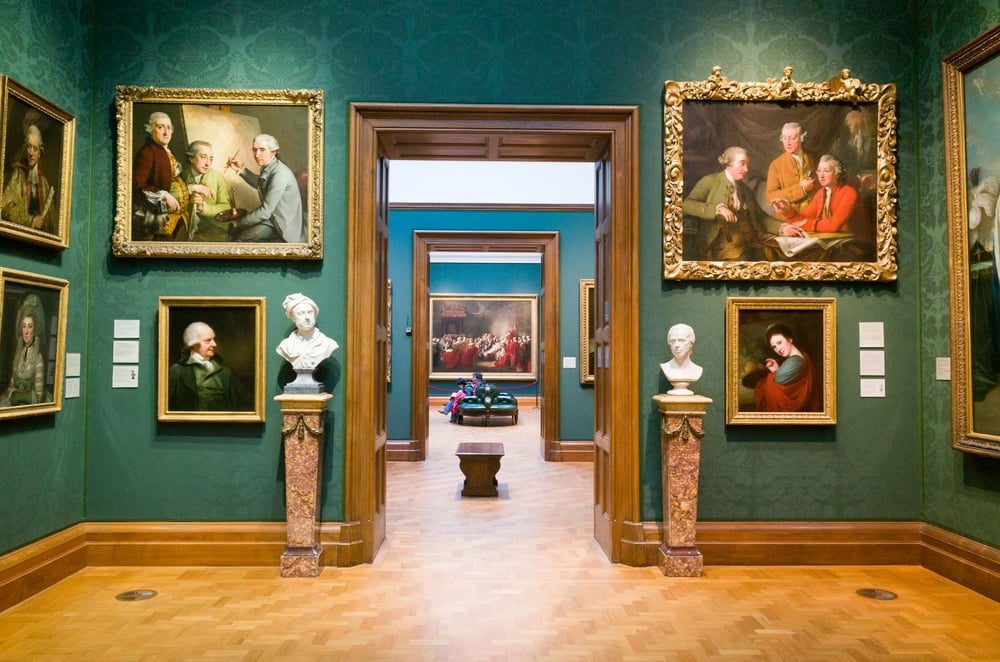
London’s contemporary art scene has evolved considerably over the last few decades. What sets more modern expressions of art in this city apart from others is not just the quantity of art spaces for viewing bold, new works, but each space's curated approach to the pieces within their collection, which reflects each gallery's individuality.
Some thrive on spectacle and scale, while others elevate a single object to a pride of place that turns the gallery into a landmark location for that single piece. Only a few of the following destinations for contemporary art lovers may be unfamiliar, unless they have already thoroughly vetted London’s considerable gallery offerings many times before.
Hauser & Wirth
Founded in Zurich in 1992 by the eponymous team behind the gallery, Hauser & Wirth’s London branch is unmissable for those who have explored the streets interconnecting Savile Row and Oxford Street on foot. The gallery is an inviting space, with shopfront-style windows allowing passersby full view of many of the exhibits, drawing the eye inward to wander what curious treasures may reside further within.
Currently, Hauser & Wirth is exhibiting a presentation of Cristina Iglesias’ Littoral series – stunning bronze sculptures whose surfaces evoke tidal erosion and mineral decay. The pieces absorb and refract light similar to how one experiences exposed tectonic plates along the shores of the coast of England. The gallery remains open to all without a ticketing system, making it an ideal spot for those who find themselves with time to spare within the beating heart of London, and can take the time to drop in for a dose of contemporary art.
Read More: The Best Art Galleries in the UK
White Cube
Bermondsey is a part of London that has transformed almost unrecognisably over the last half a century, no less thanks to the nearby construction of the country’s tallest building, The Shard. But within the shadow of London’s greatest example of contemporary architecture lies another globally recognised name. White Cube remains synonymous with statement pieces, whether it’s Anselm Kiefer’s lead and ash canvases or Antony Gormley’s cast-iron figures; each exhibition feels like a concentrated focus of the artist’s vision.
Embracing the trend for minimalist interiors, the gallery gives each artwork room to breathe, avoiding pieces that appear cluttered, and keeping them well-set out apart from each other. The current Gunpower and Abstraction display from Cai Gup-Qiang remains the Bermondsey site’s most interesting piece, whilst over at the sister-site at Mason’s Yard, the work of Andreas Gursky has been the pride of the fall collection. White Cube is a non-negotiable stop on a tour of the city’s best contemporary art galleries.
Read More: Best Art Shops in London
Lisson Gallery
Lisson Gallery has long been a sort of intellectual anchor of London’s contemporary art world. From its central Marylebone location, works by Anish Kapoor or Marina Abramović are presented in near-clinical settings that strip away distraction, making texture, tone, and gesture central to the experience.
The aforementioned experience at present is anchored by the inaugural solo display of abstract Chinese artist Ding Yi, presenting his latest body of work ahead of the Frieze art festival. Inspired by the history (both physical and cosmological) of the Naxi people of Yunnan in southern China, Yi’s latest series does carry a tangible gravitas, almost as if one is truly looking at something that belongs to the annals of history, only now being unearthed after millennia spent waiting to be rediscovered.
Read More: Best Art Galleries in London
Victoria Miro
Victoria Miro’s spaces have become sanctuaries for immersive art lovers around the world. Yayoi Kusama’s installed mirrored environments turn the gallery into a space where repetition takes on an almost poetic quality, like the very echoes of time itself. Each mirrored surface captured the viewer’s reflection within the artist’s obsessive geometry, confusing the separation between subject and viewer, and bringing visitors firmly into the experience.
Beyond Kusama, the gallery champions artists who dare to dream and build intricate worlds of their own design. From Sarah Sze’s gravity-defying installations or Chantal Joffe’s emotionally charged portraits, every piece feels intimate and specific, as if they were waiting there for each and every individual who visits exclusively, whispering a personal message and conveying feelings which are only meant for them.
Read More: Immersive Art Exhibitions in London
Saatchi Gallery
Perhaps beyond comparison with any other entry on this list, The Saatchi Gallery remains a symbol of contemporary British art and its resulting cultural impact. The space is a destination in and of itself, a landmark that is every bit the equal of a centuries-old institution like the National Gallery at Trafalgar Square. This is the creative harbour that brought young British artists into public consciousness.
Damien Hirst’s preserved shark, first exhibited under Saatchi’s patronage, wasn’t just a sculpture but a turning point in art history. It made the idea of spectacle intellectual and about public discourse rather than a commercial venture. Today, Saatchi continues to show work with an instinct for the zeitgeist. Its thematic exhibitions often revolve around a few powerful, discussion-sparking pieces, from large installations to the more provocative sculptures and multimedia works that demand attention and exist somehow, still outside the scope of the “mainstream” label.
The Serpentine
The greatest asset The Serpentine holds lies in its seasonal commissions. Here one day, but then gone as soon as the season shifts. Each summer pavilion, designed by architects from Zaha Hadid to Francis Kéré, becomes both sculpture and social experiment, and provides a highlight for contemporary art lovers, transforming Hyde Park into an open-air gallery that’s fit to burst with the expression of sweeping talents.
Split across two separate sites, one in Kensington and the other in Westminster, the Serpentine continues to offer boundary-pushing exhibits. A single room may host a sound piece, a sculptural performance, or an immersive video that dominates the resulting visit for any passing through its doors. The gallery’s commitment to wholly individual experiences ensures that each exhibition becomes a singular moment that cannot be missed, because – unlike Ouroborous, the serpent doomed to devour itself in a continuing cycle – exhibits at the Serpentine shall not be repeated.
Whitechapel Gallery
From Jackson Pollock to Lucian Freud, this East End institution has given early-stage masterpieces their first serious outing for more than a century. Today, the Whitechapel Gallery continues to stage exhibitions that hinge on one or two defining works, installations that test new forms, or films that distil social history into art with poise and panache.
The lovingly restored Passmore Edwards building adds a sense of gravitas to every show, thanks to its warm timbers and arched windows that are resplendent in their framing of bold and exciting work. Whitechapel remains a cornerstone of the contemporary art scene in London and the wider world, and is about far more than merely honouring the legacies of artworld giants and serving as a showcase for their best works.