

Published: 01 November 2025
The Royal National Hotel occupies a distinctive position in London’s hospitality landscape, but not through size alone. Built in the 1970s as part of the wider Imperial Hotels estate, it was conceived as a solution to rising visitor numbers in the city, to absorb unprecedented volumes of domestic and international guests, in an era when the capital’s tourism appeal was booming thanks to the Swinging Sixties. Its prominent location just off Russell Square is a nexus for everything from literary heritage to academic institutions and museums. However closely tied into the cosmopolitan buzz of London, the hotel’s development pursued a very different ambition.
Rather than emulate the refined townhouse hotels of Bloomsbury’s Georgian streets, it aimed instead to operate almost as a self-contained village, offering not just accommodation, but dining, retail and hosting a variety of events. Whilst this is barely a foot when one considers the vastness of the facilities of more modern hotels, The Royal National was a pioneer of this format of hotelling, and brought something undeniably new to the streets of London.
Layout
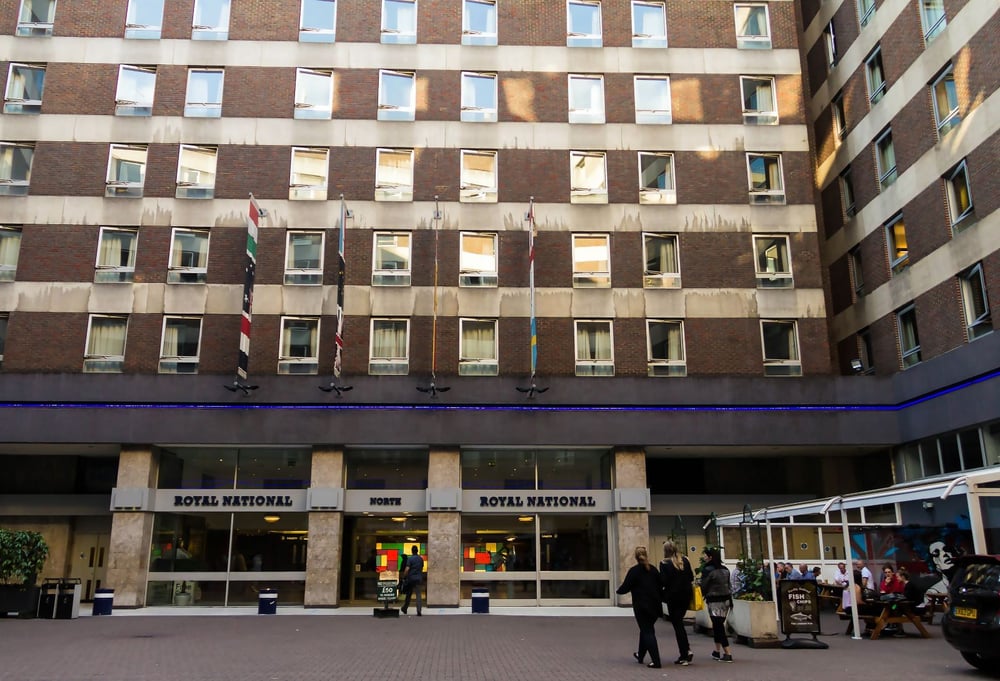
Today, with more than 1,600 bedrooms spread across a grid-like arrangement of wings, the Royal National remains London’s largest hotel by capacity, and possibly square footage. That size is immediately visible on approach, with the multi-block brick façade bordering a broad courtyard that functions as both a drop-off point and an informal entry plaza. Guests enter through sliding glass doors into a reception area designed less for decorative spectacle and more for throughput, with large tiled floors and long reception desks for checking in multiple parties at once. To the visitor encountering it for the first time, it feels more like an airport check-in terminal rather than a conventional hotel lobby, such is the sheer size of the lobby.
The ground floor is divided between the reception, a series of purpose-built units for retailers and eateries and routes leading to the central courtyard and adjoining event spaces. The hallways are wide enough to drive a small car through, more shopping arcade than hotel, stretching to almost Kubrickian levels. Closer to an airport in design, the public spaces are very utilitarian, featuring hot-desking spots, casual lounges, and quieter coffee corners to relax and unwind. Despite its size and scale, the hotel is only eight floors in total, but these stretch far beyond the limits of any conventional hotel.
Suites and Rooms
The hotel was never designed as a luxury property, and with more rooms than any other in the entire country, it’s clear where the priorities lie. The hotel has more than enough room configurations to compensate for the absence of gilded mirrors or plush carpets. Twins, triples, family rooms and multi-bed layouts make it one of the few central London hotels capable of accommodating groups of any size without dispersal across several properties.
Furnishings lean toward functional rather than aspirational. Beds, wardrobes, dressing tables and chairs arranged for practical use rather than aesthetics. Bathrooms, while modest in size, benefit from updated tiling, fitted shower enclosures and more refined lighting, offering a comfortable and modern experience without shifting the hotel out of its pragmatic approach to accommodation. Whilst definitely more along the lines of serviceable than spectacular, the Royal National is growing in popularity with business travellers thanks to its community buzz and sheer number of rooms to accommodate larger travel groups.
Dining Options
The Royal National’s ethos has seen its dining options evolve into something more reminiscent of a pop-up or fully fledged food court. The hotel’s main restaurant operates at a scale similar to an airline lounge, designed to service large numbers at breakfast and dinner without delay. Alongside the main dining room, the ground floor contains its own pub and a cafe-pizzeria, both of which can accommodate well over a hundred diners per sitting. Offering a full range of both classic British comfort dishes and more continental dishes, the hotel’s able to cater to all dietary requirements, en masse.
These spaces often serve as informal meeting points for groups, as much as standalone hospitality facilities, with layouts that allow flexible gatherings without the pressures of formal meeting spaces (although the hotel has plenty of those too). Whilst there are plenty of restaurants around Bloomsbury that offer more refined dining options, the convenience and easy access to the facilities further demonstrate the hotel’s universal solution-based approach to hospitality.
The Experience
One of the most unique features of the Royal National is its internal courtyard, a large, open-air space enclosed by the building’s wings, functioning as a semi-private plaza. This area supports larger group transfers by coach and offers outdoor seating when the weather permits. Through sheer size, it’s somewhat reminiscent of a university campus quadrangle, and during busy trade weeks and summer in the city, it offers a similar sense of buzz.
The Royal National Hotel is rarely quiet, intimate or atmospheric in the traditional sense. Instead, it feels like a self-sustaining ecosystem, a temporary community inhabiting a single building made up of visitors from all four corners of the globe, diverse in terms of age and lifestyle, as well as reasons for stay. Conference and industry events are where the hotel shines, seamlessly integrating multi-nationalities into one building for different events, either across town or within the vast throes of the Royal National itself.
For some, this scale is energising, whilst for others, it may feel impersonal, even overwhelming at times. Yet its sheer size and proximity to most of Central London remain unique, with near-unrivalled availability at even the very last moment. The hotel is a behemoth in every sense of the word, a titan of a bygone age, eclipsed in many ways by better serviced boutiques and five-star hotels like those that dot Park Lane, but even they pale in comparison to the number of rooms and the scale of the operation a hotel of this size requires.