

Germany is a land best remembered, for some, for its efficiency, industry, beer brewing and engaging political history. While none of these are inaccurate and are hallmarks of the country’s image, they obscure a land which is as incredibly rich in vistas and biodiversity as it is in culture. For much of its existence, Germany was not a single nation but a mosaic of independent states and smaller kingdoms, ecclesiastical territories and mercantile cities. That legacy still remains visible today in the difference between everything from how locals greet each other region to region, to food, and even how towns are planned, but this doesn’t necessarily distinguish the best places to visit in Germany on its own.
Only those who have travelled Germany’s length and breadth know the charms of North Rhine-Westphalia even during the rainy season, the delights of the Schwarzwald (The Black Forest) in Autumn, or that Bavaria has far more going for it than just Oktoberfest and Munich’s confines. Germany is a country which is greatly underappreciated and underexplored, even by many living in Western Europe, and for those less-travelled around the country, which forms the backbone of Europe in many senses, these are the parts to see first.
Bavaria
For centuries, Bavaria’s status as a former independent kingdom has set it apart from much of Germany. Shaped by its Catholic heritage and alpine culture, the people here are deeply religious, so much so that the average Sunday service turns into what seems to the outside eye, a full-blown holiday. Buoyed by the pomp and crash of brass bands, instruments played by traditionally dressed musicians match the crowd full of lederhosen and dirndls, as is the norm in this part of Germany. This sight is a common occurrence across the region. Alpine pastures are filled with an abundance of horned dairy cows, grazing peacefully on the slopes, deep lakes that dot the region, along with dense forest, and beautiful peaks. In contrast, Munich may appear positively cosmopolitan, but it still harbours many traditions from the rest of the region, including its aesthetics.
Although unapologetically modern in many areas, side streets give way to more heritage architecture, although much of this has been rebuilt following the extensive damage to the city from the Second World War. The wonderful city-expansive park, Tiergarten, harbours beautiful wildflower meadows, amusements and chalet-style restaurants, and the Eisbach’s surging rapids, which serve as a natural wave machine for the city’s surfing community. The north of the region has its charms, with the likes of Nuremberg providing a wonderful alternative to Munich with its Medieval aesthetic and fascinating history. Further west, the beautiful body of water that borders Switzerland in Lake Constance, offers a raft of interesting options, from the history of the infamous Zeppelin airship, Hindenburg, to floating opera performances during summer.
Rhine Valley
Running from the Swiss Alps into Germany via Lake Constance, the Rhine is Germany’s most significant river, flowing all the way across the country until it reaches the border with the Netherlands. The fertile lands along its banks were some of the most prosperous in the entire country, producing crops of wide varieties and also enshrining the reputation for Germany’s viticulture long before the separate states and kingdoms united. Evidence of this division can still be witnessed following the river’s course by viewing the castles that rise above former toll points, signalling how tightly controlled trading along the Rhine once was, as an often contested route between rival states and powers.
This very much shows how the Rhine serves Germany as a crossroads rather than a destination in itself. The best way to enjoy exploring the river is, of course, cruising up and down by boat. There are a plethora of cruises that run the length of the river from source to sea. Setting off from either Switzerland or the Netherlands and travelling the course of the river through Germany takes passengers past some of its most quaint and engaging settlements. Small towns, such as Bacharach and Oberwesel, retain their medieval layouts and charm, while larger cities like Mainz exemplify the myriad of influences that helped shape Germany’s image, from the Romans to the highest echelons of the Catholic Church.
The Black Forest (Schwarzwald)
Dark, wild, enchanting, it’s no wonder the Schwarzwald inspired so many fairy tales, such as those written by the Brothers Grimm, and earned its name from the Romans, who were baffled by its density. It’s one of, if not the most, atmospheric parts of Germany. Contrary to what many would assume is a relatively flat, expansive forest region, the Schwarzwald is surprisingly mountainous, with its highest peak, the Feldberg, just shy of 1500 meters tall. On top of this, it boasts deep glacial lakes and is even the source of one of Europe’s longest rivers, the Danube.
The small towns and hamlets that make up many of the communities around this region are famous for clockmaking, woodcarving and glass. Spa towns such as Baden-Baden originally developed under Roman rule more than a thousand years ago, thanks to their adaptation of the thermal springs that dot the region. Towns like Baden-Baden received a new lease of life through aristocratic patronage during the 19th century wellness movement, which swept the continent and remains popular today thanks to the warm waters and the elegant design of the spa they’re housed in. Through its combination of enchanting natural beauty and curiosity, the Schwarzwald remains one of the best places to visit in Germany.
The Baltic Coastline
Germany’s Baltic Coast feels markedly different from the rest of the country. Whilst much could be made of the lingering effects of this part of the country remaining behind the Iron Curtain for almost half a century, the truth is that the influences of trade blocks such as the Hanseatic League, the Teutonic Knightly order and the spread of Protestantism here have always set the area apart. Seaside resorts such as Binz and Ahlbeck reflect 19th-century wellness crazes that brought a new form of prosperity through affluent individuals who wished to “take the waters”, believing that the salty sea could cure them of their ailments. Inland, Hanseatic cities like Lübeck and Wismar exemplify the old mercantile affluence that shaped this region prominently right up until the unification of Germany. Bricked Gothic architecture dominates due to the area's historic lack of locally quarried stone, further lending credence to the practicality and adaptation of the people that inhabit this part of the country.
This ingenuity extends to remarkable lengths. The Fehmarn Belt tunnel, currently creeping along towards completion, will see the eponymous German island connected to the mainland and neighbouring Denmark. This 11-mile megastructure, the world’s longest immersed tunnel, will be submerged 40metres below the surface and halve the journey time between Hamburg and Copenhagen by rail, making it possible to reach Swedish cities like Gothenburg or Stockholm in less than 8 hours. With completion expected in 2029, the popularity of Germany's Baltic coast is expected to boom as a result, providing all the more reason to visit this small stretch of the country before it is once again dominated by its links to Scandinavia.
Moselle Valley
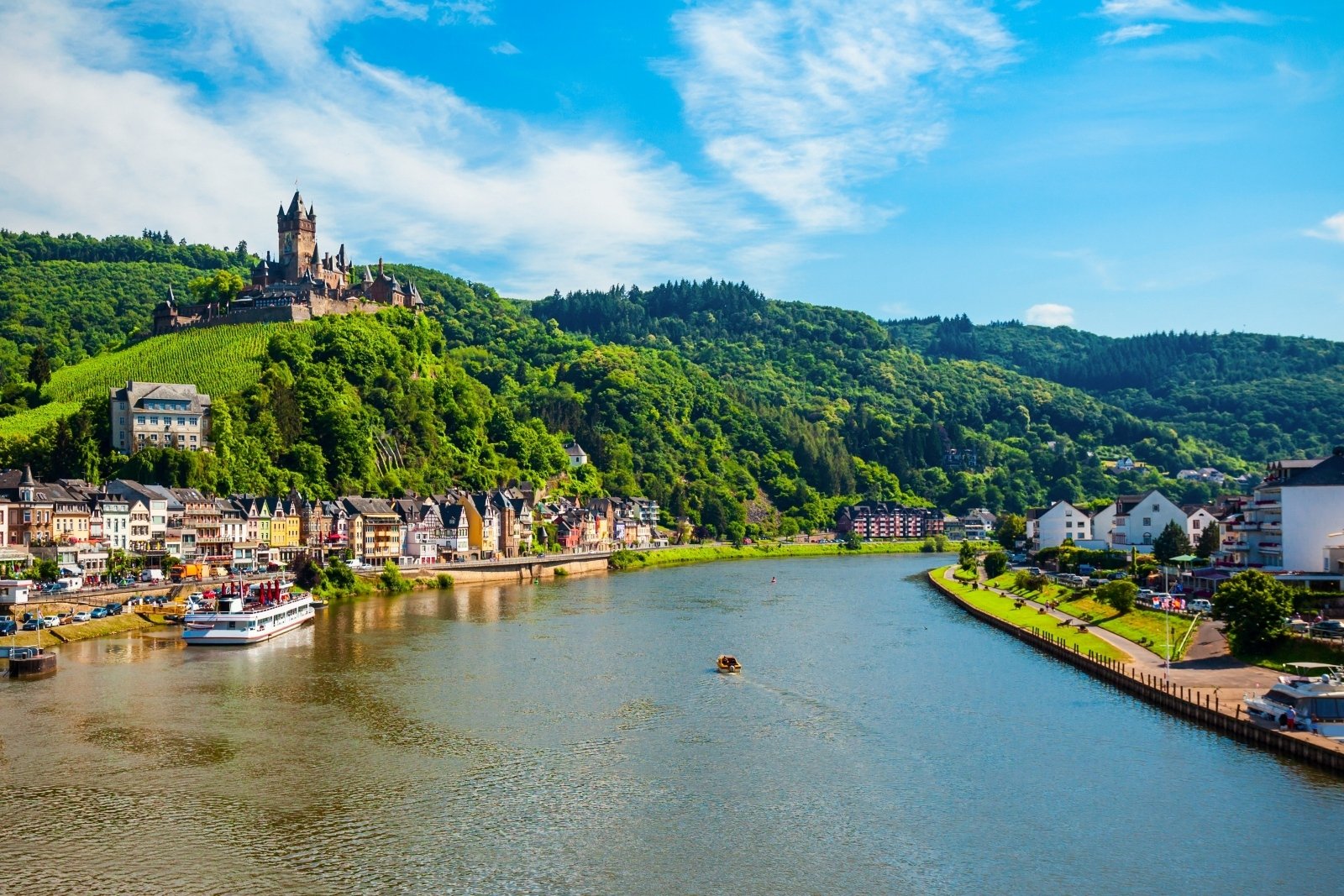
The tight curves and steep slopes of the Moselle Valley have restricted expansion throughout the last few centuries. This has led to the preservation of the characterful yet compact villages that dot the valley, giving it a sense of timelessness and unyielding charm. Viticulture dominates the region, with steep vineyards that back upwards on chalky slopes that have been slow to modernise their practices, yet still, they produce some of the finest wines in Germany. Whether travelling through this region on foot or by boat, its beauty is unquestionable, and its rustic charm is captivating.
The lingering effects of the Roman Empire are clear to see. Trier was Germany’s first official city and was a prominent settlement during the heyday of the Roman occupation. The city houses both prominent ruins from this period, such as the impressive Porta Nigra and the Imperial Bath complex, as well as stellar examples of Medieval Architecture, such as the magnificent cathedral of St.Peter. Postcard-worthy towns such as Bernkastell-Kues and Traben-Trarbach are well worth visiting, but the most delightful is surely Cochem, with its Gothic castle and sweeping panoramas. When one considers the best places to visit in Germany, the Moselle Valley will always spring to mind.