

The evolution of West London’s neighbourhoods tells the story of how the city as a whole has developed over the last 500 years. Knightsbridge and the surrounding areas were once vast open spaces of rural marshland that rested on the outskirts of the capital between the occasional villages that stretched out into the countryside.
The following centuries were kind to Knightsbridge as it transformed through the Victorian and Georgian eras into an aristocratic hub with the striking architecture and estates still serving as a wonderful reminder. Significantly, the communities that thrived here also prided themselves on cultural literacy and were often the patrons and sponsors for much of the art, music and literature that defined these fascinating times. Many of the buildings and public spaces that remain here are now dedicated to celebrating this cultural heritage through their use as galleries and museums.
This guide showcases a collection of the best museums in Knightsbridge.
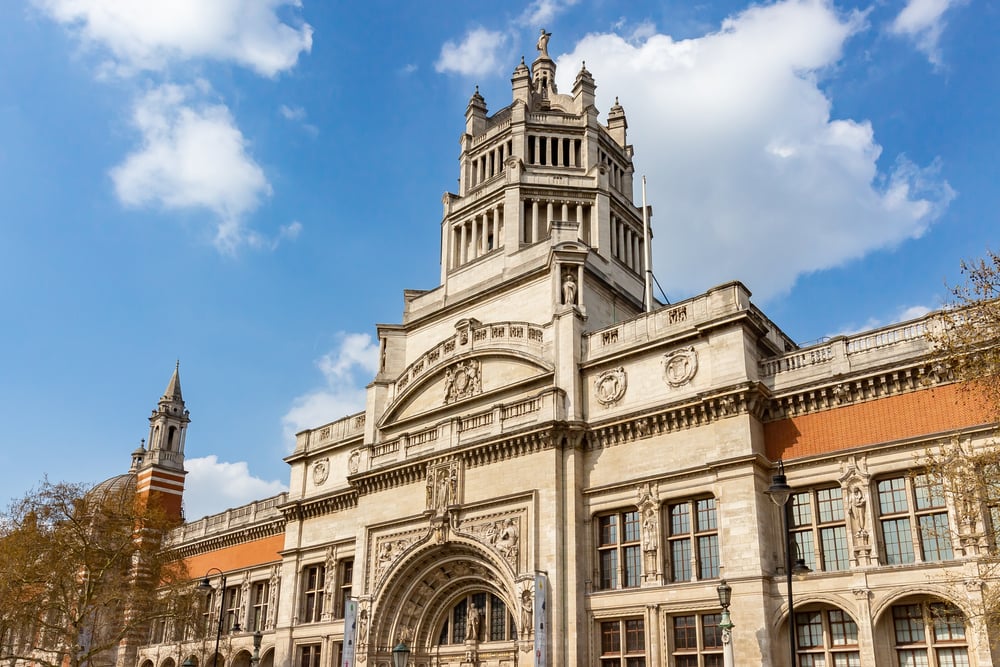
The Victoria & Albert Museum
The V&A was created as a result of the Great Exhibition of 1851, when Prince Albert enthusiastically invited the very best of the design and industrial worlds to Hyde Park. After the success of that landmark event, Albert was keen for a permanent institution in the city that would not only showcase important pieces and producers of the present but also lay the path for the future too. It was intended to educate and enthral manufacturers, designers and the public in the art of what was possible to make. In 1909, this vision eventually found its home here on Cromwell Road and was named in honour of the most famous Queen Consort in English history.
As you may expect, the building itself is a triumph of Victorian ambition in its architecture, with the earliest sections designed by Captain Francis Fowke and Major Henry Scott, leaning heavily on their Gothic Revival and Renaissance influences. The famous Aston Webb façade is a delight of Edwardian Baroque majesty and a fitting entrance for the millions of visitors who have passed through it in over a hundred years.
There are almost 3 million objects at the V&A that chart over 5000 years of human creative endeavour. Sculptures and casts of European masterpieces, such as Michelangelo’s David, are alongside the biggest collection anywhere in the world for textiles and fashion that chart human history. Incredible design objects and furniture from every era can be found here with Asian art, photography and architectural drawings and set designs from every facet of the performing arts across five floors of absolute wonder. And everything on display is continually renewed to represent the cultural identities of the present and recent past, with exhibitions from Balenciaga to Bowie and Alexander McQueen to Pink Floyd.
The V&A is a curated treasure trove unlike anywhere else on the planet and in the spirit of Prince Albert’s original mission, it remains free to enter for everybody to enjoy.
Also Read: Top Schools in Knightsbridge
Apsley House
When Lord Apsley commissioned this building to the renowned neoclassical architect Robert Adam around 1770, he wanted it to become a landmark that marked an approach to London from the west. At the time, Hyde Park Corner, where the Apsley House stands, was very much the edge of the city and it duly earned the prestigious nickname Number One, London. The house was eventually acquired by the Duke of Wellington, who promptly transformed his new home into a monument of national achievement, adding the incredible Waterloo Gallery where he would regularly honour those that fought beside him at the historic battle. This remains a spectacular example of a London Regency interior, lit by chandeliers, accented by gold and filled with exquisite art.
In 1947, the 7th Duke of Wellington gifted the property to the nation to be managed by English Heritage and the family trust. This meant that everybody could witness the grandeur of the State Dining Room, Drawing Rooms and the priceless objects that reside there. Pieces by Titian, Goya, Van Dyck and Rubens are all on show, with a provenance that tells stories of diplomatic gifts from European leaders following the 1st Duke’s victory over Napoleon.
Arriving early is always advised to beat the crowds and witness how the space once worked as a private residence. Wandering these rooms in silence alongside the ghosts of English history is an experience that one will remember for a very long time to come.
Also Read: Shops in Knightsbridge
Paradox Museum London
It seems fitting that a London neighbourhood so committed to culture in the past is now also home to a very modern museum. Paradox on Brompton Road in Knightsbridge is a new immersive experience that showcases optical illusions, perceptions and perspective and experiential art in a family-friendly and ultra-engaging way. It opened here in 2024 following great success in global cities such as Oslo, Miami and Stockholm.
This site is a late 20th-century building that was originally a part of the wider redevelopment in the area. The Paradox design team have used the space in a wonderful way to create a labyrinth of multi-sensory activities across two levels connected in a way that makes it feel like a much bigger environment to explore. Every corridor, wall and reflective surface creates a distorted image that plays with scale, depth and symmetry to continually test and challenge visitors.
There are upside-down rooms, tilted floors, infinite mirror spaces and even a room where it appears that one is walking on the ceiling. Paradox is an intriguing mix of museum and theatre where the interactive architecture encourages visitors to touch, perform and, of course, photograph their journey through every installation. Experiencing everything that this museum has to offer should normally take around 90-120 minutes and after that time, it may even be a challenge to exit back into the real world. This is a learning opportunity with fun built into every step.
Accessing any of the exhibitions, installations and permanent displays on offer in the museums of Knightsbridge is a rewarding and thought-provoking activity. When you also consider and appreciate how your interaction places you amongst a line of visitors that spans centuries, it adds an extra element that many cultural areas of the city cannot compete with.