

From historic Edwardian bathhouses to Olympic-scale aquatic centres and sprawling leisure complexes, the UK is home to some of the most impressive indoor swimming pools.
Public indoor swimming in Britain has its roots in the 19th century, when municipal baths were built to improve public health and hygiene in rapidly growing industrial cities. Many of these buildings remain in use today, having been adapted to modern standards while retaining their original civic purpose.
Alongside this heritage, the past two decades have seen substantial investment in large-scale aquatic infrastructure, driven in part by major sporting events such as the 2012 London Olympics and the 2014 Commonwealth Games in Glasgow. These developments introduced a new generation of technically advanced pools designed to operate both as competition venues and as everyday public facilities.
Below, we explore some of the best indoor swimming pools in the UK.
Subtropical Swimming Paradise, Center Parcs
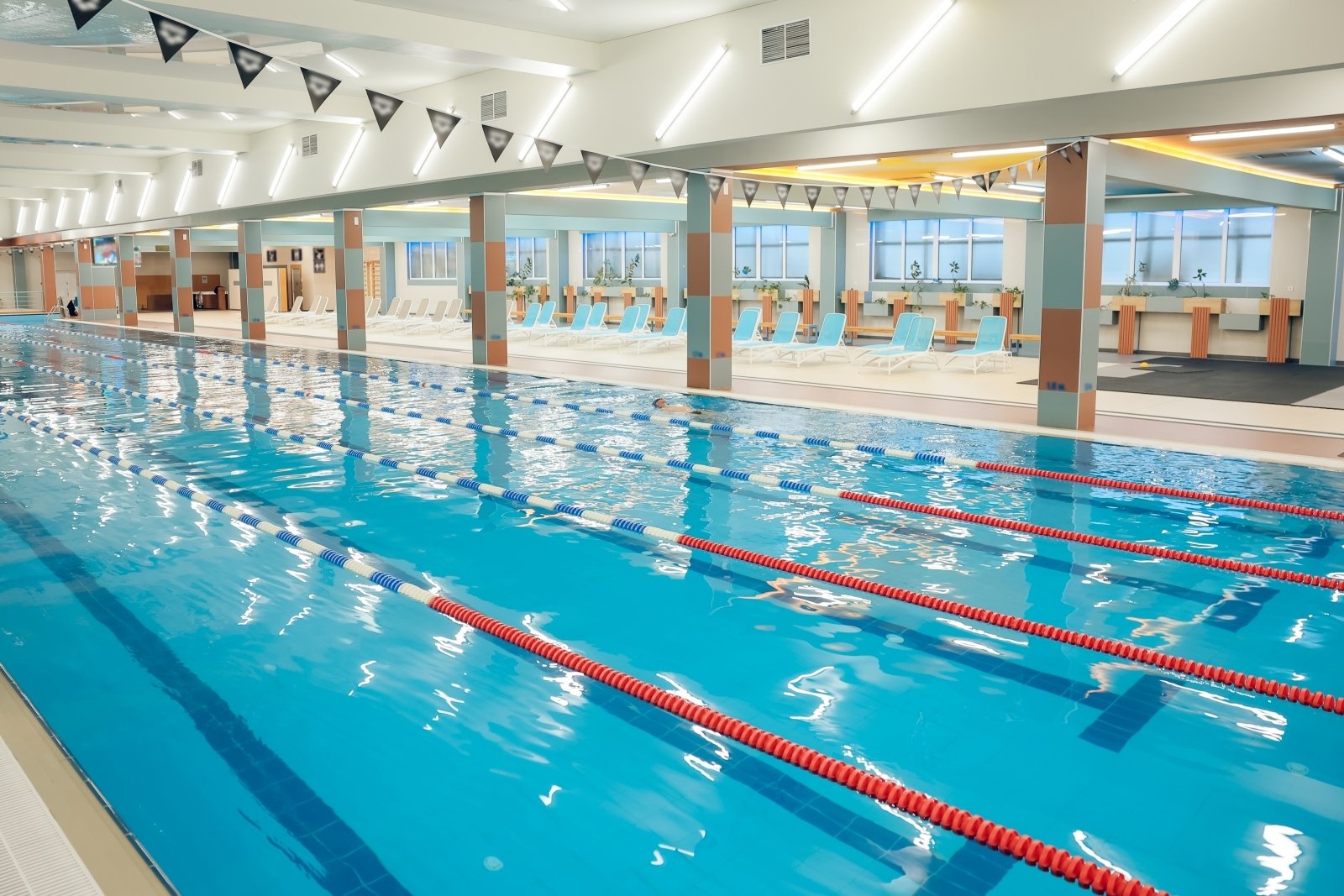
The Subtropical Swimming Paradise at Center Parcs is perhaps the UK’s most recognisable indoor swimming experience. Found across multiple Center Parcs locations, the concept is built around a permanently warm and climate-controlled complex that allows year-round swimming beneath palm trees, even in midwinter.
Rather than focusing on lanes or competition, these vast indoor complexes are designed for families and leisure swimmers, with facilities typically including wave pools, flumes, outdoor-to-indoor rapids, heated lagoons and areas for children. Large glass ceilings allow natural light to flood in, which further reinforces the illusion of an outdoor resort.
Therme, Manchester
Therme Manchester represents a newer generation of indoor water facilities, aiming to provide swimming, wellness and architecture on a monumental scale. Currently in development at TraffordCity, with enabling works underway and an opening targeted for 2028, the project is designed as a large urban wellbeing complex that is inspired by European thermal bathing culture.
Once complete, Therme Manchester is expected to include multiple indoor pools, thermal baths, mineral waters and extensive spa facilities housed beneath a vast glass structure. Unlike conventional leisure centres, the emphasis here is on relaxation, restoration and long-form bathing rather than fitness or family recreation and reflects a growing interest in wellness-led swimming spaces in the UK.
Tollcross International Swimming Centre, Glasgow
Located in Glasgow’s East End, Tollcross International Swimming Centre is one of Scotland’s best aquatic venues. Built to international standards, it features a 50-metre competition pool with movable booms, allowing it to be configured for events, training or public swimming.
The centre gained international attention during the 2014 Commonwealth Games, when it hosted swimming and diving events. Since then, it has continued to operate as both a performance venue and a public facility, offering lane swimming, lessons and recreational sessions, coupled with spectator seating.
London Aquatics Centre
Designed by architect Zaha Hadid for the 2012 Olympic Games, the London Aquatics Centre is one of the most striking indoor swimming facilities in the world. Located in the Queen Elizabeth Olympic Park, it houses two 50-metre pools and a separate diving pool, all built to international competition standards.
Since opening to the public in March 2014, the centre has functioned as a major community sports facility while retaining its world-class credentials. Advanced filtration systems, adjustable floors and movable booms make it one of the most technologically sophisticated pools in the UK. Yet, despite its Olympic origins, the London Aquatics Centre is firmly embedded in everyday use, hosting lane swimming, lessons, club training and recreational sessions, alongside major national and international events.
Moseley Road Baths, Birmingham
Moseley Road Baths is one of the UK’s most historically significant indoor swimming pools. Opened in 1907, this Grade II* listed Edwardian bathhouse has been in continuous use for more than a century and has served generations of Birmingham residents. Following extensive restoration efforts, the complex includes three pools, each originally designed for different social classes, reflecting the public health priorities of the early 20th century. Today, it still retains its ornate tiling, vaulted ceilings and original changing cubicles, offering a rare glimpse into the golden age of municipal bathing.
Marshall Street Baths, London
Hidden behind an unassuming façade in Soho, Marshall Street Baths is one of central London’s architectural gems. Originally established as public baths in the 19th century and rebuilt in 1931, the pool is known for its striking marble interior, art deco detailing and compact design.
Closed for refurbishment in 1997, the baths reopened in July 2010 as part of the Marshall Street Leisure Centre. While modern fitness facilities have been added, the pool itself retains much of its original character, which makes it a distinctive place to swim.
Ironmonger Row Baths, London
Ironmonger Row Baths, located in Islington, offers a more traditional indoor swimming experience with added spa facilities. The pool itself is generously sized, suitable for both lane swimming and casual use, while the surrounding complex includes Turkish baths, saunas and steam rooms.
Originally opened in the 1930s, the baths retain elements of their historic layout while having been updated to meet more modern standards.
Health Hydro, Swindon
Health Hydro is another example of a historic bathhouse successfully adapted for modern use. Opened in 1891, the building was originally part of Swindon’s railway heritage, constructed to improve workers’ health and wellbeing.
Today, the complex includes an indoor swimming pool, Turkish baths, spa facilities and fitness spaces, all housed within a carefully restored Victorian structure. Decorative tiling, stained glass and original architectural features also remain prominent.
Poplar Baths, London
Poplar Baths has a long and complex history. The site has operated as public baths since the 19th century, with the listed building dating from the 1930s. After decades of decline and closure, the leisure centre was redeveloped and reopened in July 2016.
The modern Poplar Baths boasts a sleek indoor swimming pool with leisure and fitness facilities, while also incorporating references to the original building’s art deco heritage.
Crystal Palace National Sports Centre
The Crystal Palace National Sports Centre has been a symbol of British sport since the 1960s. Its indoor swimming facilities were designed to support training and competition, alongside being open for public use.
The centre includes a 50-metre competition pool and a diving pool, though these have been closed since 2020 pending major repair works. Other parts of the complex remain in use during the wider redevelopment planning process.
As the weather remains unreliable, seas are cold and outdoor pools appear a seasonal commitment at best, indoor pools have always mattered here, offering somewhere to swim properly, consistently and without checking the forecast.