

Daniel Hourdé is among contemporary sculpture's most compelling artists, known for his innovative use of materials and profound emotional range. The French sculptor’s oeuvre inhabits a threshold between reverie and terror. His human-scale expressionistic works demonstrate complete command of both technique and knowledge of human anatomy. Hourdé has long been utterly consumed by his practice and now, in collaboration with Sotheby's Paris, extends a rare invitation to collectors and enthusiasts: the chance to encounter treasures he has quietly assembled across decades.
This extraordinary assemblage is set to go under the hammer on 25 February 2026, following a public exhibition from 19 to 24 February. Beyond viewing the collection itself, visitors enter a reconstruction of Hourdé's studio, its distinct atmosphere conjured within the walls of Sotheby's Paris for these brief days.
For over four decades, Hourdé has moved through multiple roles: collector, dealer, and essential presence within early African and Oceanic art. Now he prepares to transfer these objects to others who recognise what he has seen in them.
Selection of Significant Pieces
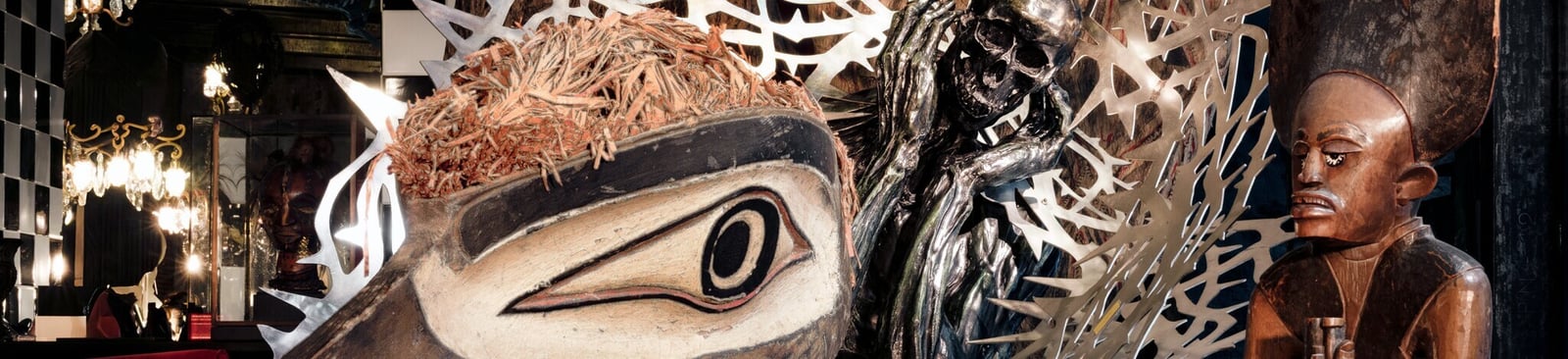
The auction spans African, Oceanic, and Pre-Columbian art alongside archaeological objects, Asian and religious works, and antique furniture. These are totemic pieces that address the oneiric dimension of human existence in the world, notable for how they hold the kinetic force of bodies in motion and the persistent conversation between humanity and what lies beyond it.
Among the most significant: an exceptional Egyptian mummy mask from the 21st and 22nd Dynasties, joined by works from New Ireland, multiple Kota reliquary figures from Gabon, a Māori prow figure, and a rare Kwakiutl mask from British Columbia.
Hourdé's auction record stands at €74,500 for a piece titled 'Arbre', achieved in 2023.
Master of His Craft
At the age of 20, Hourdé studied painting and drawing at the École des Beaux-Arts in Grenoble and Paris. Since the 1980s, he has dedicated himself fully to the art of sculpture. He bends classical form to his own syntax, creating pieces that feel anchored in contemporary mythology. Steel, bronze, and gold become the vehicles through which his characters come alive, both physically and spiritually. Drawing and installation also occupy his practice, where the human form appears with absolute freedom: tragic and playful in the same breath.
His technique suggests a forensic grasp of anatomy. The figures emerge monumental and athletic, yet he fractures that classical vernacular with irreverent details and fragments of pop culture. Frequent motifs include skeletons, the Fall and Redemption, mediaeval dances of death, and the Cross and crown of thorns. His characters are captured mid-action, suspended in existential moments that quietly compel viewers to reckon with the world’s transience and mortality.
Auction Highlights
1. An Egyptian Polychrome Wood Mummy Mask, 21st/22nd Dynasty, 1075-716 B.C.
125,000 - 175,000 EUR
Carved from fine-grained hardwood and originally part of an inner coffin lid, this mask features an oval face with inlaid eyes, lips outlined and deeply rounded at their corners, a sharp nose, and elongated eyebrows. The eyes themselves are inlaid with blue and white glass, their recessed pupils painted black. The sheer singularity of this piece positions it as the sale's most anticipated centrepiece.
2. Malagan Figure, New Ireland, Bismarck Archipelago, Papua New Guinea
80,000 - 120,000 EUR
A Malagan figure is an intricately carved, handpainted, and often fragile wooden sculpture from Northern New Ireland, typically created to honour the dead, celebrate life, and mark the end of mourning.
While many Malagan figures showcase male authority, this one depicts a kneeling woman. The carving and hues represent the hallmarks of works dating to the 1880–1890 period. Pronounced ribs grant the body tautness. A wide loincloth descends as elongated arms hang in deliberate symmetry. The legs are slender, nearly abstract in their simplicity. Her head bears a distinctive conical coiffure, worn by New Ireland women as rain protection.
This form appears occasionally on male figures, including one once associated with French painter Maurice de Vlaminck and another now held at the Field Museum in Chicago. Geometric painted motifs animate the entire surface, intensifying both ritual charge and visual authority.
3. Le Roi las
45,000 - 50,000 EUR
Le Roi las was crafted in 2020, in bronze and painted steel. A biblical story serves as the inspiration behind this piece, though interpretation extends into personal mythology. The theme addresses both ascent to Paradise and descent into Hell. Le Roi las (The Weary King) is steeped in tension, and the crown marks its first disruption.
The anatomy achieves surgical clarity: ribs and muscle stretch visibly across the torso, revealing Hourdé's exacting understanding of human anatomy. Yet the drama emerges from opposition: this is a body built for dominance, yet visibly buckling under strain. Ribs protrude as the head drops. The figure's bearing speaks to authority as weight rather than privilege and expectation as pressure, all set against a backdrop where rulership proves hollow.
Final Thoughts
Daniel Hourdé lives and works in Paris. His sculptures have been exhibited internationally, including at the Pont des Arts near the French National Assembly and the Museo de la Cancillería in Mexico City. His work draws from classical mythology, contemporary social movements, and cross-cultural sources, always returning to the human form as the site where movement and emotion converge, demonstrating command over texture and detail.
Hourdé has achieved singular distinction within contemporary sculpture. His works are recognised not only for technical execution but also for the emotional voltage they possess. His figures carry immense weight – physical, mental, and spiritual. This equilibrium between craft and symbol grants the work endurance in contemporary discourse.