

A Guide to Private Schools in Oxfordshire
Oxfordshire is a celebrated county in South-East England, threaded with quintessentially English villages and characterful market towns. Firmly rooted in its rural identity, it is cherished for its charming houses, undulating landscapes, and a calm pace of life that has long attracted wealthy families. Its northern fringes stretch into some of the finest parts of the Cotswolds, an area that has become a favoured address for several high-profile residents.
Among its many draws, the county's world-class schooling stands out. Home to the globally acclaimed University of Oxford, Oxfordshire holds an exceptional standard in education. Below, we explore some of its most reputable private schools.
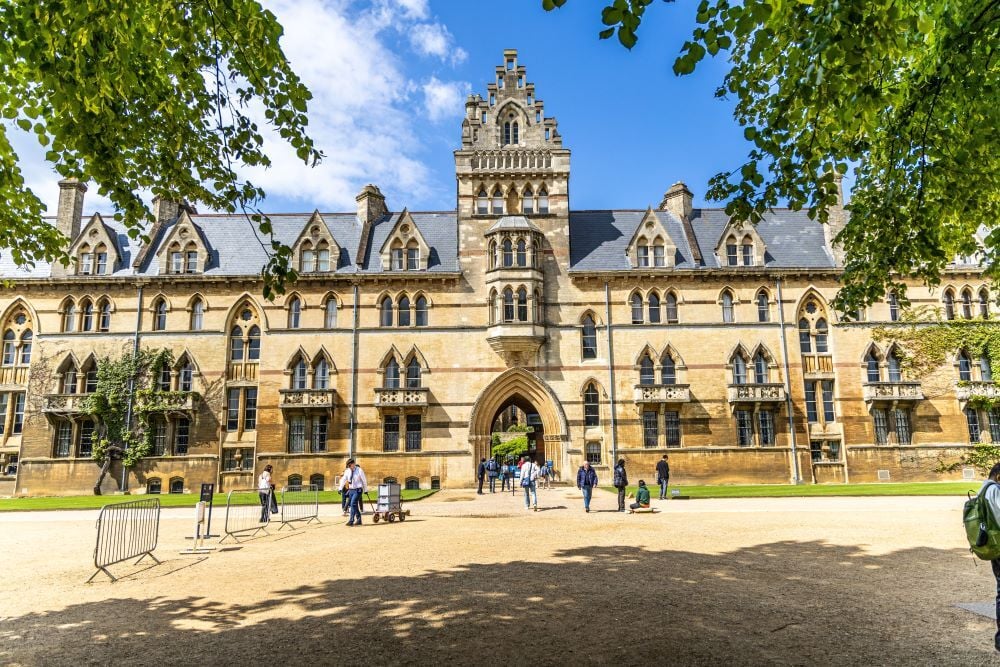
1. Oxford International College
Oxford International College is one of England's leading A-level colleges, educating students aged 16 to 21. Based in the heart of a university city, it reports an 85% A-plus rate at A-level, with teaching staff including Oxbridge graduates, accredited examiners, published authors, and doctorate holders.
The curriculum spans pure sciences, humanities, and foreign languages, including Chinese and Russian. For students seeking faster progression, the college offers two accelerated pathways: a one-year GCSE programme covering up to seven subjects, and an 18-month A-level programme oriented towards science, medicine, and engineering.
Students can also pursue work beyond the examined syllabus through EPQs, elective courses, and Fusion, the college's own real-world research programme. Oxford itself adds another dimension: a city whose cultural, academic, and social life extends well beyond any single institution.
2. Bloxham School
Bloxham School is a co-educational boarding and day school for pupils aged 11 to 18. Small by design, it takes pastoral care seriously, with tutors meeting students individually each half term to review progress and agree on next steps. Parents receive regular reporting regarding their child's academic progression and overall development.
In the Lower School, students follow a broad core curriculum across the sciences, humanities, languages, and creative subjects, taught by subject specialists in small classes. The aim is to build confident foundations in numeracy, literacy, and digital skills before pupils make their GCSE choices.
Sixth formers have their own space in the White Lion Sixth Form Centre, with individualised timetables and dedicated self-directed study periods each week. By this stage, students are expected to take ownership of their learning, both in lessons and outside them.
The co-curricular offer runs to over 100 options, from mainstream team sports to astronomy and cooking. Activities span creative arts, physical education, academic enrichment, and hobby clubs.
3. Abingdon School
Abingdon School is an independent co-educational day and boarding school for pupils aged 11 to 18, with a prep school catering for ages 4 to 13. The curriculum runs from sciences and mathematics through to languages, humanities, and the creative arts, with Latin among the subjects available from the earlier years.
Results hold up well: 85% of GCSE entries achieved A-plus or A. Beyond the classroom, more than 150 extracurricular options are on offer, taking in debate, film, creative writing, music, science, and computing, as well as a sports programme spanning over 25 disciplines, from rowing, rugby, and cricket to fencing, water polo, and croquet.
In a 2025 parent survey, the school was noted for its attentiveness to individual pupils, with respondents recognising its effort to understand and respect students as individuals.
4. Magdalen College School
Founded in 1480, Magdalen College School is a selective independent day school in Oxford for pupils aged 7 to 18, currently boys throughout, with girls joining the Sixth Form and transitioning to full co-education from 2027. It features in the Sunday Times top 20 independent schools nationally and holds the top spot in Oxfordshire.
Results at both GCSE and A-level are among the strongest in the country: 61% of GCSE grades were 9s, and 43% of A-level grades were A-plus in 2025, with 26 pupils taking places at Oxbridge or Ivy League universities. The school also has around 100 clubs, 30 music ensembles, and 14 drama productions each year involving more than 300 pupils, with 93% of pupils competing in fixtures.
Beyond results, the school has an admirable record on access, with around 10% of senior school pupils receiving help with fees, and over 5,600 pupil volunteer hours logged last year across more than 140 community partnerships. It won the 2025 Independent Schools of the Year Award for Social Mobility.
Notable alumni include British filmmaker Sam Mendes and BBC Politics correspondent Joe Pike.
5. Oxford High School GDST
Oxford's only all-girls independent school, Oxford High School GDST has been educating pupils from age 4 to 18 since 1875, when it was established by the Girls' Day School Trust. Over 150 years later, it remains the city's longest-running girls' school.
The senior school curriculum covers the sciences, humanities, languages, technology, and the arts. At GCSE, pupils take core subjects before choosing from options that range from Latin and computer science to drama and Spanish, all taught in small classes by subject specialists. In 2025, 83% of GCSE grades were in the 8s and 9s, and 89% of A-level grades were A* to B.
The school's alumni offer a reasonable indication of its range. Miriam Margolyes and Charithra Chandran both passed through its drama studio; so did Anna Lapwood, now an organist and broadcaster with over a million social media followers. Sarah-Jayne Blakemore, Professor of Psychology and Cognitive Neuroscience at the University of Cambridge, is also among its former pupils, as is astrophysicist Professor Samaya Nissanke, whose work contributed to the first observed neutron star merger.
6. Cokethorpe School
Set within verdant, rolling acres near Witney, Cokethorpe is a co-educational prep and senior school for pupils aged 4 to 18. Broadly selective, it places emphasis on individual progress over raw attainment statistics.
Academically, the school is more focused than its pastoral setting might suggest. A dedicated programme pairs pupils targeting Oxbridge or competitive universities with a supervisor for reading and extension work beyond the A-level syllabus. In 2025, 44% of A-level grades were A-plus or A, with physics, art, politics, and mathematics all seeing over two-thirds of the cohort reach that mark. At GCSE, 48% of papers were graded 9 to 7, with biology, chemistry, drama, history, physics, and Spanish emerging as the strongest subjects.
The school runs over 100 clubs and activities spanning sport, music, and drama. For many parents, though, the landscape is the main draw: 150 acres of sweeping West Oxfordshire parkland that shapes the rhythm of the school day, giving children an unusually close relationship with the natural world around them.
Final thoughts
For families weighing a move to Oxfordshire, schooling rarely needs to be a compromise. The county offers a compelling range, with holistic development treated as a priority and results that hold up against the best in the country. That, as much as anything, is part of why families who arrive here tend to stay.
Read More